Mapping regional tracksuit style from away-day photos is less about spotting one famous jacket and more about reading a whole scene: date, club, weather, stance, trainers, colours and the way people wore the kit. A single picture can mislead, but a run of photographs from the same season can show how local taste travelled between grounds, record shops, high streets and coach parks.
The trick is to treat the photograph as evidence, not decoration. Look for repeat patterns, compare them with known era markers, and stay honest about what the image can and cannot prove.
The short version
- Start with the photograph’s context: club, ground, date, competition, travel route and likely age group.
- Separate era clues from regional clues. A 1990s cut does not automatically identify a city.
- Read the whole outfit: track top, trousers, trainers, outerwear, caps, bags and how items are worn.
- Look for clusters across several photographs rather than making a claim from one standout dresser.
- Avoid lazy stereotypes. Away-day clothing was shaped by money, access, music, holidays, mates, imitation and local pride.
Step 1: Fix the photograph in time and place
Before naming a region, pin down the basics. Is the image from a league away day, a cup match, a European trip, a pre-season friendly, or a neutral venue? Each setting changes what people wore. A long coach journey in February says something different from a warm early-season match outside a station.
Date matters because tracksuit silhouettes shift quickly. Wide collars, shiny poly, contrast piping, colour-blocking, zip pulls, cuff shapes and badge placement can all point towards a period. If the caption is vague, cross-check the ground, advertising hoardings, ticket stubs, police uniforms, scarves and visible match details. For wider cultural context on why football, music and sportswear became so tightly linked in Britain, the overview of tracksuit culture in Britain is a useful starting point.
Step 2: Build a small evidence set, not a theory from one photo
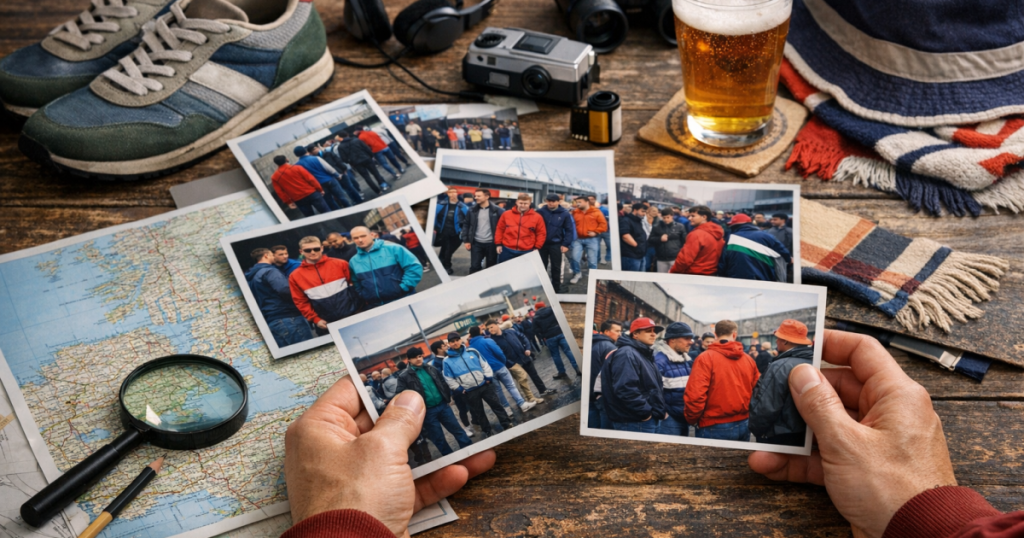
One lad in an unusual top might be ahead of the curve, newly back from holiday, borrowing from an older brother, or simply wearing whatever was clean. A group of twenty people in similar cuts, colours or brands is more meaningful. Try to gather at least three to five images from the same club, city, season or away route before making a regional reading.
Put the images into loose groups: same match, same season, same decade, same club, same travel setting. Station platforms, service stations and ground approaches are especially useful because they often show full outfits rather than just shoulders in the crowd. The more of the outfit you can see, the less likely you are to overvalue one logo.
Step 3: Separate era markers from local taste
A common mistake is treating every visible detail as regional. Some cues simply belong to the period. A boxier track top may be a late-1980s or early-1990s shape rather than a Liverpool, Manchester, Newcastle or Glasgow clue. A full tracksuit worn with running shoes may reflect wider sportswear trends, not a local signature.
Use era identification first, then ask what looks locally distinctive. If you are unsure whether a top belongs broadly to the 1970s, 1980s, 1990s or 2000s, compare collars, sleeve stripes, fabric sheen, branding scale and trouser shape against a dedicated guide to tell 1970s, 1980s, 1990s and 2000s tracksuits apart. Once the decade is clearer, the regional reading becomes much less speculative.
Step 4: Read the jacket, but do not stop there
Track tops attract the eye because they carry colour, branding and shape, but the regional story often sits in the supporting details. Look at whether the top is worn zipped to the neck, open over a polo, under a cagoule, or as part of a full matching set. A jacket used as a practical layer gives a different impression from one worn as a status piece.
Then check the trousers. Are they matching track bottoms, denim, cords, chinos or tailored casual trousers? A full set can suggest sport-led dressing, youth-club influence, travel comfort or later retro revival. A track top with jeans can push the look closer to casual terrace dressing. Neither reading is automatic, but the pairing changes the feel.
Step 5: Map colour habits across the group
Colour is one of the strongest clues, but it needs caution. Navy, stone, burgundy, forest green, royal blue, red, white and black all carry different meanings depending on club colours, fashion cycles and available stock. Some areas leaned into understated colours because they worked with outerwear and trainers; others made bolder use of contrast panels and bright sports branding.
Start by logging repeated colours rather than trying to name a local palette immediately. If several away-day photographs from the same city show navy track tops, light jeans and dark trainers, that is a pattern worth noting. If another set shows bright Italian-style colour-blocking, full tracksuits and prominent chest branding, that may point to a different influence. Always ask whether the colours are club-related, brand-led, seasonal, or simply what was widely stocked at the time.
Step 6: Use trainers and outerwear as cross-checks
Footwear can confirm or challenge your first impression. Running shoes, court trainers, football-inspired indoor shoes and chunky casual trainers all pull the outfit into different moments. A track top that looks early-1990s may feel later if paired with a trainer shape strongly associated with the following era.
Outerwear also matters. A track jacket under a wax jacket, cagoule, bomber, parka or technical shell tells you how the wearer balanced sportswear with weather and local taste. British away days are rarely pristine styling exercises; rain, cold platforms and long journeys shape clothing choices. That practical layer can reveal more about everyday use than the most visible logo.
Step 7: Look for travel, shopping and music routes
Regional clothing scenes did not develop in sealed boxes. Football trips, European holidays, independent sports shops, market stalls, record shops, nightclubs and older lads all moved style around. A group from one city might adopt Italian sportswear because of European away travel, local retail access, or the prestige attached to something less common at home.
Music can also explain why two places with different football cultures share similar clothing. Indie, post-punk, rave, house and Britpop-adjacent scenes all changed how sportswear was worn. A photo outside a ground may be football evidence, but the haircuts, bags and layering might point towards a club night, a gig, or a record-shop circuit as much as a stand.
Step 8: Make notes like a researcher
Keep your mapping simple and repeatable. For each photograph, note the source, claimed date, location, club, visible brands, dominant colours, trouser types, trainers, outerwear, age range and any uncertainty. Do not erase doubt; mark it. A caption such as probably 1994 is not the same as a dated press image.
Photo books and documentary stills can help when used carefully. They are not neutral archives, because selection and cropping shape the story, but they show texture that written memories often miss. For a method rooted in real visual details, the guide on how to use A Casual Look to research terrace tracksuit details is especially relevant.
Step 9: Write the regional reading without overclaiming
Good wording matters. Instead of saying a city wore one exact style, say a set of images suggests a tendency. Use phrases such as appears common, shows a leaning towards, or crops up repeatedly in this sample. That keeps the interpretation credible and respects the fact that working-class and youth cultures were never uniform.
Also avoid turning clothing into a character judgement. Away-day style can be read culturally without romanticising violence, policing people by class, or flattening whole regions into clichés. The most interesting work usually sits in the ordinary details: how a top was zipped, whether the trousers matched, which colours repeated, and how the same idea changed from one station concourse to another.
Common mapping clues to log
- Collar and zip shape: useful for dating track tops and spotting reissue-like details in later images.
- Logo scale: small embroidered marks often read differently from large chest branding or sleeve-heavy designs.
- Fabric finish: shiny, matte, brushed and lightweight finishes can help separate sporting kit from casual wear.
- Layering: track top over polo, under shell jacket, or worn as a full set changes the cultural reading.
- Colour repetition: log repeated tones before linking them to club identity or local taste.
- Group consistency: several similar outfits matter more than one exceptional dresser.
Things readers ask
Can one away-day photo prove a regional style?
No. One image can suggest a clue, but it cannot prove a regional habit. Treat it as a starting point and look for repeated details across more photographs.
Are brands the most important evidence?
Not always. Branding helps, but fit, colour, footwear, layering and the setting often tell you more about how the clothes were actually worn.
How do I avoid confusing club colours with regional taste?
Check whether the same colours appear away from match-specific clothing. If the palette only appears in scarves, flags or replica items, it may be club identity rather than wider style.
Should modern reissues be used as references?
They can help with broad recognition, but they may alter cut, fabric, branding size or colour. Use originals, dated photos and reliable archive material wherever possible.
What is the biggest mistake beginners make?
Overconfidence. A precise-sounding claim based on a blurry image is weaker than a cautious reading based on several dated photographs.
The big picture
Mapping regional style from away-day photographs is really a form of cultural detective work. The best readings combine enthusiasm with restraint: date the image, read the whole outfit, compare several sources, and keep social context in view. When you do that, tracksuits stop being just nostalgic sportswear and become evidence of how British football culture, music scenes and local pride moved through everyday clothing.