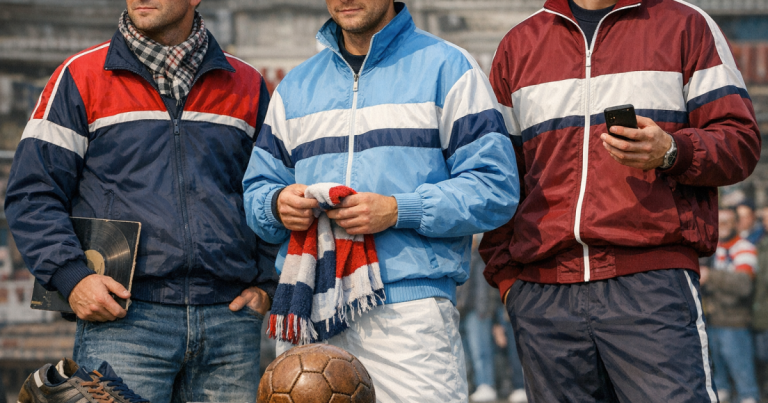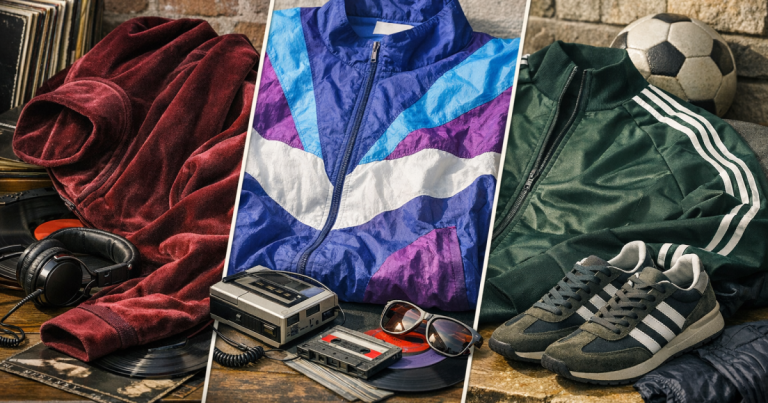
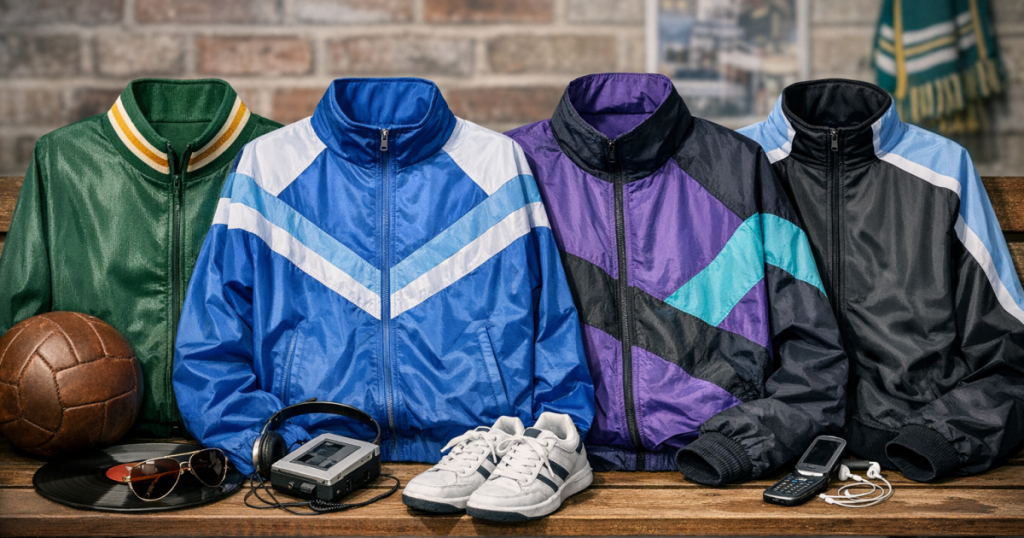
Old track tops rarely give up their decade through one clue. For vintage tracksuit identification, the useful method is to read silhouette, fabric, branding, colour and the social setting together: running club practicality, football-casual status, rave looseness or early-2000s logo confidence.
The difference matters because a 1970s warm-up top, an 1980s casual jacket, a 1990s football-influenced set and a 2000s streetwear tracksuit all sit differently on the body. Get the era right and the outfit looks intentional rather than fancy dress.
In brief
- 1970s: slimmer cuts, knitted collars, restrained branding, club-sport energy and a cleaner athletic line.
- 1980s: sharper colour blocking, status labels, nylon sheen, football-casual codes and bolder shoulder shapes.
- 1990s: roomier fits, louder panels, football training influence, rave spillover and more relaxed styling.
- 2000s: oversized or low-slung shapes, bigger logos, velour and lifestyle sportswear with more visible brand attitude.
- Best method: compare cut, collar, zip, pocket shape, fabric handle, logo placement, colour palette and how the set was meant to be worn.
Start with silhouette, not the badge
Branding can mislead. A reissue may carry an old badge, a vintage jacket may have a replacement zip, and a later fashion piece may borrow an earlier colour scheme. Shape is harder to fake. Look at the shoulder, sleeve width, body length and trouser cut before you get distracted by the logo.
Early tracksuits often have a neater athletic fit: shorter bodies, slimmer sleeves and trousers that taper without pooling. By the 1980s, jackets frequently gain more presence through bigger panels, sharper colour contrasts and a more assertive shoulder. The 1990s loosen things further, helped by football training wear, dance music culture and a general move towards relaxed streetwear. The 2000s bring lifestyle sportswear into the foreground, with larger branding, softer casual fabrics and shapes that were not always pretending to be performance kit.
That social shift is central to why tracksuits became loaded with meaning on British terraces. For the broader background, the site’s explainer on why tracksuits became British terrace uniforms gives useful context for the move from sportswear to status language.
1970s tracksuits: lean, sporty and relatively restrained
A 1970s tracksuit usually feels closer to actual warm-up clothing than later terrace fashion. The jacket often has a compact body, ribbed cuffs, a knitted or ribbed collar, and a zip that sits cleanly without making the front look too bulky. Trousers tend to be neater through the leg, sometimes with a centre crease effect or a simple athletic drape rather than a baggy streetwear shape.
Fabrics can vary, but many 1970s pieces have a less glossy finish than the nylon-heavy casual looks that followed. Polyester was part of the story, but the overall mood is often drier, flatter and more club-sport than nightclub. Branding is usually present but not shouting: chest logos, sleeve stripes, small badges and team-style details rather than giant across-body statements.
Clues that point to the 1970s
- Shorter jacket length, often finishing around the upper hip rather than hanging long.
- Trim sleeves and trousers, designed for movement rather than slouch.
- Simple ribbed collars or small stand collars, not huge zipped funnels.
- Clean side stripes, contrast piping or modest chest logos.
- Colours such as navy, royal blue, red, cream, bottle green and brown used in tidy combinations.
For modern wear, the 1970s influence works well if you prefer understated track tops with straight-leg denim, cords or simple trainers. It is the easiest decade to soften into everyday outfits because the styling is more athletic than theatrical.
1980s tracksuits: casual culture sharpens the look
The 1980s are where British terrace reading becomes more specific. Italian and European sportswear gained status, travel mattered, and the right label could say as much as the right scarf. Jackets became stronger visual objects: brighter blocking, diagonal panels, contrast sleeves, shinier fabric and more dramatic use of colour.
Fit is the giveaway. An 1980s casual jacket is rarely as tidy as a 1970s warm-up top, but it is not always as loose as a 1990s rave or football training piece. It often sits in that sweet spot: roomy enough for attitude, sharp enough to look deliberate. Collars can stand higher, zips feel more central to the look, and pockets become more visually integrated into the panel design.
Labels associated with this period include Sergio Tacchini, Fila, Ellesse, Kappa, Diadora, Lacoste and adidas, among others. The important point is not just the badge; it is how the badge interacts with colour, cut and social meaning. If you want the bigger brand map, the guide to the brands that built British retro tracksuit culture is a useful companion read.
Clues that point to the 1980s
- Sharper colour blocking, often with panels across the chest, shoulders or sleeves.
- Shinier nylon or polyester blends that catch light more than 1970s club kit.
- Medium-roomy fit: bold but not always oversized.
- More visible designer-sportswear identity, particularly with European labels.
- Collars that can be worn up without looking accidental.
To wear the decade well in 2026, avoid stacking too many signals at once. One strong track top, plain trousers and understated trainers will usually look better than a full costume of badges, scarf, cap and period-correct swagger.
1990s tracksuits: looser, louder and more crossover
The 1990s are where many people get confused, because the decade pulls from football training wear, Britpop, jungle, rave, hip-hop, gym culture and late casual style all at once. Not every 1990s tracksuit is loud, but the average silhouette is easier and more relaxed than earlier decades. Jackets can be boxier, sleeves wider, trousers fuller and colour panels more graphic.
Football influence matters. Training tops, shell suits and full tracksuit sets became everyday clothing well beyond the pitch. You start seeing more zip pockets, larger sponsor-style thinking, contrast blocks and fabrics that rustle or shine in a distinctly 1990s way. Even when a piece is minimalist, the proportions often give it away: more space across the chest, more volume in the sleeve and a trouser leg that does not hug the calf.
The decade also overlaps with music culture. Jungle and rave looks could take sportswear away from neat terrace codes and into darker clubs, pirate radio energy and street-level practicality. That means a 1990s jacket may look less polished than an 1980s Italian casual top, but it often has more movement and attitude.
Clues that point to the 1990s
- Boxier jackets and wider sleeves, especially through the upper arm.
- Fuller track pants, sometimes with zipped ankles or a looser break over trainers.
- Bolder use of black, purple, teal, red, white and bright contrast panels.
- Football training details: zip pockets, club-style panels, technical-looking trims.
- More casual mixing with caps, hoodies, loose denim and chunky trainers.
If you are building a 1990s look now, keep the palette disciplined. One loud jacket can do the work; a matching loud top and bottom can tip into costume unless the proportions and trainers are carefully chosen.
2000s tracksuits: lifestyle sportswear takes over
The 2000s tracksuit is less about pretending to be match-day equipment and more about lifestyle. Velour sets, oversized logos, low-slung trousers, zip-through hoodies and full matching branded outfits all sit naturally in the decade. The look can be sporty, but it is often more celebrity, streetwear, gym-to-town or music-video coded than classic terrace.
Compared with the 1990s, branding often becomes more front-facing. Logos can sit larger across the chest, down the leg or on the back. Cuts vary widely: some pieces are baggy, some are slim and shiny, and some are deliberately casual rather than athletic. Trouser rises can be lower, hems can be wider, and jackets may feel closer to leisurewear than training kit.
There is still room for subtlety. Not every 2000s tracksuit is garish. But if the fabric feels soft and lounge-like, the branding dominates the design, or the outfit seems built as a matching lifestyle set rather than a sports warm-up, you are probably looking at a 2000s direction rather than a terrace original.
Clues that point to the 2000s
- Bigger, more obvious logos or wordmarks.
- Velour, soft fleece-backed fabrics or fashion-led shiny synthetics.
- Zip-through hoodie shapes alongside traditional track jackets.
- Low-rise or wide-leg trousers, depending on the sub-style.
- Styling that feels linked to music television, high street sportswear and celebrity casualwear.
Colour is a dating tool, but never the whole answer
Colour can help, but it should not be treated as proof on its own. Navy, red and white run through several decades. Green can look 1970s in one context, 1980s in another and 1990s in a football training palette. Burgundy can feel classic terrace when paired with stone or navy, but much later if used with oversized logos and glossy trims.
The safer approach is to read colour alongside proportion. A neat navy track top with modest stripes may feel 1970s. A navy, white and red blocked jacket with a sharper collar may lean 1980s. A loose navy shell with teal or purple flashes may land in the 1990s. A navy velour zip set with large branding is much more 2000s. For wearable palette decisions, the terrace style colour guide helps translate those old codes into outfits that work now.
Fabric, zips and labels: the small details that help confirm the era
Once the silhouette and colour story point you towards a decade, look at construction. Zips, cuffs, labels and pocket shapes can either support your read or complicate it.
- Labels: older labels can be useful, but brands changed labels many times and reissues often borrow archive graphics. Compare several sources before making a confident call.
- Zips: chunky plastic zips can suggest later casual or training wear, while smaller metal or finer zips may appear on earlier pieces. Replacements are common, so do not rely on the zip alone.
- Cuffs and hems: tight ribbing often feels earlier or more athletic; open hems, zip ankles and looser cuffs can point later.
- Pockets: simple side pockets feel cleaner and older; zipped pockets integrated into graphic panels often suggest later performance influence.
- Fabric handle: flat polyester, shiny nylon, brushed tricot, fleece-backed leisure fabrics and velour all tell different stories, but each needs to be judged with the cut.
Books and photo archives are invaluable because they show clothing on actual bodies rather than isolated hangers. Gavin Watson’s A Casual Look: A Photodiary of the 1980s Casual, Terrace and Football Scene is especially useful for studying fit, stance and how sportswear was mixed with jeans, coats and trainers. Cass Pennant’s The Football Casuals: A History gives a wider cultural route into why certain clothes carried weight beyond their materials.
How to avoid the common mistakes
The biggest mistake is assuming every retro tracksuit is automatically 1980s. The second is calling anything shiny a shell suit. The third is trusting a single badge, colour or seller description without checking the whole garment.
- Do not date by nostalgia alone: if it reminds you of a football photo, find out whether that photo is actually from the same decade.
- Separate original from reissue: modern archive pieces can be excellent to wear, but they may combine old styling with modern sizing and fabric.
- Check the trousers: jackets get most attention, but track pants often reveal the decade through rise, taper, ankle treatment and volume.
- Notice how it layers: a 1970s top may sit cleanly under a light jacket; a 1990s or 2000s piece may need more room because of sleeve width and fabric bulk.
- Look for contradictions: a 1970s-looking collar with a huge modern wordmark probably needs more checking.
Wearing each era without looking overdone
A good retro outfit does not need to be museum-perfect. The aim is to borrow the strongest signal from the era and let modern restraint do the rest.
- For 1970s: choose a neat track top, straight denim or tailored casual trousers, and simple low-profile trainers.
- For 1980s: let a bold European-style jacket lead, then keep the rest plain so the colour blocking has space.
- For 1990s: allow more volume, but control the palette with one dark base colour and one accent.
- For 2000s: lean into lifestyle sportswear carefully; a zip top or trousers can work better than a full logo-heavy set.
Modern pieces can still serve the look if the proportions are right. A heritage track jacket, a plain hoodie, a simple cap or a pair of terrace-friendly trainers can support the era without pretending to be an original. The trick is knowing which decade you are referencing before you start mixing.
Common questions
Can a tracksuit have details from more than one decade?
Yes. Reissues, later fashion pieces and long-running brand designs often blend old graphics with newer cuts. Treat mixed clues as a reason to be cautious, not as a problem.
Are 1980s tracksuits always better for terrace style?
No. The 1980s are central to casual culture, but 1970s, 1990s and even some 2000s pieces can work if the outfit is balanced and not overly branded.
How can I tell if a tracksuit is a reissue?
Look for modern care labels, contemporary sizing, newer fabric feel, fresh zips and current retail finishing. Reissues can be very wearable, but they should not be priced or described as untouched originals without evidence.
Should I buy a full matching set or just the jacket?
For most modern wardrobes, the jacket is easier to wear. Full sets can look excellent, but they demand better fit, quieter accessories and more confidence.
Which decade is easiest to wear day to day?
1970s and restrained 1980s-inspired pieces are usually easiest because they sit closer to classic sportswear. Louder 1990s and 2000s looks need more control in colour and proportion.
Main lessons
Dating a tracksuit is a matter of pattern recognition, not one magic clue. The 1970s tend to be lean and athletic, the 1980s sharper and more status-driven, the 1990s looser and more crossover, and the 2000s more lifestyle-led and logo-aware.
Read the whole garment: silhouette first, then fabric, collar, zip, pockets, branding and colour. Once the era makes sense, styling becomes easier. You can wear the reference lightly, choose modern alternatives more intelligently, and avoid turning a strong piece of sportswear history into a costume.