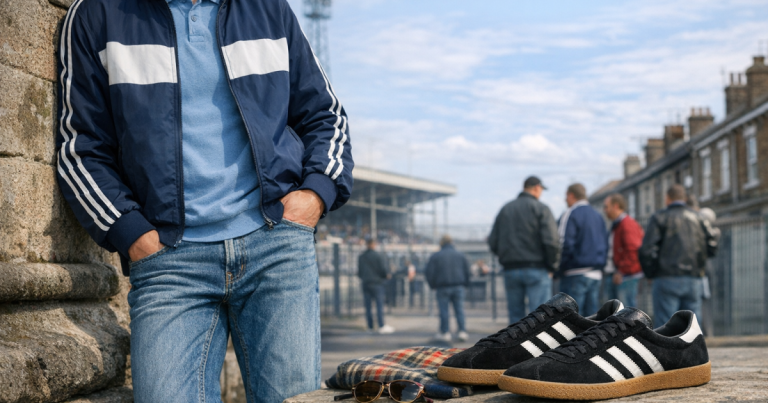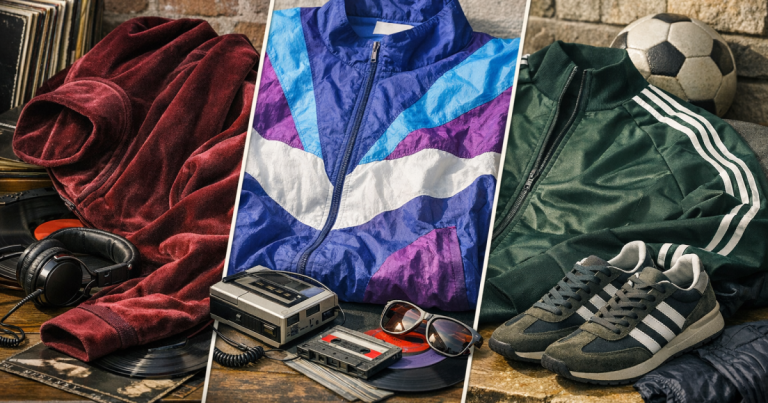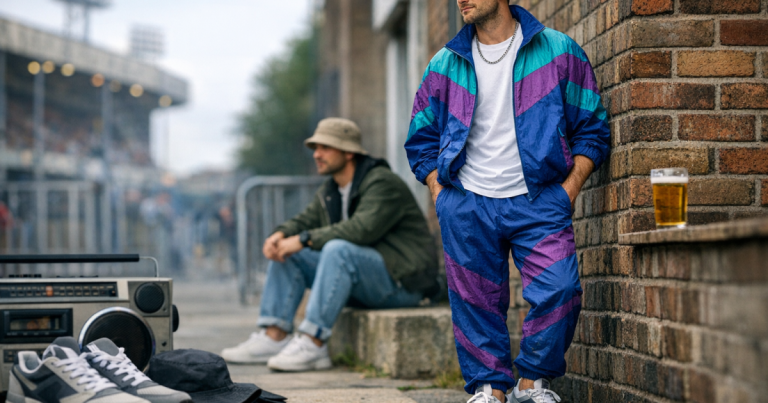
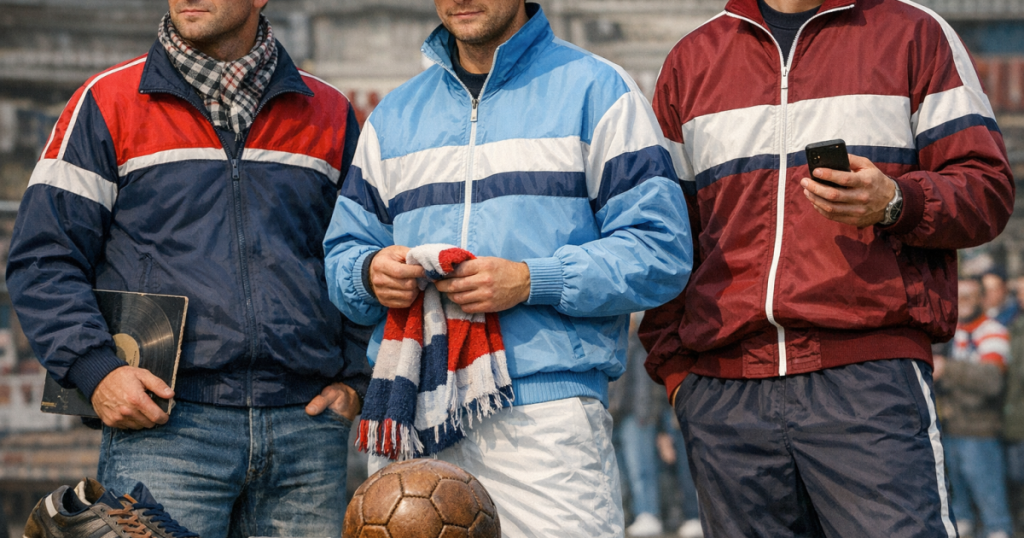
The story of football casuals tracksuit style is not just about logos and old photos; it is about how match-going lads turned sportswear into a coded uniform. Each era had its own priorities: imported labels, glossy nylon, rave colour, Britpop practicality, then the modern reissue culture that lets you borrow the look without dressing like a museum display.
For anyone building a retro wardrobe now, the useful question is not simply “what did they wear?” It is “which decade’s attitude am I borrowing, and how do I make it work on a British high street, in a pub garden or on a wet walk to the ground?”
At a glance
- Late 1970s: the roots were smart, European and travel-led, with tennis and leisurewear starting to matter as much as club colours.
- 1980s: the classic casual era pushed Italian labels, Adidas terrace trainers, shiny track tops and status through scarcity.
- 1990s: rave, Britpop and sportswear branding made tracksuits louder, roomier and more mainstream.
- 2000s: retro revivals began to mix with Nike, Adidas Originals and archive nostalgia.
- Now: the strongest looks take one era cue at a time rather than copying a full-period costume.
Before the tracksuit became the point
The early casual look grew out of football travel, youth competition and a sharp eye for what was not yet common back home. European away days mattered because they exposed British lads to sportswear, trainers and leisure labels that felt sharper than ordinary high-street kit. The tracksuit was not always the full outfit at first; it sat alongside cords, knitwear, polos, cagoules and clean trainers.
That is why the best casual-inspired tracksuit outfits still need some restraint. The original appeal was not fancy dress. It was the sense that you knew something other people had not clocked yet. If you need the language decoded, the site’s British tracksuit culture glossary is a useful reference for terms such as casuals, creps and clobber without flattening the subculture into clichés.
Late 1970s: smart sportswear, not gym kit
In the late 1970s, the casual look was still forming. The influence came from tennis clubs, European leisurewear, ski shops, golfwear and imported trainers as much as from football itself. Track tops were appealing because they looked athletic but tidy. Worn with jeans, cords or smart trainers, they shifted sportswear away from school PE and towards Saturday identity.
Colours tended to be cleaner than later rave-era palettes: navy, burgundy, bottle green, cream, sky blue and red all made sense. Full tracksuits existed, but the more wearable modern interpretation is often a track jacket with straight denim, cords or simple track pants rather than a head-to-toe matching set.
For today’s wardrobe, look for ribbed cuffs, contrast piping, small chest branding and a fit that sits neatly rather than ballooning. A tennis-derived top, a plain polo and low-profile trainers can suggest the era without making you look as if you are heading to a fancy-dress night.
1980s: the terrace uniform sharpens up
The 1980s are the era most people picture when they think of British football casuals. Adidas trainers became markers of knowledge, Italian sportswear carried weight, and labels such as Sergio Tacchini, Fila, Ellesse, Kappa and Lacoste Sport fed into a style language that was competitive but precise. Scarcity mattered: a top you could not easily buy in your local sports shop had more pull.
Tracksuits in this period often had a smarter, more structured feel than later oversized styles. Glossy polyester, nylon blends, colour-blocking and stand collars helped create a silhouette that looked clean from the terraces to the pub. The link between tennis style and football crowds is especially important here; Sergio Tacchini’s move from tennis courts to terraces explains why a brand built for one sport became symbolic in another setting.
Modern equivalents work best when you keep the palette tight. A navy track top with white piping, stonewash jeans and leather trainers says 1980s terrace without overdoing it. The Adidas Originals Firebird Track Top is a familiar modern reference point for the broad shape of archive sportswear, though the details, cut and fabric should always be checked against the era you want to evoke.
1990s: rave colour, bigger fits and mainstream sportswear
By the 1990s, the casual look had been pulled through rave culture, indie clubs, sports branding and television. Tracksuits became louder, larger and more visible. The fit loosened. Shell suits, nylon jackets and bold panels were part of the broader British street scene, even when purists would draw lines between proper casual style and general sportswear fashion.
This is where the mood changes. The 1980s look often feels coded and tidy; the 1990s look is more public, more graphic and more relaxed. Think zip-neck tops, bolder colour blocking, baggier track pants, bucket hats, branded tees and trainers with more visible air or cushioning profiles. Not every 1990s outfit was tasteful, but the energy still drives a lot of retro sportswear today.
If you are wearing this influence now, be careful with volume. One roomy piece is usually enough. A bigger track jacket can work with straighter trousers and cleaner trainers, while wide track pants are easier with a simple sweatshirt or plain tee. The era gives permission for colour, but too many bright panels at once can tip from nostalgic to chaotic.
2000s: nostalgia starts feeding the revival
The 2000s were complicated for tracksuit style. On one hand, sportswear became everyday uniform across football, music television and high-street fashion. On the other, a clearer nostalgia for earlier casual culture began to form. Archive Adidas, old Nike silhouettes, reissued trainers and vintage shops gave younger wearers a route into styles they had not lived through first time round.
Nike’s position in terrace style became stronger as Air Max culture, football training gear and branded tracksuits crossed into everyday British dress. For more detail on that shift, the site’s piece on how Nike tracksuits built credibility on British terraces is worth reading alongside any 2000s-era outfit planning.
The wearable lesson from this period is balance. A clean Nike track jacket, straight-leg jeans and a cap can feel natural. A full matching shiny set with huge trainers can work for some, but it is much harder to wear casually unless the proportions are controlled. The Nike Air Max 90 remains a recognisable reference for the broader trainer culture around this period, but pairing matters more than the label alone.
2010s to now: reissues, vintage hunting and edited nostalgia
The modern revival is less about one terrace uniform and more about choosing your lane. Some people chase true vintage labels. Others prefer reissues because they are easier to size, cleaner to care for and less fragile. Many mix a retro track top with modern basics, which is usually the most convincing approach for everyday wear.
Current terrace-inspired dressing is strongest when it edits the past. A 1980s-style track top with contemporary trousers. A 1990s shell jacket with muted colours underneath. A tennis-influenced polo under a zip track jacket. A cap, but not five other accessories fighting for attention. The aim is to carry the reference, not perform the whole archive.
For readers who like physical reference points, books such as A Casual Look: A Photodiary of the 1980s Casual, Terrace and Football Scene by Gavin Watson are valuable because they show real proportions, settings and combinations rather than polished catalogue styling.
How to borrow an era without looking costume-like
Choose one decade as the anchor
Do not mix every signal at once. A 1970s tennis-style top, 1980s Italian branding, 1990s rave colours and 2000s chunky trainers can all be strong separately, but together they blur the point. Start with one decade and let the rest of the outfit support it quietly.
Watch the fabric
Fabric gives away the era quickly. Smooth polyester, shiny nylon, velour, brushed cotton and modern recycled blends all sit differently. Older-looking fabrics can feel brilliant, but they need the right setting. A high-shine shell top on a grey February matchday can look sharp; the same piece under harsh indoor lighting might feel too much.
Keep colour disciplined
Casual style has always had colour, but the best outfits rarely look random. Navy and white, burgundy and cream, forest green and off-white, black and gold, or royal blue and red can all feel terrace-friendly. If the track top is loud, calm the trousers and trainers down.
Care matters with synthetics
Retro and retro-inspired tracksuits often rely on synthetic fabrics that dislike rough treatment. Check the care label, avoid excessive heat, and hang pieces properly so collars and cuffs keep their shape. For creases in modern synthetics, a handheld steamer such as the Philips 3000 Series Handheld Garment Steamer is one type of tool some wearers compare, but always test cautiously and follow the garment label.
Things readers ask
What defines football casuals tracksuit style?
It is the use of sportswear as social code: track tops, trainers, labels, colour and fit chosen with terrace culture in mind rather than just exercise or comfort.
Which era is easiest to wear today?
The late 1970s and 1980s influences are usually easiest because the colours and shapes are cleaner. A neat track jacket, polo and simple trainers rarely looks forced.
Are full tracksuits still terrace-friendly?
Yes, but they are harder to get right. Matching sets work best when the fit is controlled, the colours are not too loud, and the trainers do not compete with the top.
Is vintage better than a reissue?
Not always. Vintage has character, but reissues can be easier for sizing, condition and regular wear. Check fabric, cut, cuffs, zips and branding before deciding.
Can you mix Adidas, Nike, Fila and other brands?
You can, but it needs restraint. One dominant brand cue usually looks sharper than several big logos fighting across the same outfit.
What stands out
Football casuals did not create tracksuits, but they changed how Britain read them. A track top stopped being only sports kit and became a signal of travel, taste, rivalry, music, money, scarcity and belonging. That is why the style still carries weight decades later.
The most useful way to wear the influence now is to treat each era as a set of clues. Late-70s neatness, 1980s imported sharpness, 1990s colour, 2000s sportswear confidence and modern reissue practicality all offer something. Pick the part that fits your life, keep the outfit wearable, and let the reference do its work quietly.