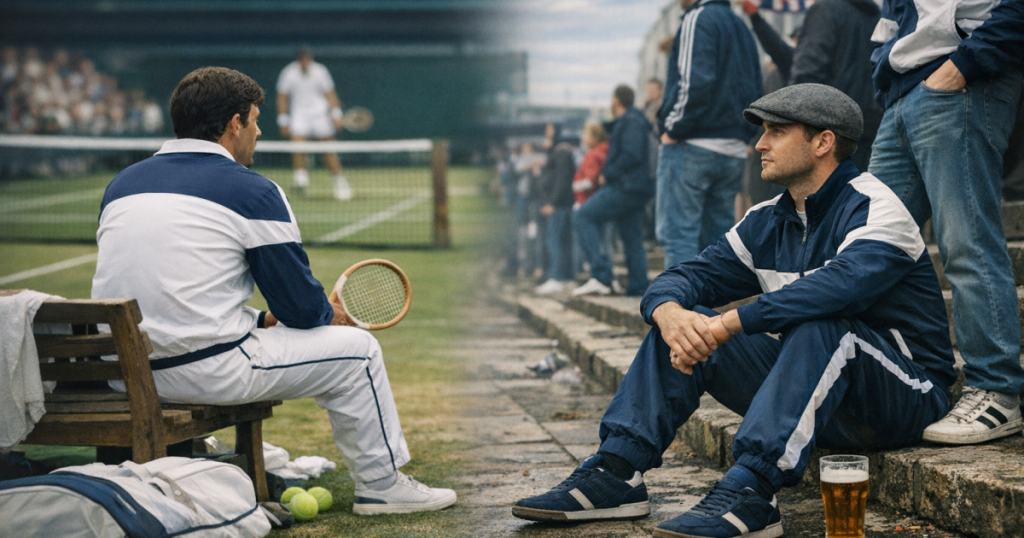
Sergio Tacchini tracksuits occupy a particular place in British casual culture: smart enough to nod back to tennis clubs, bold enough to hold their own outside a ground, and just continental enough to feel different from the usual sportswear rotation. The brand’s terrace appeal makes more sense when you see it as a journey from controlled court elegance to the competitive language of matchday clothes.
At a glance
- Sergio Tacchini began as an Italian tennis label, not a football brand.
- Its status came from colour, cut, sponsorship, European cachet and the way British casuals read sportswear as social code.
- The best Tacchini looks tend to be clean, panelled and controlled rather than loud for the sake of it.
- Vintage pieces can carry real charm, but condition, fabric ageing and fit matter more than nostalgia.
- Modern wear works best when the track top is treated like a smart casual layer, not fancy dress.
From Italian tennis to visible sportswear
Sergio Tacchini was launched in Italy in the 1960s by the former tennis player of the same name. That origin matters because the label was built around tennis at a point when the sport still carried a strong visual code: whites, neat collars, controlled lines and a sense of club-house polish. Tacchini helped push tennis clothing towards stronger colour and clearer branding without losing that tidy, athletic base.
Compared with football kit or gym wear, tennis apparel had a different kind of aspiration. It looked mobile, international and expensive without needing to shout. On British terraces, where casual style often rewarded the person who knew the reference before everyone else did, that was powerful currency. The label sat alongside other European names that carried a sense of travel, import shops, away days and taste that could not be faked by simply buying the loudest jacket available.
To understand where Tacchini fits in the wider hierarchy, it helps to place it next to the labels covered in our guide to the brands that defined British retro tracksuit culture. Adidas had football-adjacent familiarity, Fila had Björn Borg-era tennis glamour, Lacoste had preppy bite, and Sergio Tacchini offered a sharper Italian reading of court style.
Why tennis clothing worked on British terraces
The casual scene did not adopt sportswear at random. It favoured pieces that carried status but could still be worn in real life: track tops, polos, trainers, lightweight jackets and knitwear. Tennis clothing fitted that perfectly. It was sport-derived, but less obvious than wearing a club shirt. It suggested taste rather than allegiance.
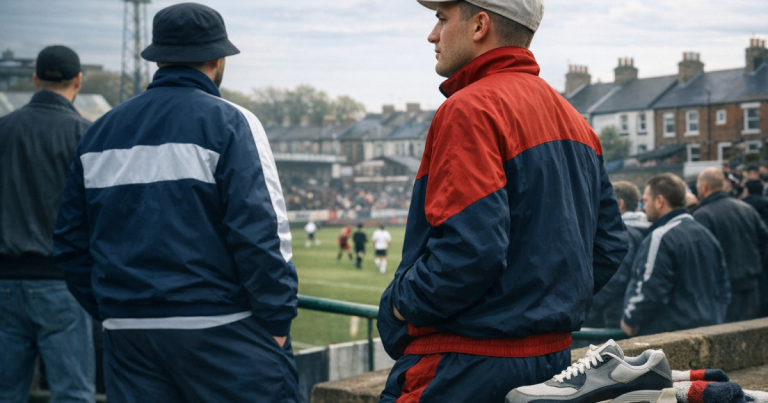
Tacchini’s visual language also suited the terrace environment. Many of its best-known pieces used contrast panels, ribbed collars, chest branding and colour blocks that framed the upper body clearly. That made a track top readable from a distance, which matters in the visual theatre of football crowds. The clothes had presence, but the better examples still felt composed.
There was also the European factor. British casuals were often alert to what looked continental, whether picked up on trips, spotted in magazines, seen on athletes or filtered through shop windows in larger cities. Italian sportswear carried a particular romance: warmer colours, smoother shapes and a dressier attitude than standard training gear. Sergio Tacchini was not merely worn because it was sporty; it was worn because it looked selected.
The McEnroe factor and the power of sporting attitude
Brand history becomes terrace history when a label gathers personality. Sergio Tacchini’s tennis sponsorships gave it that. John McEnroe is the obvious reference: volatile, brilliant, confrontational and visually memorable. His association with the brand gave Tacchini a harder edge than genteel tennis might otherwise suggest.
That mattered in Britain. Terrace style has always borrowed from visible characters: footballers, musicians, boxers, film anti-heroes and athletes with attitude. A tennis label worn by a fiery champion could cross over more easily than one associated only with polite club culture. McEnroe did not make Tacchini a terrace brand on his own, but he gave the clothing a recognisable charge.
The brand also appeared in the orbit of other tennis names across its history, reinforcing the idea that this was performance clothing with a premium sporting pedigree. For casuals, that pedigree mattered less as technical validation and more as cultural proof. The wearer was not dressing like a tennis player; he was borrowing the authority of elite European sport and reworking it for the street.
How Tacchini differed from Fila, Ellesse and adidas
One reason Sergio Tacchini remains interesting is that it does not blur entirely into the rest of the retro sportswear field. Fila often reads plush, glamorous and slightly showman-like, particularly through its tennis legacy. Ellesse leans into Italian leisure, ski and tennis crossovers with a warmer resort feel. Adidas, especially in Britain, carries football, training and streetwear familiarity that can make it feel more everyday.
Tacchini sits somewhere more restrained. The right jacket can look continental without being peacocky, athletic without being basic, and dressy without losing its sportswear roots. That balance is why it works with slim denim, cords, track pants or a clean polo underneath. It can handle a pub before the match, a train journey, or a low-key weekend fit without looking as though the wearer is staging an 1980s reconstruction.
This is also where subcultural distinctions matter. A Tacchini track top might overlap with mod neatness, ska-era sharpness or casual sportswear, but those influences are not identical. If you want to separate those cues properly, the breakdown of mod, ska and casual influences in tracksuits is a useful companion read.
What to look for in a Sergio Tacchini piece
Whether you are eyeing a vintage track top, a reissue or a newer piece inspired by the archive, the same checks apply. Start with the silhouette. Tacchini usually looks best when the shoulder line is clean, the body is not too long, and the collar sits properly rather than collapsing. A track top that is too oversized can lose the smart tennis-derived quality that makes the brand appealing in the first place.
Then look at colour. Navy, cream, burgundy, forest green, red, white and sky blue all make sense in the Tacchini world, but the palette should feel deliberate. Strong colour blocking is part of the appeal; clashing for novelty is not. If the piece is already doing a lot at the chest and sleeves, keep the rest of the outfit quieter.
Fabric is the next check. Older synthetic sportswear can age beautifully, but it can also suffer from pulls, shine, weakened elastic, tired cuffs or awkward odours that are difficult to shift. Velour and heavier poly blends give a different impression from smooth tricot or shell-style nylon. None is automatically better; the question is whether the fabric suits how you will actually wear it.
For current archive-leaning references, pieces such as the Sergio Tacchini Damarindo Track Top and Sergio Tacchini Orion Track Top show why shape, collar, colour placement and logo scale are worth comparing before you buy. Check the retailer’s latest sizing notes, fabric composition and return terms rather than assuming all Tacchini cuts fit the same.
Making it work now without costume energy
The most wearable modern Tacchini outfit usually avoids going head-to-toe retro unless the proportions are very controlled. A track top over a plain T-shirt, straight denim and low-profile trainers is often enough. If you want the fuller tracksuit look, balance it with clean footwear and avoid piling on too many period signals at once.
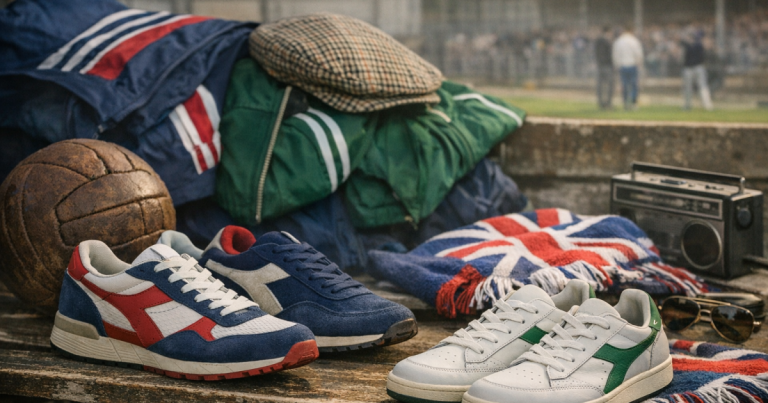
Trainers should match the mood rather than simply the colour. Court-style trainers, terrace classics and low-profile suede pairs tend to work better than bulky modern runners if the track top has a tennis feel. White leather, gum soles, navy suede or burgundy accents can all sit comfortably with the brand’s Italian sportswear language.
Layering also changes the read. Under a wax jacket, mac or plain overcoat, Tacchini becomes a flash of colour rather than the whole statement. With a polo underneath, it leans smarter. With track pants, it becomes more obviously retro. With jeans and a knitted layer, it can feel like a grown-up version of casual style rather than a borrowed archive photo.
If fit is the sticking point, use our terrace style fit guide before committing to a vintage piece or a modern remake. A good Tacchini top should move easily, sit cleanly at the waist and keep its collar shape; those details do more for the look than chasing a rare label variation in poor condition.
Vintage versus reissue: the sensible trade-off
Vintage Sergio Tacchini carries the strongest nostalgia and often the most interesting labels, cuts and colour combinations. The trade-off is uncertainty. You need to inspect cuffs, zips, lining, embroidery, stains and any cracking or distortion around printed details. Measurements are more useful than the size on the tag, because older sizing can feel very different from current UK expectations.
Reissues and newer archive-inspired pieces are easier for regular wear. They are usually simpler to size, easier to return when bought from reputable UK retailers, and less stressful if you want something for everyday use rather than collection value. The downside is that some modern pieces can feel too polished or too generic if the colour blocking and proportions do not carry enough character.
The best choice depends on purpose. For collecting, a clean vintage top with provenance and strong condition has obvious appeal. For wearing to matches, pubs, gigs or weekends, a well-cut modern version may be the better call. Tacchini’s legacy is not preserved by keeping every piece in a wardrobe; it lives when the clothes still make sense on real streets.
Things readers ask
Was Sergio Tacchini originally a football casual brand?
No. It began in tennis and became part of football casual style because British terrace dressers adopted premium European sportswear and gave it a new context.
Which colours feel most authentic for a Tacchini terrace look?
Navy, white, cream, burgundy, red, green and sky blue all work well. The key is controlled contrast rather than novelty colour blocking.
Is a full Sergio Tacchini tracksuit too much now?
Not automatically, but it needs restraint. Keep trainers clean, avoid excessive accessories, and make sure the fit is sharp rather than baggy or costume-like.
Should I buy vintage or a modern reissue?
Buy vintage for character and collectability; buy a reissue or newer piece for easier sizing, returns and regular wear. Always check measurements and fabric details.
What trainers suit Sergio Tacchini best?
Low-profile terrace trainers, classic court shoes and simple suede pairs usually work best. Avoid footwear that overpowers the track top’s cleaner tennis lines.
Final thoughts
Sergio Tacchini’s route from tennis courts to terraces was not a random style accident. The brand had sporting credibility, Italian polish, strong visual codes and the right level of difference for British casual culture. It offered a way to look athletic without looking basic, smart without looking formal, and continental without trying too hard.
That is still the lesson for wearing it now. Choose pieces for proportion, colour and condition before rarity. Let the track top do one clear job in the outfit. Keep the rest of the look grounded. When Tacchini works, it does not need a lecture or a costume reference; it simply looks like the wearer knows exactly why that badge matters.