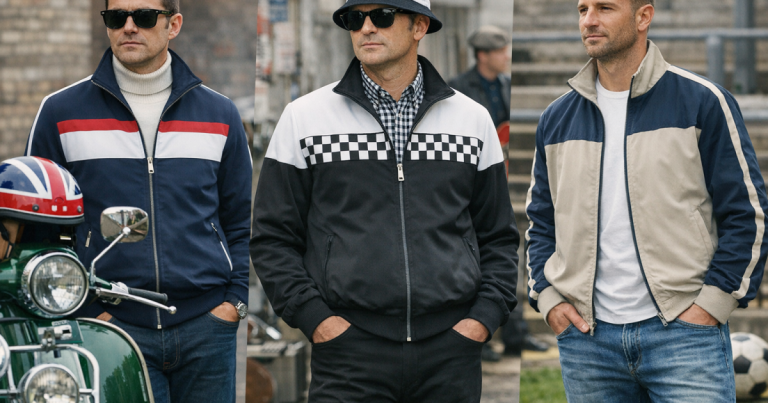
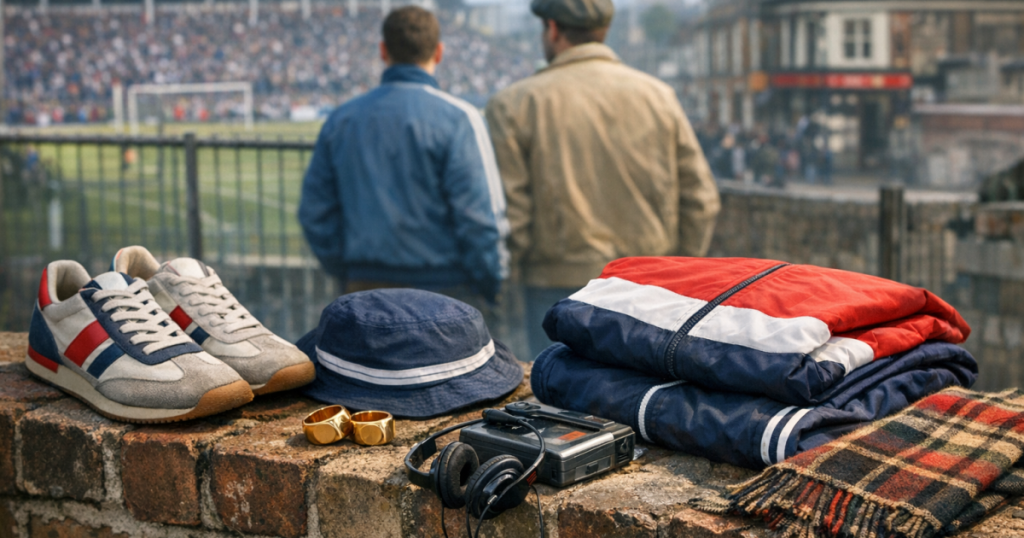
Terrace talk can sound like a private language: one mate says “nice creps”, another calls a jacket “proper clobber”, and someone else starts arguing about whether a full set is casual or rave. This British tracksuit culture glossary gives the terms enough context to be useful without flattening the humour, regional variation or football-day nuance behind them.
The words matter because they are not just labels for clothes. They carry class signals, football loyalties, music references, local pride and a fair bit of wind-up energy. Use them too literally and you miss the point; use them without context and you risk sounding like you have learnt terrace style from a fancy-dress aisle.
The short version
- “Casual” usually refers to the football-influenced subculture and its dressed-down but highly considered sportswear look.
- “Creps” means trainers, often said with the same seriousness someone else might reserve for tailoring.
- “Clobber” means clothing, but in this world it usually implies gear with taste, status or story behind it.
- “Trackie”, “track top” and “shell suit” are not interchangeable; fabric, era and fit change the meaning.
- Context is everything: the same piece can read as terrace, rave, gym wear or costume depending on how it is worn.
Why the language is so specific
British tracksuit and terrace language grew out of lived culture rather than fashion marketing. Football away days, independent sports shops, European labels, market stalls, music scenes and local one-upmanship all fed the vocabulary. A jacket was rarely just a jacket. It might say where you shopped, what match you travelled to, what records you listened to, and whether you understood the codes without making a show of them.
That is why the language can feel playful and serious at once. Someone calling a top “decent clobber” may simply mean it looks good. They may also be clocking its cut, label, condition, colourway and whether it fits the setting. For the wider roots of the look, it helps to read around terrace style and tracksuit culture rather than treating the words as isolated slang.
Core terms worth knowing
Casuals
“Casuals” refers to a football-linked style movement associated with British terraces, especially the shift towards designer sportswear, European leisurewear and sharp-but-unformal dressing. It does not simply mean “people dressed casually”. In this context, casual means considered, brand-literate and quietly competitive.
The important distinction is that casual style often avoids looking too coordinated or too flashy, even when the clothes are chosen carefully. A track jacket with the right jeans and trainers can feel casual in the cultural sense; a head-to-toe matching set can feel more retro sportswear, rave, gym or throwback depending on the details.
Creps
“Creps” means trainers. It is one of the most common terms in British street and terrace-influenced style, although usage varies by region, age and social circle. In terrace dressing, creps are not an afterthought. They often anchor the whole outfit.
Classic silhouettes, gum soles, suede uppers, low profiles and football-training heritage all tend to carry more cultural weight than obvious hype. The term can be affectionate, admiring or critical. “Fresh creps” is praise; “wrong creps” can quietly undo the rest of a fit.
Clobber
“Clobber” means clothes, but it has a particular warmth in British style language. It suggests gear with presence: a good jacket, a well-cut track top, a proper polo, a rare label, or a piece that looks right because it has been worn with confidence.
It is not necessarily expensive. Good clobber can be vintage, reissued, second-hand, high street or carefully looked after. The word is more about judgement than price. If someone says “that’s good clobber”, they are usually recognising taste, not just branding.
Trackie
“Trackie” can mean a tracksuit, a track jacket, track bottoms, or sometimes just the general tracksuit look. It is casual speech, so context does the work. “Full trackie” usually means a matching or near-matching top and bottoms. “Trackie top” means the jacket or zip top.
The trap is assuming every trackie carries the same cultural meaning. A fitted polycotton football-style tracksuit, a shiny nylon shell suit and a velour leisure set sit in different lanes. Fabric, era and attitude change the message.
Track top
A “track top” is usually the zip-up upper half of a tracksuit. In terrace style it is often the most wearable piece because it can sit with denim, cords, chinos or casual trousers without becoming costume. Ribbed cuffs, collar shape, piping, colour blocking and logo placement all affect whether it feels sharp or generic.
Track tops are also where brand history shows clearly. Italian tennis-inspired shapes, German sportswear classics and British high-street revivals can all look similar at a glance, but the cultural associations are different.
Shell suit
A “shell suit” usually refers to lightweight synthetic tracksuit sets, often with shine, colour blocking, elasticated details and a strong late-80s to 90s association. In Britain, the term carries nostalgia and danger in equal measure: wear it well and it looks knowing; overdo it and it tips into party costume.
The safer modern route is often to break the set up. A shell jacket over a plain tee or sweatshirt feels easier than a full bright set. For more detailed styling, the guide to wearing a 1990s shell suit without fancy dress is a useful next step.
Words shaped by football and place
Terrace
“Terrace” refers to football standing areas historically, but in style language it now points to the wider culture around match-going dress, away-day identity and casual sportswear. It is not a single uniform. Liverpool, Manchester, Glasgow, London, Newcastle and Leeds have all produced different interpretations, and smaller towns have their own codes too.
When a piece is described as “terrace-friendly”, it usually means it has enough heritage, subtlety and proportion to sit naturally within that world. It does not need to be vintage, rare or expensive, but it should avoid looking like a novelty throwback.
Away day
“Away day” refers to travelling to watch your club away from home. In clothing terms, it often implies practicality as much as status: layers for train platforms, pubs, cold concourses and changing weather. The best away-day clobber tends to be wearable, packable and unfussy.
This is where tracksuit culture becomes practical rather than just nostalgic. A good jacket must survive movement, rain in the air, crowded transport and a long day without looking collapsed by mid-afternoon.
Firm
“Firm” is a loaded word linked to football hooligan history and group identity. It appears in books, films and older terrace conversations, but it should be used with care. Not every casual dresser is interested in that side of the culture, and reducing the style to violence misses much of the music, fashion, travel and community around it.
For writing, styling or conversation, it is usually better to be precise: talk about casual style, football fashion, terrace influence or match-going dress unless you are specifically discussing hooligan history.
Brand language and status signals
Badge
“Badge” means the logo or visible brand mark, but it also stands for recognition. A small chest logo can carry more weight than a giant graphic if the brand has terrace credibility. The badge works as shorthand: it tells people what lane the garment sits in before they inspect the cut or fabric.
That does not mean bigger branding is always wrong. Some eras were louder than others. The key is whether the badge feels integrated into the garment or pasted on for effect.
Deadstock
“Deadstock” usually means unworn old stock, often from a closed shop, warehouse or forgotten retail run. It can be appealing because it offers period-correct fabric, labels and proportions. It can also be fragile, oddly sized or less practical than a modern reissue.
With deadstock tracksuits, check elastic, zips, lining, colour fading and storage marks. Age alone does not make a piece wearable. Sometimes the smarter move is a modern piece that captures the look without the maintenance risk.
Reissue
A “reissue” is a new version of an older design. Reissues can be excellent for everyday wear because they usually avoid the fragility of vintage pieces. They may also change fit, fabric, branding or details, so they are not always identical to the original.
For readers interested in why certain names carry more weight than others, the overview of brands that shaped British retro tracksuit culture gives useful context beyond logo spotting.
Fit and fabric terms that change the meaning
Baggy
“Baggy” can be a compliment or an insult depending on the era being referenced. A relaxed 90s silhouette can look intentional, especially with shell fabrics, rave influence or wide-leg track bottoms. But baggy can also mean shapeless if the shoulders drop badly, the hem sits wrong or the trousers pool over the trainers.
The modern trick is balance. If the jacket is oversized, keep the rest controlled. If the bottoms are wide, make sure the footwear has enough weight to hold the shape.
Boxy
“Boxy” describes a short, wide cut, often seen in older track jackets and some reissues. It can look very authentic with straight-leg trousers and low-profile trainers. It can also feel awkward if you expect modern slim sportswear proportions.
Boxy is not the same as oversized. A boxy jacket may fit correctly at the shoulders and sleeves while still sitting wide through the body. That shape is part of the charm when styled deliberately.
Shiny
“Shiny” usually points towards nylon, polyester or shell fabrics. It can suggest 90s sportswear, rave crossover, market-stall nostalgia or bold casual outerwear. Shine is powerful, so the rest of the outfit needs restraint unless you are deliberately chasing a full throwback look.
Plain tees, muted trainers and simple caps can calm down a shiny jacket. Too many loud elements together can make even strong vintage clobber look like costume.
How not to misuse the words
- Do not call every tracksuit “terrace”. Some are gym wear, some are streetwear, some are fashion sportswear, and some are genuinely terrace-adjacent.
- Do not treat “casual” as automatically meaning expensive. The culture has always involved taste, access, scarcity, imitation and local interpretation.
- Do not assume London slang applies everywhere. Northern, Scottish, Welsh and Midlands usage can differ sharply.
- Do not flatten the culture into hooligan stereotypes. Violence is part of some histories, but it is not the whole story.
- Do not force the vocabulary. If a word does not feel natural in your mouth, plain English is better than cosplay.
Main points
The language around British tracksuits is practical, funny and socially observant. “Creps” are trainers, but they are also taste signals. “Clobber” means clothes, but it hints at approval. “Casuals” is not just a dress code; it is a culture built from football, travel, music, shopping knowledge and local identity.
The best way to use the words is to understand the difference between era, fabric, fit and context. A track top, a shell suit and a full trackie can all belong in the same broad world, but they do different jobs. Get those distinctions right and the vocabulary becomes useful rather than decorative.
Helpful questions
Is “creps” the same as “trainers”?
Yes, broadly. “Creps” is slang for trainers, but it often carries more style emphasis. In terrace conversation, it usually means the footwear has been noticed.
Can you call modern sportswear “clobber”?
Yes. Clobber does not have to be vintage. The word works for any clothing that looks right, fits the context and shows a bit of judgement.
Is casual style only about football?
No. Football is central, but music, club culture, travel, class identity, films and local shopping habits all shaped the look.
Are shell suits part of terrace culture?
Sometimes. They overlap with terrace and rave histories, but styling matters. A shell jacket can look sharp; a loud full set can easily read as fancy dress.
What is the safest term if I am unsure?
Use plain descriptions: track jacket, trainers, tracksuit, shell jacket or retro sportswear. The slang is best used when the context feels natural.
Final thoughts
Good terrace vocabulary is less about memorising slang and more about reading the room. The same words can be affectionate, cutting, nostalgic or precise depending on who says them and where. That is part of the appeal: British tracksuit culture has always been about more than fabric and logos. It is about knowing when something looks right, why it looks right, and when to leave the explanation unsaid.