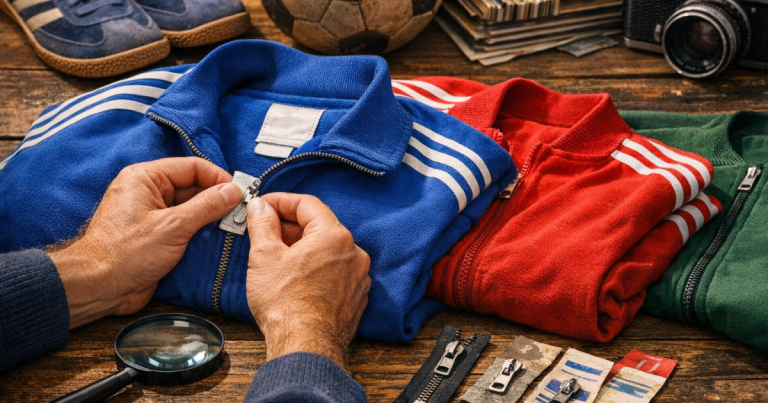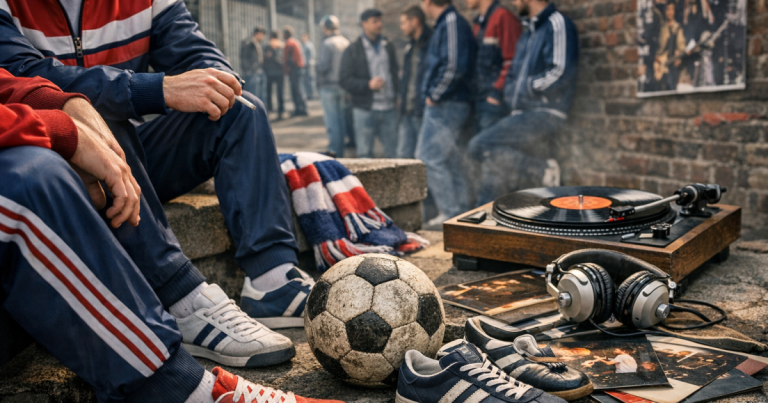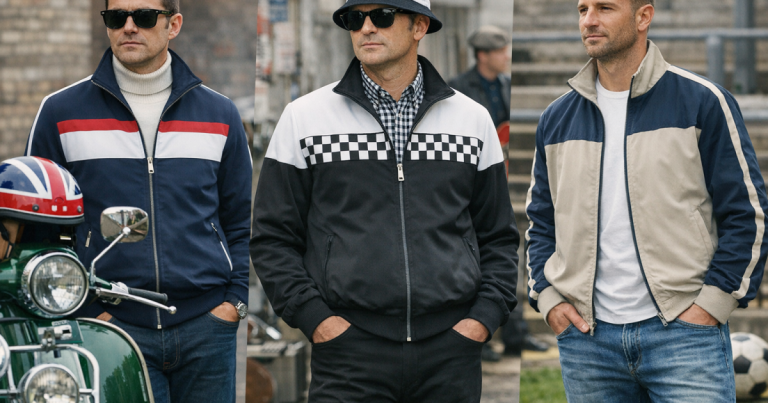
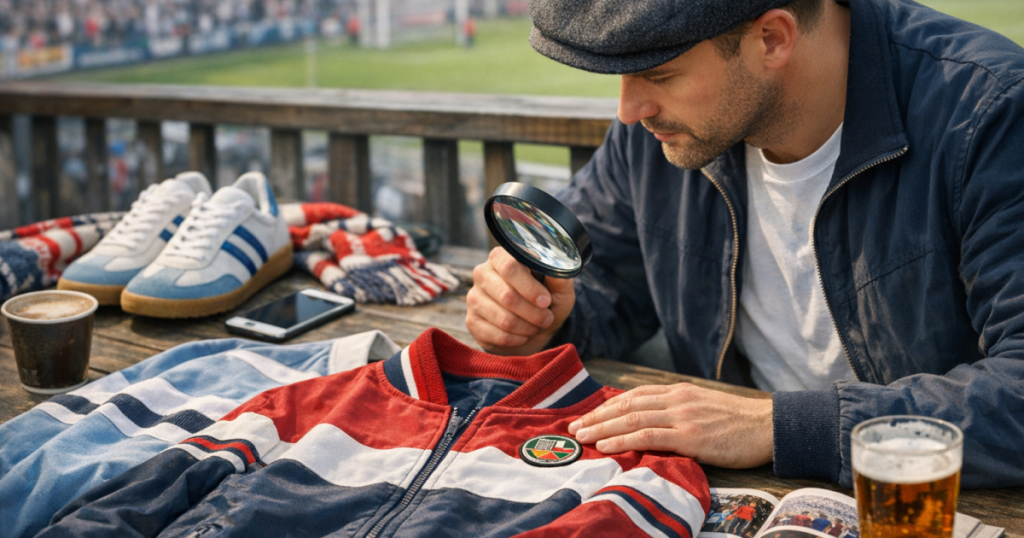
Old terrace photographs reward slow looking. For anyone trying to understand original track tops, cuffs, creases and badge placement, A Casual Look research works best when you treat Gavin Watson’s photodiary as evidence rather than moodboard wallpaper.
The aim is not to copy a lad in a picture head to toe. It is to learn how real clothes sat on real bodies, in British streets, grounds and youth culture moments, then use those observations to read modern retro tracksuit style with sharper eyes.
The short version
- Start with the whole photograph before zooming in on the tracksuit.
- Separate what you can see clearly from what you are guessing.
- Look for fit, fabric behaviour, trims, collars, cuffs, stripes, piping and badge position.
- Compare several images before calling a detail “typical”.
- Use the book to understand wear, attitude and context, not just brand names.
Step 1: Read the scene before the garment
A track top in a Watson photograph is rarely just a track top. It sits in a pub doorway, a bedroom, a street, a coach trip, a front room, or the edge of a match-day social world. That setting tells you how dressed-up the wearer is, whether the kit is being worn for warmth, display, comfort, or a bit of all three.
Before hunting for logos, note the posture, the group, the weather clues and the other clothes in shot. A zipped-up top under a coat reads differently from a half-open track jacket over a polo. A matching full set sends a different signal from a track top worn with jeans and trainers. This wider reading matters because terrace tracksuit culture was never only about buying sportswear; it was about how sportswear was absorbed into everyday British youth style. For wider background on that shift, the history of why tracksuits became British terrace uniforms gives useful context.
Step 2: Build a simple observation system
Do not try to identify everything in one pass. Work through the image in layers, almost like a still-life study. A notebook helps, but a simple phone note is enough if you are consistent.
Use four quick passes
- Silhouette: Is the jacket boxy, slim, cropped, long, blouson-like, or relaxed through the body?
- Surface: Does the fabric look shiny, matte, soft, crinkled, smooth, or heavy? Black-and-white images can mislead, so describe behaviour rather than assuming exact fabric.
- Details: Look at collar shape, zip pull, pockets, ribbed hems, cuffs, sleeve stripes, contrast panels, piping and logo placement.
- Wear: Check whether the piece is pristine, slouched, creased, layered, tucked, zipped, open, or clearly lived-in.
This method stops you jumping straight from “three stripes” to a confident brand call. Terrace dressing depended on detail, but photographs also contain blur, poor light, folded arms and cropped sleeves. A careful reader admits uncertainty.
Step 3: Treat brand clues as evidence, not answers
Brand recognition is part of the pleasure, but it can also become the trap. In older photographs, a logo may be obscured, a sleeve stripe may be partially hidden, or a jacket may resemble a better-known model without being one. Even with adidas, Fila, Sergio Tacchini, Ellesse, Diadora, Kappa or Lacoste Sport in mind, the first rule is to describe before identifying.
Ask these questions in order: can the logo be seen clearly? Is the badge shape readable? Does the collar match the brand language you think you are seeing? Are the sleeve stripes, piping or colour-blocking consistent across the visible panels? Is there a caption or neighbouring image that supports the reading?
The same caution applies when separating casual culture from the broader idea of terrace style. Not every sportswear detail in a football-adjacent photograph automatically means a fully formed casual look. The difference between football casuals and terrace style is worth keeping in mind when you are interpreting what the clothing is doing socially.
Step 4: Focus on fit, because fit dates the look
Modern retro styling often gets the mood right but the fit wrong. Photographs in A Casual Look: A Photodiary of the 1980s Casual, Terrace and Football Scene are useful because they show how garments actually hung rather than how they appear in flat product photography.
Pay particular attention to shoulder width and sleeve length. A track top that sits slightly off the shoulder gives a different period feel from one cut close and neat. Ribbed cuffs can bunch fabric around the wrist, changing how the sleeve reads. Waistbands may sit high, low, loose, or pulled in depending on the wearer and the garment. These are small details, but they are often what separate a convincing retro-casual fit from fancy dress.
Track bottoms deserve the same care. Look at whether the leg is straight, tapered, pooled over trainers, or held by elastic. Check whether the wearer pairs them with matching tops, sports jackets, polos, denim, knitwear or outerwear. The more combinations you note, the less likely you are to reduce the culture to a single uniform.
Step 5: Look for repetition across groups
One photograph can inspire you, but several photographs start to show a pattern. If you notice the same collar shape, sleeve contrast, trainer profile, zip position or way of layering appearing again and again, you have a stronger clue that the detail belonged to a broader code rather than one person’s accident of dress.
Work in clusters. Compare lads standing together, then compare similar garments across different pages. Are track tops being worn open with polo collars showing? Are full sets common, or are separates doing more work? Are trainers clean and low-profile, or chunkier and more visible? Are caps, bags or coats changing the meaning of the tracksuit underneath?
This is where the book becomes more than nostalgia. It helps you notice social rhythm: who is dressed similarly, who is pushing the look further, and who is blending sportswear with ordinary everyday clothing. Terrace style was built through repetition, one-upmanship and local taste, not through a single official rulebook.
Step 6: Cross-check against modern reissues carefully
Once you have gathered details from the photographs, you can use them to assess modern retro sportswear more intelligently. Do not ask whether a current track jacket is “authentic” in a vague sense. Ask which details it echoes: collar, sleeve stripe, contrast panel, fit, fabric handle, ribbing, logo scale, pocket shape, or overall attitude.
A current adidas Originals full set, a court-heritage Sergio Tacchini top, or a Fila-style track jacket may carry archive energy without matching any exact photograph. That is fine if you know what you are borrowing. The mistake is to treat every retro-branded item as equally terrace-coded. Some pieces lean gym, some lean tennis, some lean football, some lean rave, and some simply borrow a badge without the same shape or stance.
Use your notes to decide what matters for the outfit you are building or interpreting. If the photograph that drew you in was all about a sharp collar under a jacket, a modern full tracksuit may not recreate that feeling. If the attraction was the clean line of a matching set, separates may dilute it. This is not shopping advice; it is a way of keeping the culture visible when modern clothes enter the conversation.
Step 7: Avoid the common reading mistakes
- Over-identifying brands: A blurred badge is not proof. Mark it as possible, not certain.
- Ignoring ordinary clothes: Jeans, polos, jumpers and coats often explain the look as much as the track top.
- Assuming every image is match-day: The culture moved through homes, streets, clubs, travel and everyday life.
- Flattening the era: Details changed across years, towns, scenes and friendship groups.
- Copying without translating: A faithful modern outfit needs proportion and restraint, not just a stack of visible logos.
A quick research routine you can repeat
Choose one photograph and spend five minutes on it. First, write one sentence about the scene. Then list every visible tracksuit detail without naming a brand. Next, note the supporting clothes: trainers, polo, jacket, denim, cap, bag or knitwear. Finally, decide what you can say confidently, what is only probable, and what remains unknown.
After doing this with five or six images, compare your notes. You should begin to see your own pattern library: common fits, recurring combinations, frequent mistakes in modern recreations, and small styling choices that feel genuinely British rather than generically retro.
For a deeper companion method, the site’s piece on reading A Casual Look for terrace style cues is a useful next step once you have started building your own observations.
Things readers ask
Is A Casual Look mainly useful for identifying brands?
No. Brand spotting is only one part of it. Its real value is showing fit, layering, posture, social context and how sportswear was worn away from studio styling.
Can I use black-and-white photos to judge tracksuit colours?
Be careful. Black-and-white images can suggest contrast, shine and panel placement, but they cannot reliably confirm exact colour. Use captions, other images and known archive references where possible.
What detail should beginners look for first?
Start with silhouette. Jacket length, shoulder position, sleeve shape and trouser cut usually tell you more about the period feel than a half-seen logo.
Does a modern reissue need to match the old photographs exactly?
No. It only needs to carry the details you care about clearly. A good modern interpretation may echo the collar, fit or layering logic without being a replica.
How many photos should I compare before trusting a pattern?
Three or four similar examples are a stronger basis than one striking image. The more often a detail appears in different settings, the more meaningful it becomes.
What stands out
Using Watson’s photographs well means slowing down. The details that matter are not always the loudest ones: a cuff pulled over the wrist, a zip left at chest height, a polo collar sitting under a track top, or a pair of trainers changing the balance of the whole outfit.
That is why the book remains so valuable for terrace tracksuit research. It shows clothing in use, not as costume. Read it patiently and it gives you a sharper eye for the culture, the garments and the modern retro pieces that genuinely carry the old codes forward.