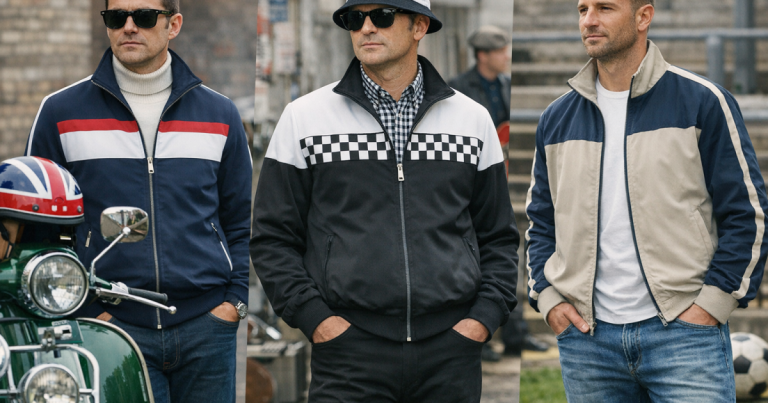
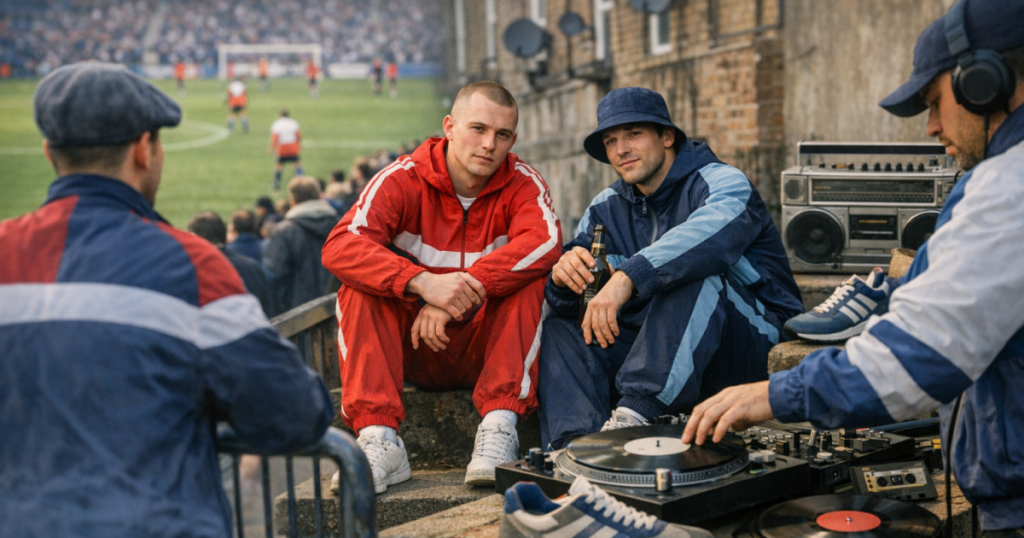
A British tracksuit is never just a warm-up layer. It can signal football allegiance, music taste, regional identity, era knowledge and, sometimes, a careful decision not to say too much. The story of tracksuit culture in Britain sits at the meeting point of terraces, nightclubs, high streets and youth style: practical clothing turned into a visual language.
That language is easy to misunderstand if it is reduced to stereotypes. The best way to read it is through context: who wore what, where they wore it, and why certain colours, logos and silhouettes carried more meaning than others.
The short version
- Football terraces helped make tracksuits visible, competitive and status-driven, especially through awaydays and imported sportswear.
- Music scenes gave the look movement: post-punk, indie, rave, hip-hop, Britpop and later grime all shifted how track tops and trainers were worn.
- Street style made the tracksuit less literal. Pieces were mixed with polos, denim, knitwear, wax jackets, caps and smarter trainers.
- Era details matter. Fabric, fit, collar shape, zip style, colour blocking and logo placement can tell you whether a look leans 1970s, 1980s, 1990s or 2000s.
- The modern version works best when it respects the references without copying them head to toe.
Why football gave the tracksuit its British charge
The tracksuit entered British life through sport, but football gave it a sharper social meaning. On the pitch, it was functional teamwear. On the terraces, it became a way of showing knowledge, taste and nerve without wearing a scarf or replica shirt. The appeal was partly practical: a track top could handle cold concourses, train journeys and long Saturdays. But it also had the right mix of casual ease and visual impact.
From the late 1970s onwards, young supporters increasingly looked beyond obvious club colours. European sportswear, tennis labels, ski-inspired outerwear and continental trainers became part of the code. A jacket did not need a badge to feel football-connected; in some circles, subtlety was the point. For more background on how the garment became bound up with the matchday crowd, read why tracksuits became British terrace uniforms.
There is also a regional layer. Liverpool, Manchester, Glasgow, London, Birmingham, Leeds and Newcastle all developed their own mixtures of football dress, music influence and high-street adaptation. No single city owns the story. What connects them is the way supporters used clothing to mark belonging while still competing over detail.
Music made the tracksuit move differently
Football gave the tracksuit status; music gave it rhythm. In Britain, the same garment could mean very different things depending on the sound around it. A zipped-up track top at a post-punk gig carried a different mood from a loose shell suit at a rave, a clean sportswear set in a Britpop crowd, or a darker, sharper track jacket in a grime-adjacent streetwear look.
Post-punk and new wave helped strip sportswear of pure athletic meaning. The tracksuit could look stark, working-class, awkward, stylish and anti-glamour all at once. By the rave era, synthetic sportswear made even more sense: bright colours, lightweight fabrics and relaxed shapes fitted warehouses, fields and service-station journeys. Britpop then brought a more laddish, football-aware version into the mainstream, where adidas, Umbro, track tops and retro trainers became part of the national visual furniture.
Hip-hop and later grime added another set of meanings. The tracksuit became sharper, more urban and more directly connected to street identity. Full sets, caps and trainers could look disciplined rather than lazy. That matters, because one of the lazy clichés around tracksuits is that they are only about slouch. In the best British examples, they are usually about control: fit, colour, logo balance and the confidence to look casual without looking careless.
Street style turned uniform into a toolkit
The most interesting British tracksuit outfits are rarely just full kit. The culture developed because people mixed things: a track top with denim, track pants with a knit, a sports jacket under a waxed coat, a polo shirt beneath a zip-neck, trainers chosen for a particular decade rather than whatever was newest.
That is where the look becomes street style rather than costume. A 1980s-inspired outfit might use a tricolour track jacket, straight-leg jeans and leather trainers. A 1990s look might lean into fuller shapes, bolder colour blocking and heavier trainer silhouettes. A 2000s influence might bring in caps, technical outerwear and more obvious branding. A pair like the Nike Air Max 90 can point towards a different streetwear mood from a slimmer terrace trainer, so the trainer choice changes the whole read of the outfit.
The same is true of accessories. A cap can make a tracksuit look more streetwear-led, while a knitted polo or plain overshirt can calm it down. Something as simple as a New Era 9Forty Cap may work in a modern casual outfit, but it will shift the reference away from classic 1980s terrace minimalism and towards a more contemporary high-street sportswear frame.
How to read the eras without guessing
Era knowledge is a major part of the appeal. People often talk about “retro tracksuits” as though everything old-looking belongs together, but the differences are obvious once you know where to look. A 1970s top usually feels neater and sportier, with a closer fit and less exaggerated branding. The 1980s brought stronger colour blocking, bolder panels and a sharper relationship with casual culture. The 1990s widened the silhouette and made logos, football influence and streetwear energy more visible. The 2000s often pushed shinier fabrics, larger branding and a more obvious leisurewear identity.
Fabric is one of the fastest clues. Brushed polyester, shiny tricot, nylon shells and heavier jersey all create different silhouettes. Collars matter too: funnel necks, ribbed collars, mock necks and stand collars each point to a different mood. Even zip pulls, cuffs and hem shapes can help date a piece. If you want a deeper checklist, the site’s guide to telling 1970s, 1980s, 1990s and 2000s tracksuits apart is the useful next stop.
Modern reissues complicate the picture, often in a good way. A current Adidas Originals Superstar Tracksuit can give a recognisable heritage outline without the uncertainty of vintage condition, sizing or fabric ageing. It should still be judged on its own terms: fit, colour, logo size and how naturally it works with the rest of your wardrobe.
The logos are never just decoration
Logo placement is one of the biggest dividing lines in British tracksuit style. Some looks depend on obvious branding: the trefoil, the ellesse semi-palla, the Fila F-box, the Kappa Omini, the Le Coq Sportif triangle. Others rely on low-key recognition, where only people who know the cut or colourway will catch the reference.
Too many logos can flatten the outfit. A loud track top, branded track pants, logo cap and statement trainers all at once can feel like a display cabinet. One strong mark usually works better when the rest of the outfit gives it space. This is especially important with terrace-inspired dressing, because the tradition often values knowledge over shouting. The practical rule is simple: decide which piece is speaking loudest, then let the others support it.
For a more detailed approach to this part of the look, use the guide on balancing logos in a terrace style outfit.
Two competing readings: heritage or cliché?
There are two common mistakes when discussing British tracksuit culture. The first is romanticising everything: treating every track top as a sacred relic of terraces, record shops and weekend trains. The second is dismissing the whole thing as cliché: a uniform of hooligan films, lazy tabloid imagery and nostalgia merchants.
The truth sits between the two. Yes, tracksuits are bound up with football-casual history, including parts of that history people may not want to celebrate. But they are also tied to ordinary working-class pride, youth creativity, immigrant influence, music scenes, sports participation and the British habit of turning functional clothes into subcultural codes. A tracksuit can be loaded, but it is not automatically a caricature.
That is why careful styling matters. Wearing a retro track top today is less about pretending to be on an awayday in another decade and more about understanding proportion, colour and reference. The most convincing modern outfits borrow the intelligence of the old looks rather than copying the full mythology.
Why it still matters in 2026
The reason the tracksuit keeps returning is that it solves several British style problems at once. It is comfortable without being invisible. It works with trainers. It can be smartened slightly or worn loose. It carries football and music references without needing a slogan. It also suits the climate better than people admit: a track top is ideal for spring layers, summer evenings and autumn trips when a heavy coat feels wrong.
It also offers a route into clothing knowledge. Once you start noticing why one track jacket feels terrace, another feels gymwear, and another feels festival-ready, you begin reading clothes more carefully. Colour, cloth, proportion and context become more important than hype. That is the real value of the culture: it trains the eye.
Questions people ask
Is British tracksuit culture only about football casuals?
No. Football casuals are central to the story, but music, dance culture, youth clubs, high streets, council-estate style, sports participation and regional identity all shaped how tracksuits were worn.
Can a full tracksuit still look good today?
Yes, but it needs intention. Keep the fit controlled, choose trainers that match the era or mood, and avoid piling on too many competing logos or colours.
What is the easiest way to avoid looking like fancy dress?
Break the set up. Wear the track top with denim, chinos or a plain polo, or wear track pants with a simple jacket. One retro reference is usually stronger than five.
Which colours feel most connected to terrace style?
Navy, burgundy, forest green, stone, cream, red, royal blue and black all have strong roots. The key is how they are combined, not just the colour itself.
Are vintage tracksuits better than reissues?
Not automatically. Vintage has character and era accuracy, while reissues can be easier to wear and care for. Condition, fit and fabric matter more than age alone.
Key takeaways
Tracksuits became culturally powerful in Britain because they moved between worlds: football grounds, clubs, estates, record sleeves, pubs, trains and high streets. They were never only sportswear, and they were never only nostalgia. The strongest looks still come from understanding that movement.
If you want to wear the style now, start with context rather than costume. Choose an era, keep the colours disciplined, let one logo lead, and make sure the trainers support the reference. That is where the British tracksuit stops being a throwback and becomes a living part of street style.