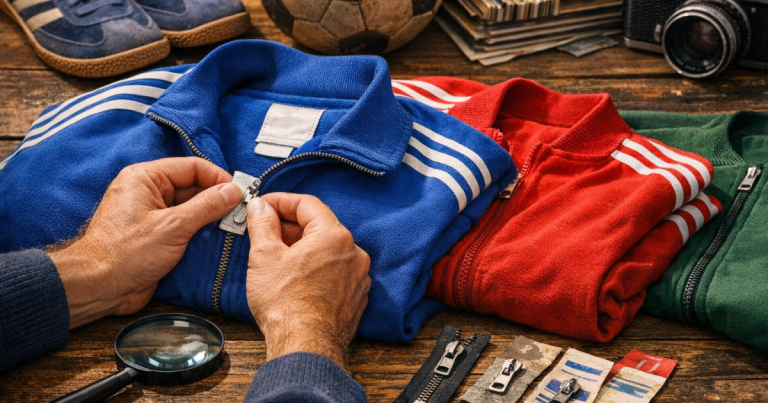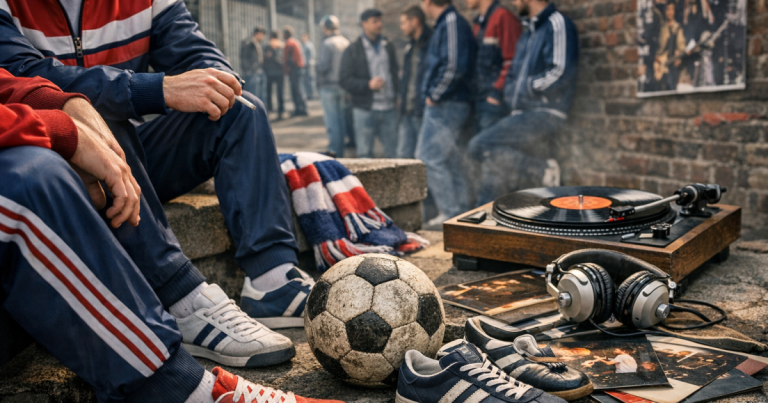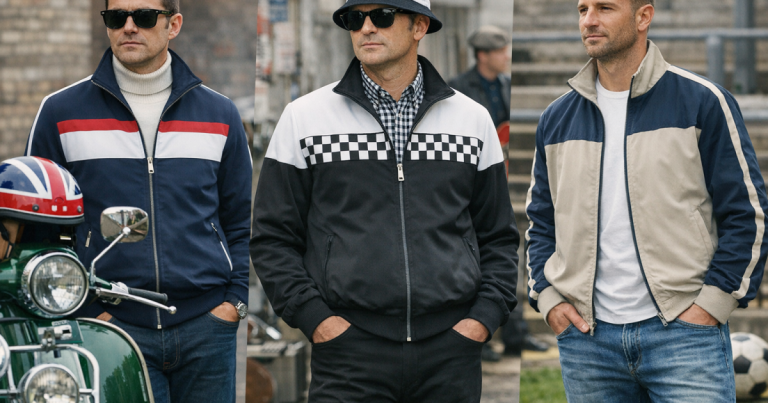
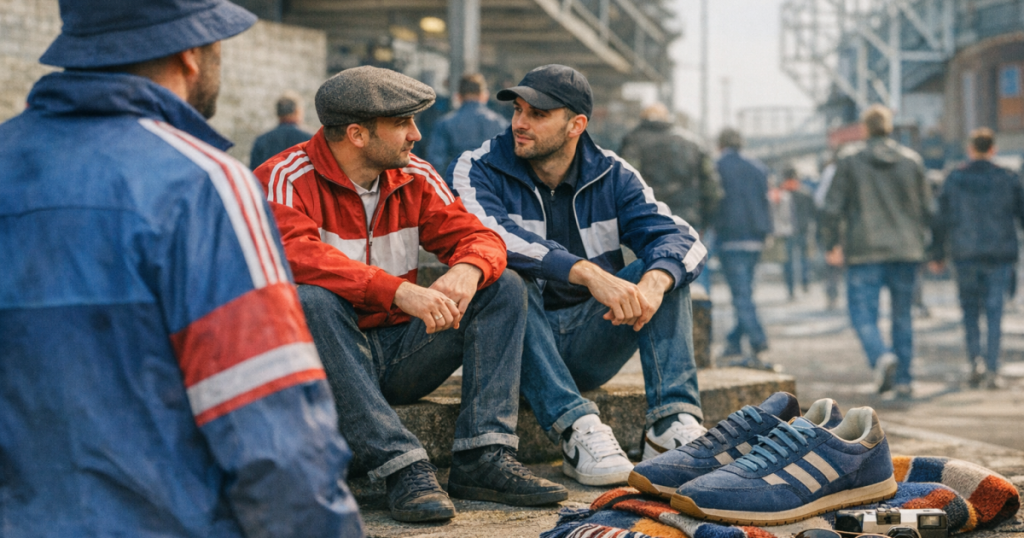
Football casuals did not invent sportswear, but they gave it a British street code: sharper, rarer, and loaded with away-day meaning. The retro tracksuit revival makes most sense when you read it through that code, not just through nostalgia for old logos.
What came back was not only nylon sheen, funnel necks and embroidered badges. It was a way of judging clothes by context: where they were worn, who recognised them, and whether they looked natural rather than staged.
What to know first
- Football casuals helped turn European and American sportswear into status clothing on British terraces.
- The tracksuit revival is about memory, fit, colour and subcultural fluency, not just wearing a matching set.
- Brands such as adidas, Sergio Tacchini, Fila, Ellesse, Diadora, Lacoste, Kappa and Nike all carry different terrace associations.
- modern wearability depends on restraint: one strong archive-style piece usually says more than a head-to-toe costume.
- The most credible looks still borrow from real matchday culture, music scenes and regional taste rather than social-media fancy dress.
The casuals code: sportswear as social language
The casuals movement made tracksuits matter because it treated them as coded objects. A track top was not simply gym wear. It could suggest travel, contacts, taste, disposable income, nerve, or belonging to a particular crowd. On the terraces, small differences counted: the cut of a collar, the shade of a sleeve panel, the rarity of a badge, or whether a piece looked newly discovered rather than widely available.
That culture grew around football travel, especially when British fans encountered continental sportswear in Europe. Italian tennis labels, French crocodiles, German training gear and American running silhouettes entered a British football context and took on new meanings. for a broader chronology of how the look moved through brands, fits and terrace codes, the football casuals style timeline is the natural next step.
By the time the look became part of wider youth culture, the tracksuit was no longer just a leisure item. It had been reclassified by use: worn on trains, in pubs, under jackets, in grounds, at clubs and on estates. That is why the retro tracksuit revival has always carried more weight in Britain than a simple vintage sportswear trend.
Why track tops became easier to revive than full tracksuits
The modern return of casuals-influenced sportswear has been led by track tops more than full matching sets. A track jacket can sit with jeans, cords, technical trousers, an overcoat or a wax jacket without demanding that the whole outfit behaves like an archive photograph. It gives the reference without making the wearer look as if they are dressing for a themed night.
full tracksuits still have their place, especially when the silhouette is clean and the colourway is understated. But in ordinary British settings, the track top is the more adaptable survivor. It works at the football, in the pub, on a city weekend, or as a light layer in spring and autumn. That flexibility has helped old terrace pieces translate into present-day wardrobes.
The brands that benefited most are the ones with strong visual memory. adidas has the trefoil, three stripes and a deep football-training lineage. Sergio Tacchini and Fila carry tennis-club glamour filtered through British terrace taste. Ellesse brings Italian sport branding and bold colour blocking. Nike’s Windrunner shape has its own running-meets-street identity. Even when modern pieces are not exact reissues, those shapes trigger recognition.
Music, film and photography kept the look alive
Football built the code, but music and visual culture kept it circulating. Indie, acid house, rave, Britpop, garage and later casual-revival scenes all borrowed from sportswear in different ways. A track jacket could look laddish, dancefloor-ready, nostalgic, regional, stylish or deliberately anti-fashion depending on what sat around it.
Photography matters here because casual style was never only about catalogue images. It was about how clothes moved through real life: platform shots, away-day crowds, youth-club poses, estate walls, club queues and Sunday-league sidelines. Gavin Watson’s work is often discussed because it captures that lived quality without turning the clothes into museum exhibits. The review of A Casual Look by Gavin Watson is useful if you want to see how much of the appeal comes from attitude, not pristine styling.
Film and television also helped flatten and spread the image, sometimes usefully and sometimes crudely. The danger is that casuals style gets reduced to a caricature: a shiny top, a scowl, and a pair of trainers. The better reading is more nuanced. The clothes were aspirational, competitive, practical and tribal at the same time.
Brand meaning: why one badge does not equal another
Part of the retro tracksuit revival comes from the fact that different brands carry different emotional signals. adidas often reads as football-adjacent and familiar, but certain archive-inspired cuts still feel sharp rather than obvious. Sergio Tacchini suggests tenniswear adopted by terrace culture, especially when the colour palette is cream, navy, burgundy, green or deep red rather than loud novelty tones. Fila and Ellesse can feel more flamboyant, particularly through panelled tops and big chest branding.
Nike occupies a slightly different lane. Pieces such as the Windrunner point towards running, American sportswear and later streetwear, but they still fit British casual language when styled with restraint. Diadora brings an Italian football and tennis connection that feels slightly more insider than mainstream. Lacoste Sport works best when the mood is clean, preppy and understated.
For modern readers, the point is not to memorise a hierarchy and police everyone else’s jacket. It is to understand why some pieces feel historically grounded while others only imitate the surface. A believable outfit usually has one clear reference, natural proportions and a setting where it makes sense.
The revival changed the fit
Original terrace style was not frozen in one silhouette. Fits shifted with eras, regions and brands. Some track tops were boxy and cropped, some were slim, some had generous sleeves, and some were worn oversized because that was what was available or desirable at the time. Modern reissues and archive-inspired pieces often adjust those shapes for current bodies and tastes.
That creates a tension. Vintage originals can have the best patina and most authentic details, but they may be fragile, awkwardly sized, or difficult to replace. Modern versions are usually easier to wear and care for, but can lose some of the oddness that made the originals interesting. Neither route is automatically better. The strongest revival looks tend to mix old and new: an archive-style track top with contemporary denim, a plain polo under a bolder jacket, or modern trainers that echo a terrace era without pretending to be deadstock.
As practical references, an Adidas Originals Superstar Tracksuit shows how a familiar sportswear shape can remain wearable, while Nike Air Max 90 trainers show how later trainer culture can sit alongside track tops without copying an early casuals look too literally. The key is proportion and context, not buying a uniform.
Why Britain received the revival differently
In Britain, retro tracksuits carry football memory in a way that is hard to separate from class, place and weekend routine. The same jacket can mean something different in Liverpool, Glasgow, Manchester, Leeds, London or the Midlands because local scenes absorbed different brands at different moments. Availability, local shops, club travel, music venues and friendship groups all shaped what looked right.
That regional layer explains why terrace style often resists neat fashion storytelling. It was not one national outfit issued at the turnstile. It was a loose set of codes interpreted through local pride and rivalry. Modern revival pieces work best when they respect that looseness. Too perfect can look false; too random can look like a costume rail.
There is also a British weather point that rarely gets enough credit. Lightweight shells, track tops, polos, knitwear and trainers suit the stop-start reality of matchday: train, pub, walk, ground, queue, rain, repeat. Tracksuit culture survived because it was visually strong but also practical enough for actual weekends.
The problem with nostalgia-only dressing
The weak version of the retro tracksuit revival is pure nostalgia: buy a famous logo, add obvious trainers, call it casuals. That misses the intelligence of the original scene. Casuals style was about selection. It rewarded people who noticed detail and understood timing. A jacket that looked fresh in one town might look played out in another. A rare European piece could say more than the loudest item in the room.
Modern dressing needs that same selectiveness. If the track top is bold, keep the rest quieter. If the trainers are the statement, let the jacket be calmer. If you are wearing a full tracksuit, avoid piling on every other terrace signifier at once. The aim is to look like you own the reference, not like the reference owns you.
That is where current readers can take something useful from the culture without pretending to be part of a scene they did not live through. The lesson is not to cosplay an away end from a different decade. It is to use sportswear with confidence, memory and restraint. For practical styling boundaries, dressing terrace without looking like fancy dress covers the difference between influence and imitation.
What still feels credible now
- One archive-style centrepiece: a track top, shell jacket or polo can carry the reference without making the outfit shout.
- Era-aware trainers: choose footwear that suits the mood rather than defaulting to the most hyped pair.
- Muted layering: navy, stone, grey, burgundy, forest green and off-white often age better than novelty colours.
- Natural wear: terrace clothing should look lived in, not overly styled or precious.
- Regional curiosity: old photos, books and matchday memories reveal more than brand marketing alone.
If you want a deeper read on the wider culture around football, music and street style, tracksuit culture in Britain sets the revival in a broader social frame.
Questions people ask
Did football casuals start the tracksuit trend in Britain?
They did not start sportswear in Britain, but they changed how it was read. Casuals helped make tracksuits and track tops status-led, style-conscious and tied to football identity.
Is terrace style only about adidas?
No. adidas is central, but Sergio Tacchini, Fila, Ellesse, Diadora, Lacoste, Kappa, Nike and others all have strong places in the wider casuals story.
Can a modern reissue be credible?
Yes, if the shape, colour and styling feel grounded. A modern reissue can be more wearable than a fragile vintage original, especially for regular use.
How do you avoid looking like fancy dress?
Keep the outfit balanced. Wear one or two strong references, avoid overloading logos, and mix retro sportswear with normal contemporary pieces.
Why do old casuals photos matter so much?
They show how clothes were actually worn: fit, attitude, setting and combinations. That real-life context is more useful than polished product shots alone.
Final thoughts
Football casuals shaped the revival by giving tracksuits a language. They showed that sportswear could be competitive, local, stylish, practical and quietly coded. That is why the return of retro track tops and matching sets still feels culturally charged rather than merely decorative.
The best modern approach is not to recreate the past perfectly. It is to understand why the past looked good: sharp choices, regional flavour, useful layers, confident restraint and an eye for the small details that separate a proper look from a pile of famous logos.