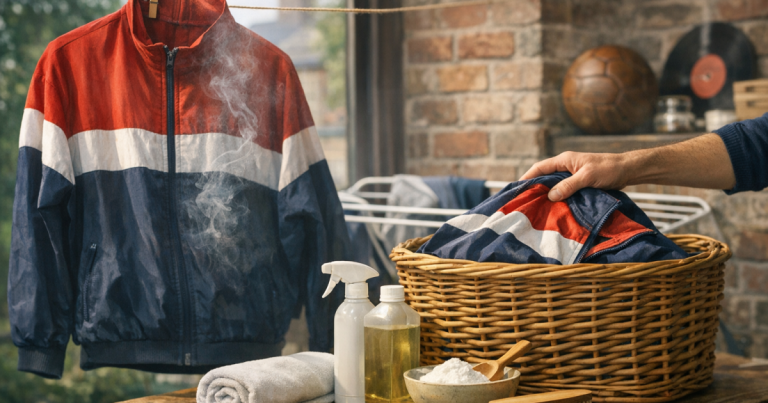
A nylon track jacket can look sharp straight from the rail, then crease the moment it is stuffed into a pub booth, rucksack or away-day holdall. The trick is to remove creases from a nylon track jacket without flattening the texture, glazing the surface or melting the fibres. Treat it gently and the jacket keeps that light, crisp terrace shape instead of looking boiled and tired.
Nylon is tough in the right conditions, but it is not fond of careless heat. That matters whether you are looking after a modern reissue, an old shell top, or a lightweight terrace jacket you actually wear between drizzle, trains and match-day crowds.
The safe short version
- Hang the jacket first and let gravity do some of the work before using heat.
- Use steam before an iron. Steam relaxes creases with less direct pressure on the fabric.
- Keep heat moving and keep distance between the steamer and the jacket.
- Never press directly over printed logos, heat-applied badges, taped seams or shiny panels.
- Only iron nylon if the care label allows it, and always use a pressing cloth on the lowest suitable setting.
Why nylon creases differently
Nylon track jackets are usually built for lightness, weather resistance and movement rather than formal tailoring. The fabric can spring back well from mild rumpling, but sharp folds can set in when the jacket is compressed in the same position for hours. That is why a jacket pulled from a drawer often has horizontal lines across the body, crushed sleeves, or a bent collar.
The other issue is heat sensitivity. Nylon is a synthetic fibre, so too much heat can create shine, rippling or permanent distortion. A heavy cotton overshirt can take more aggressive ironing; a nylon terrace jacket needs restraint. The aim is to relax the crease, not press the life out of the cloth.
If you are unsure whether your jacket is nylon, polyester, a blend or a coated shell, check the care label before doing anything. Fabric choice also affects how a jacket behaves in rain and humidity, so it is worth reading more on choosing retro tracksuit fabric for British weather if you wear these pieces regularly.
Step 1: Start with hanging and reshaping
Before steaming or ironing, hang the jacket on a broad hanger. Do not use a thin wire hanger, as it can create shoulder points and make the jacket hang badly. Fasten the zip, straighten the hem, smooth the sleeves down by hand and make sure the collar sits in its natural position.
Leave it somewhere with airflow for a few hours, or overnight if the creases are only light. A lot of nylon jackets recover surprisingly well once they are not crushed under other clothes. This is the lowest-risk method, and it should always come before heat.
Step 2: Use bathroom steam for light creases
For mild folds, bathroom humidity can be enough. Hang the jacket away from direct water spray while you run a warm shower, then leave it in the steamy room for around 10 to 15 minutes. Afterwards, move it to a well-ventilated space and smooth the fabric gently with clean hands.
Do not soak the jacket. You want warm humidity, not a wet garment. This method is useful when you are getting ready quickly and do not want to risk a direct iron mark on a jacket with old-school shine, contrast piping or printed branding.
Step 3: Steam the jacket properly
A handheld garment steamer is often the best tool for stubborn but ordinary creases. A model such as the Philips 3000 Series Handheld Garment Steamer or Tefal Access Steam Easy can be useful for synthetic sportswear, but always check the jacket label and the steamer instructions rather than assuming every nylon shell can be treated the same way.
Hang the jacket, fill the steamer as directed, and wait until the steam output is steady. Hold the steamer a short distance from the fabric rather than clamping it flat against the nylon. Work from the top down, using slow vertical passes. Keep your other hand below the area being steamed to hold the fabric lightly taut, but do not pull hard enough to distort seams or elastic.
Pay attention to areas that naturally crease: the lower front panels, inner elbow, pocket edges and collar. For sleeves, put a rolled towel inside the sleeve so it has shape while you steam. This stops the fabric collapsing into new folds as soon as the steam hits it.
Step 4: Use an iron only with care
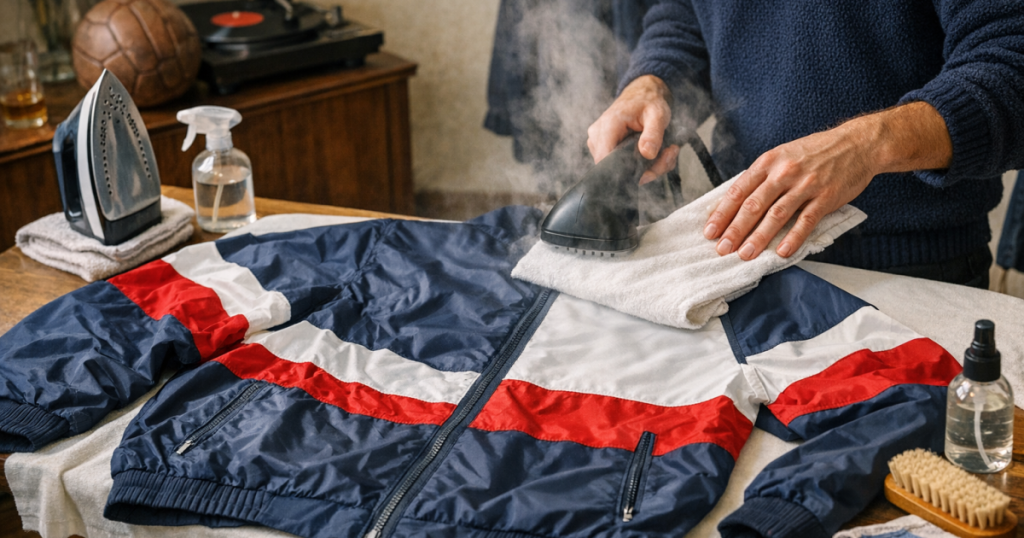
An iron is the last resort, not the first move. If the care label says not to iron, do not iron. If ironing is allowed, turn the jacket inside out where possible, place a clean cotton pressing cloth between the iron and fabric, and use the lowest suitable synthetic setting. Do not use heavy pressure.
Press briefly, lift the iron, and check the result. Avoid sliding the iron across nylon as if you were ironing a shirt. Sliding can stretch seams, drag linings and create shiny patches. Keep well clear of embroidered badges, printed chest logos, reflective details and any bonded or taped areas.
Step 5: Deal with sharp fold lines
Deep storage folds need patience. Steam the crease lightly, let the fabric cool, then repeat. Do not blast one line with high heat in the hope it disappears faster. The crease formed gradually under pressure, and the safest fix is also gradual.
For a fold across the chest or back, hang the jacket zipped up and place a clean towel inside to support the panel. Steam from the outside, then leave it hanging until fully cool and dry. Cooling time matters because synthetic fibres can take a set while warm. If you shove the jacket straight back into a wardrobe, the crease can return.
What not to do
- Do not put a hot iron directly onto nylon.
- Do not use starch or heavy crease-release sprays unless the care label and product instructions clearly suit synthetic sportswear.
- Do not tumble dry unless the garment label explicitly allows it.
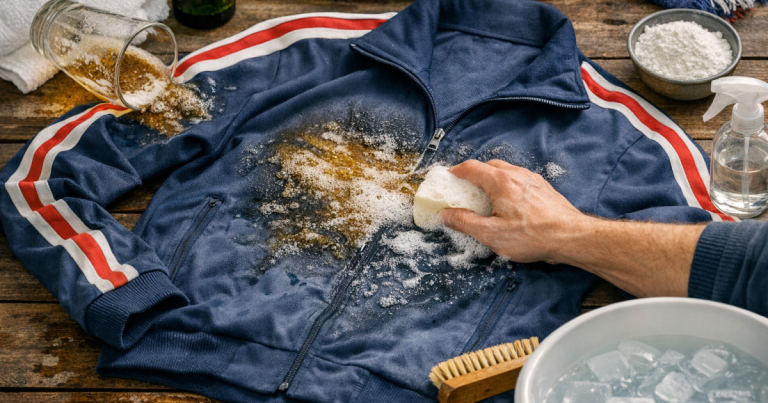
- Do not steam over beer, mud or food marks; heat can help stains settle.
- Do not hang a damp jacket in a packed wardrobe, as trapped moisture can leave odours and odd shaping.
If the jacket picked up a drink mark before it creased, clean that first. Heat and residue are a poor combination, so use the stain advice in getting beer spills out of a track jacket before you start steaming.
Crease clues: what the marks tell you
Soft ripples
These are usually from normal wear or light packing. Hanging, bathroom steam or quick garment steaming should be enough.
Hard horizontal fold
This usually means the jacket has been folded tightly in a drawer or bag. Steam, support the panel from behind, and repeat rather than increasing heat.
Shiny flat patch
This can be a sign of previous heat or pressure damage. You may improve the surrounding creases, but the shine itself may not disappear. Avoid pressing that area again.
Crushed elastic cuff or hem
Steam around it carefully without stretching. Elastic and heat are not a great pairing, so keep the steamer moving and let the trim cool naturally.
How to stop the creases coming back
Storage does most of the work. Hang nylon track jackets rather than folding them tightly, especially if they have a smooth shell finish. Give each jacket enough space so the sleeves are not trapped at awkward angles. If you must fold one for travel, fold along natural seams, avoid hard compression, and unpack it as soon as you arrive.
After wet weather, let the jacket dry fully on a hanger before it goes back into a wardrobe. British match-day weather is not kind to lightweight shells: rain, warm trains, crowded pubs and cold air all work the fabric in different ways. A jacket chosen for pub-to-ground wear should be easy to air out and reshape, which is why the advice on picking a track jacket for pub-to-ground wear is useful beyond styling alone.
For longer-term storage, avoid vacuum bags for nylon jackets you care about. They save space, but the compression can create hard folds that take more work to relax. A breathable garment cover is kinder if the jacket is vintage, rare or part of a carefully built terrace wardrobe.
Questions people ask
Can you steam a nylon track jacket?
Usually, yes, if the care label permits steaming or gentle heat. Keep the steamer moving, hold it slightly away from the fabric, and avoid logos, prints and bonded details.
Can you iron nylon safely?
Only if the care label allows it. Use the lowest suitable setting, place a clean cotton cloth between iron and jacket, and lift rather than drag the iron.
Why has my nylon jacket gone shiny?
Shine is commonly caused by too much heat or pressure. It can be difficult to reverse, so focus on preventing further damage by avoiding direct ironing.
Should I steam the jacket inside out?
Inside-out steaming can help protect outer details, but it depends on the lining and construction. If the outer shell needs treatment, use gentle steam from a distance.
Is it better to wash the jacket before removing creases?
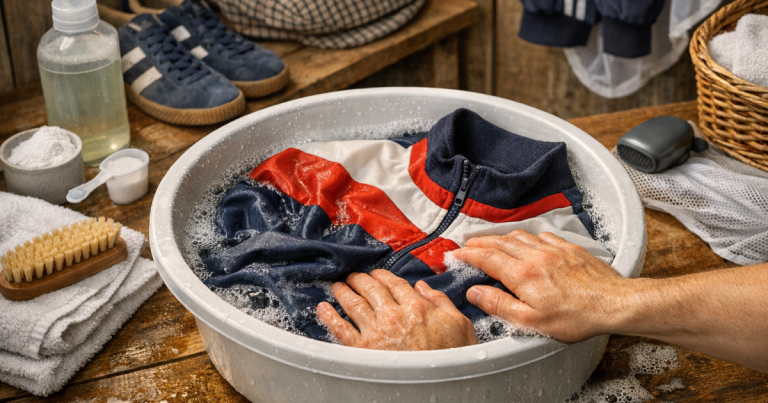
Only wash it if it is dirty or smells stale. For clean creases, hanging and steaming are usually kinder than a full wash cycle.
The big picture
A nylon track jacket does not need aggressive treatment to look right. Hang it properly, use humidity first, steam with patience, and treat the iron as a controlled last step. That approach keeps the shape, sheen and casual sharpness intact, whether the jacket is a modern reissue or an older piece with a bit of terrace history in the seams.