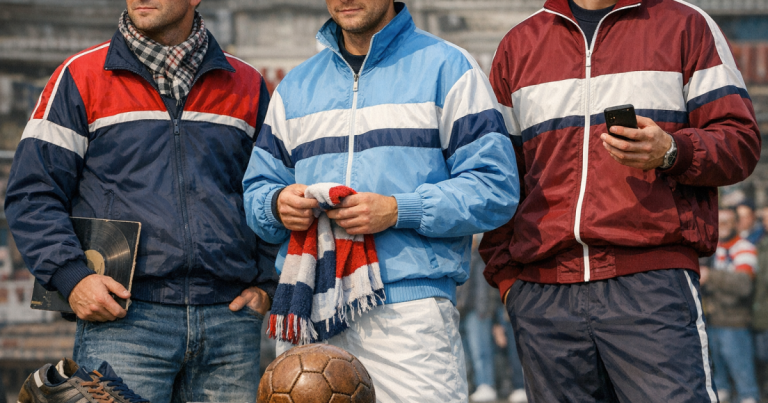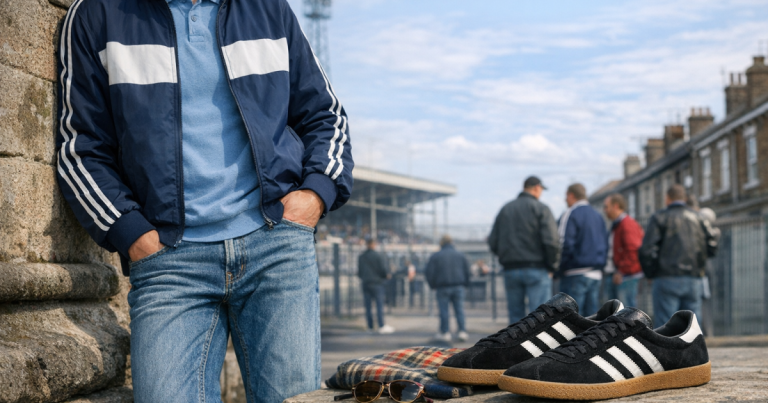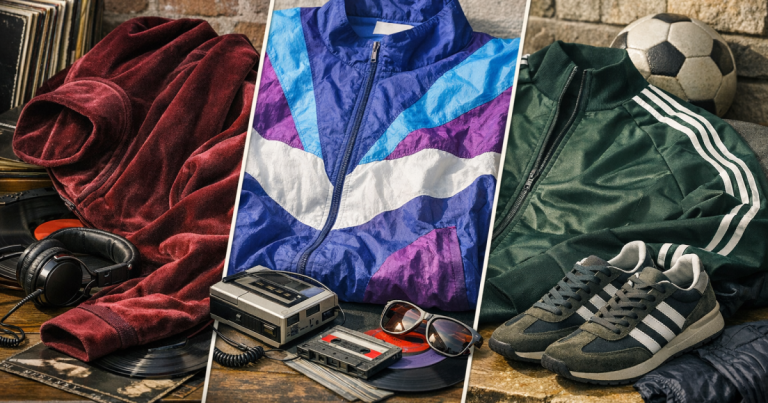
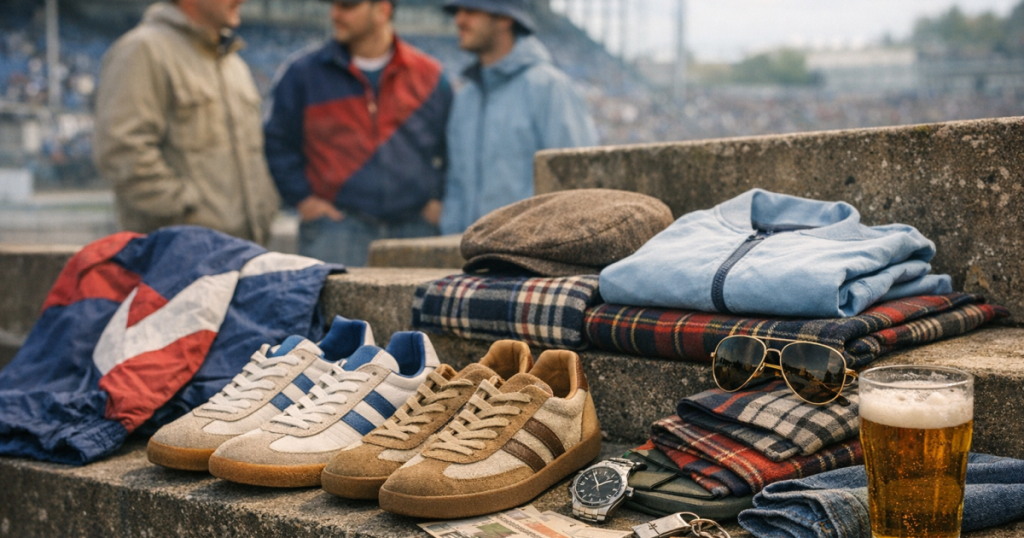
The appeal of football casuals style is that it was never just a uniform. It was a moving code: away-day finds, continental sportswear, regional taste, pub talk, music, rivalry and one-upmanship stitched into clothes. Getting the timeline right helps you avoid the two common mistakes: treating every track top as the same, or dressing like a period drama extra when you only wanted a sharp terrace-informed outfit.
Main points
- The look shifted by decade: smarter tennis and leisurewear in one moment, louder shells and full tracksuits in another.
- Brand credibility came from context, scarcity, fit, colour and who wore it, not just a logo on the chest.
- Regional scenes mattered. Liverpool, Manchester, London, Glasgow and other football cities did not all dress identically.
- Modern wearability depends on restraint: one strong archive cue, current proportions and clean trainers usually work better than a full replica outfit.
Before the labels: late 1970s foundations
The casuals look did not appear fully formed. Late 1970s football crowds were already moving away from obvious scarves and club colours towards clothes that carried a different type of signal. Sportswear, knitwear, straight-leg denim, smart trainers and imported pieces became part of the language. The shift was practical as well as stylistic: less visible allegiance, more status, more movement, and a sharper sense of what other lads had not yet found.
Adidas trainers were central to this early language, but the clothes around them were not always full tracksuits. Think clean training shoes, neat jeans, polo shirts, Harrington-style jackets, cagoules and knitwear. The earliest codes were often about understatement: looking dressed, not dressed up. If you want the wider cultural definition before diving into eras, the site’s guide to what terrace style means gives the broader matchday frame.
Early 1980s: continental sportswear becomes a status game
The early 1980s hardened the code. European trips, sports shops, mail order, imports and word-of-mouth pushed brands such as Sergio Tacchini, Fila, Ellesse, Lacoste, Kappa and Diadora into British football culture. Tenniswear was especially important because it looked expensive, crisp and different from standard British high-street sports kit. A track top or polo could say you knew where to look, had the money or nerve to get it, and understood the scene.
Fits were generally neater than many people imagine today. Track tops sat fairly trim, collars mattered, cuffs mattered, and colour blocking was often bold without being cartoonish. Navy, white, burgundy, sky blue, bottle green and red all appeared, but the sharper outfits balanced one statement piece with calmer trousers and trainers. Sergio Tacchini’s role here is worth separating from vague nostalgia; the brand’s tennis identity translated into terrace credibility because it felt aspirational without being formal. For more on that crossover, read the deep dive on how Sergio Tacchini tenniswear became a British casuals staple.
Mid-to-late 1980s: colour, shells and the bigger silhouette
By the mid and late 1980s, the look became more visible. Shell jackets, nylon tracksuits, colour-blocked windbreakers and bolder branding were common across football, street style and music. This is where many modern comparison points come from: the zip-up jacket, the sports-logo chest hit, the slightly blouson shape, the elasticated waist and the flash of white trainer below.
It is also the period where people most often overdo it. A bright vintage shell with matching trousers, era-correct trainers, retro cap and period haircut can tip into fancy dress unless you have the confidence and setting for it. Worn well in 2026, an 1980s cue might mean a bold track jacket with plain navy trousers, straight denim, or clean off-white trainers. Current pieces such as the adidas Originals Firebird Track Top can work as a readable modern reference, but check fabric, cut and logo treatment rather than assuming every reissue carries the same feel as an archive original.
1990s: Britpop, rave edges and sportswear everywhere
The 1990s widened the language. Football casual clothing overlapped with Britpop, acid house afterglow, indie venues, high-street sports shops and Saturday town-centre dressing. Adidas remained hugely visible, but Nike, Umbro, Reebok, Kappa, Fila and Ellesse were part of the broader sportswear landscape. Full tracksuits became more mainstream, which made the distinction between terrace-coded and simply sporty more subtle.
Fits loosened. Track tops had more room, trousers could be fuller, and trainers became chunkier in many scenes. The codes were less purely about rare imports and more about how sportswear sat within music, pub culture and local identity. A 1990s-inspired look today might use a slightly relaxed track top, a plain T-shirt, wider denim or straight track pants, and trainers with a bit more substance. The mistake is mixing every 1990s reference at once: Britpop haircut, oversized jacket, bucket hat, football shirt and chunky trainers can look more like a theme night than a usable outfit.
2000s: logos, replica culture and the line between retro and recent
The 2000s are tricky because they are now old enough to be revisited but close enough to feel like recent memory. Branding became more direct, sportswear and streetwear overlapped heavily, and matchday style absorbed influences from club shops, skate-adjacent clothing, designer casualwear and the trainer boom. Some looks were cleaner and more minimal; others leaned into large logos, shiny fabrics and coordinated sets.
For a modern terrace wardrobe, the strongest 2000s references are usually selective: a clean zip track top, technical-looking shell, low-profile trainer, or cap, rather than a head-to-toe reconstruction. A New Era 9Forty Cap can sit naturally with later terrace-influenced outfits, but it changes the feel immediately: less early casuals, more modern sportswear and streetwear crossover. That is not wrong; it just belongs to a different part of the timeline.
How the brands signalled different things
Brand meaning was never fixed across Britain. A label could feel elite in one town, obvious in another, or played out by the time it reached the high street. Still, some broad patterns help when reading old photographs or building a modern outfit.
- Adidas: the constant thread, especially through trainers, track tops and later Originals reissues. Gazelle, Handball Spezial and Superstar shapes all carry different era cues.
- Sergio Tacchini: strongly tied to tenniswear, early 1980s aspiration and smarter casual dressing.
- Fila: often associated with premium sports leisure, colour blocking and a polished continental feel.
- Ellesse: Italian sportswear heritage with strong track top appeal; pieces such as the Ellesse Rimini Track Top show why the chest logo and colour balance matter.
- Diadora: important through trainers and Italian sportswear credibility, especially when paired with less obvious clothing.
- Nike: increasingly visible through jackets, trainers and broader street sportswear, though the exact terrace reading depends heavily on era and piece.
Fit is the detail that saves the outfit
Era accuracy is not just about labels. A great outfit can fall flat if the silhouette is wrong. Early casual looks tend to read cleaner when the top is neat, the trousers are straight rather than sprayed-on, and the trainer profile is not too bulky. Late 1980s and 1990s looks can take more volume, but there should still be shape: a blouson jacket over a plain base layer, a relaxed track top with controlled trouser width, or a shell jacket with simple denim.
Modern sizing also complicates things. Reissues are often cut for current consumers, not necessarily as direct historical replicas. Vintage pieces may have shorter bodies, narrower shoulders, longer sleeves, or elastic that has lost its bite. Before buying or wearing older sportswear, inspect the label, zip, cuffs, lining, logo style and fabric feel. The guide to telling 1970s, 1980s, 1990s and 2000s tracksuits apart is a useful next step if you are trying to date an archive find rather than guess from colour alone.
Terrace codes that still matter
The old codes were never written down, but they were understood. Do not over-brand every layer. Do not wear club colours when the point is a casual look. Do not confuse rare with good. Do not assume expensive means credible. And do not ignore local context: what reads sharp in a Manchester pub might feel different on a south-coast away day or in a London gig queue.
The most wearable approach is to choose one dominant reference. For example, a Sergio-style tennis track top with straight denim and clean trainers; a late 1980s shell with a plain sweatshirt; or a 1990s adidas-inspired top with relaxed trousers and minimal accessories. If the jacket is loud, keep the rest quiet. If the trainers are the focal point, avoid a competing logo-heavy tracksuit. The goal is not invisibility, but control.
Where modern pieces fit without rewriting history
Not every current item needs to be a museum-grade reproduction. Reissues and archive-inspired lines are often more practical for regular wear: easier to wash, easier to size, and less fragile than vintage nylon or ageing polyester. A Sergio Tacchini Damarindo Track Top can suggest the tenniswear side of the scene without pretending to be an unworn 1980s original. Likewise, adidas Originals, Fila, Ellesse and Diadora releases can give you the outline of a period while still fitting a present-day wardrobe.
The trade-off is authenticity versus wearability. Vintage may give you the correct cut, label and fabric character, but condition can be uneven. Reissues may be more accessible, but details can shift: collar height, logo placement, fabric weight, pocket design and trouser taper all affect the final read. Treat product photos as a starting point, not proof. Check measurements in centimetres, look for real wearer photos where possible, and think about whether the piece works with clothes you already own.
Helpful questions
Is casuals style the same as terrace style?
They overlap, but they are not identical. Casuals style is closely tied to football subculture and status-coded sportswear, while terrace style can include a wider modern mix of matchday-influenced clothes.
Which decade is easiest to wear now?
Early 1980s and 1990s references are usually easiest. The former gives you clean tenniswear and neat trainers; the latter allows more relaxed fits without needing full vintage accuracy.
Can you wear a full tracksuit without looking like fancy dress?
Yes, but keep it simple. Avoid theatrical accessories, choose a flattering fit, and make sure the trainers suit the era of the tracksuit rather than fighting it.
Are reissues less credible than vintage originals?
Not automatically. Vintage has historical character, but a good reissue can be more wearable. Credibility depends on cut, styling, restraint and context, not only age.
What is the safest first piece for a beginner?
A heritage track top in a controlled colour is the easiest starting point. Wear it with plain denim or simple track pants before building a stronger era-specific look.
Final thoughts
The football casuals timeline is best understood as a set of shifting signals rather than a checklist. Late 1970s understatement, early 1980s continental tenniswear, late 1980s colour, 1990s looseness and 2000s sportswear crossover all have their own logic. The sharpest modern outfits respect those differences without becoming trapped by them.
If you want the look to feel lived-in rather than borrowed, start with the era that genuinely suits your wardrobe. Build around fit, trainer shape and one strong brand cue. The rest is judgement: knowing when a logo carries history, when a colourway is doing too much, and when the most casual thing you can do is leave one reference out.