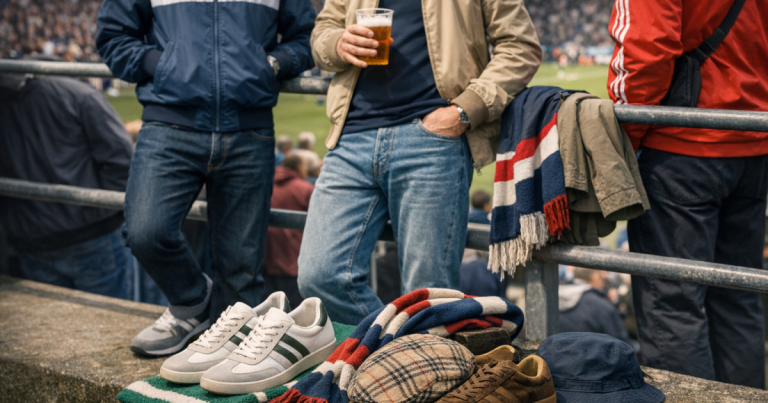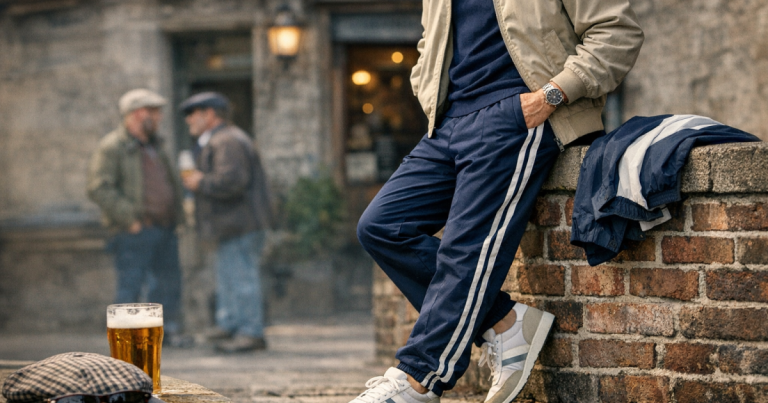
On a cold Saturday concourse, the clothes say plenty before anyone opens their mouth. Terrace style is the shorthand: track tops, trainers, muted colours, football memory and just enough restraint to show you know the code.
It is not a uniform, and it is not simply dressing like an extra from a football film. The look works because it balances sportswear, local identity, music culture, away-day practicality and a very British suspicion of looking too polished.
Main points
- The look grew from football-casual culture, but it now sits across everyday menswear, music nostalgia and retro sportswear.
- Track tops, trainers, polos, knitwear, overshirts, cagoules and understated outerwear all have a place, but not all at once.
- Matchday codes are about restraint: one strong logo, clean footwear, sensible colours and nothing that looks like a costume.
- Modern reissues can work well, provided the fit, fabric and colour feel wearable rather than fancy dress.
- Regional taste still matters: Liverpool, Manchester, Glasgow, London and the Midlands have never dressed identically.
Where the look comes from
The roots sit in the late twentieth-century football-casual scene, when supporters brought back Italian, French and German sportswear from European trips and turned it into a language of taste. A label, a zip pull, a trainer shape or a colour combination could say more than a scarf. For a deeper cultural backdrop, our guide to tracksuit culture in Britain explains how football, music and street style kept feeding each other.
That is why terrace style is hard to reduce to one item. It is not just an adidas track jacket, a pair of classic trainers or a Stone Island badge. It is the way those things are worn: slightly guarded, practical for weather and travel, connected to music and sport, but rarely loud for the sake of it.
Britpop helped push parts of the look into the mainstream, while post-punk, acid house, indie and later lad-mag culture all left their marks. The danger now is treating it as a mood board rather than a lived style. The best outfits still feel as if they could handle a train platform, a pub table, a turnstile queue and a rainy walk home.
The clothes that carry the code
Track tops and full sets
The track top is the obvious centrepiece, but obvious can still be good. A clean zip-through in navy, forest green, burgundy, black or off-white gives the outfit structure without making it look forced. The adidas Originals Firebird Track Top is a familiar modern reference point because it is bold, recognisable and easy to understand; that also means it needs calmer styling around it.
Italian-leaning pieces bring a different flavour. The Ellesse Rimini Track Top sits closer to the tennis-and-football crossover that shaped plenty of terrace wardrobes. With anything logo-heavy, the trick is to let the jacket do the talking: plain tee, simple trainers, no competing cap, no novelty scarf unless you are actually going to the match.
Full tracksuits can work, but they are the highest-risk move. Matching top and bottoms read strongest when the cut is relaxed rather than sprayed on, the colour is not too shiny, and the footwear is clean but not box-fresh in a showroom way. If the set already looks loud, avoid adding more branded accessories.
Trainers
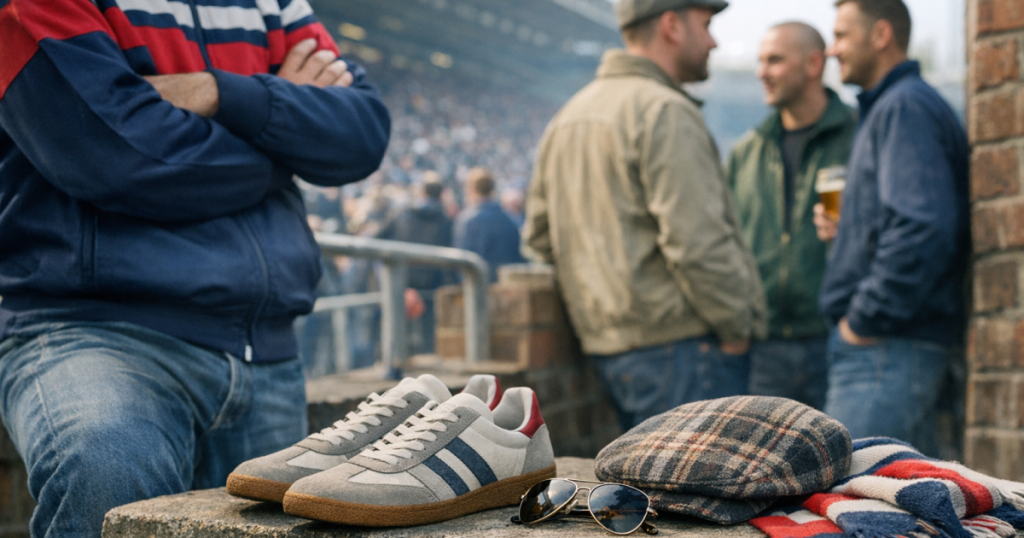
Trainers do a lot of the cultural work. A slim gum-sole trainer gives a different signal to a chunky running shoe. Suede classics and indoor court shapes tend to sit naturally with track tops, denim and cords. The adidas Originals Handball Spezial is a good example of the low-profile indoor shape that fits the look without shouting over it.
Keep condition in mind. Terrace dressing does not require pristine collector behaviour, but battered trainers can collapse the outfit. Clean midsoles, brushed suede and unfrayed laces matter more than chasing a rare colourway.
Polos, knitwear and layers
Under the jacket, keep it simple. A plain crew-neck tee, fine knit, rugby-style top or understated polo gives the outfit a lived-in feel. Too many heritage cues at once can tip into costume: track top, retro polo, flared jeans, period trainers and vintage sunglasses is usually too much unless you are styling a shoot.
Layering is also where British weather shapes the look. A lightweight overshirt, cagoule or waxed jacket can make more sense than a pristine track top on a wet Saturday. The better version is practical first, nostalgic second.
Matchday codes: what people notice
There are no written rules, but there are patterns. The first is restraint. A strong jacket with quiet trousers looks sharper than three competing statement pieces. A small badge can carry more weight than a huge chest logo. Dark denim, stone chinos, navy track pants and straight-leg cargos all have a place, depending on the era you are referencing.
The second is context. What works for a pub before a match may feel too theatrical at work or in a family restaurant. The easiest way to keep the look modern is to strip one period detail away. If the jacket is very 1980s, make the trousers current. If the trainers are retro, keep the top half less themed.
The third is not dressing as a stereotype. Football-casual style has a history, but reducing it to aggression, slogans or cosplay misses the point. If you want to keep the nod subtle, our piece on dressing terrace without looking like fancy dress gets into that balance in more detail.
Colour, region and the quiet signals
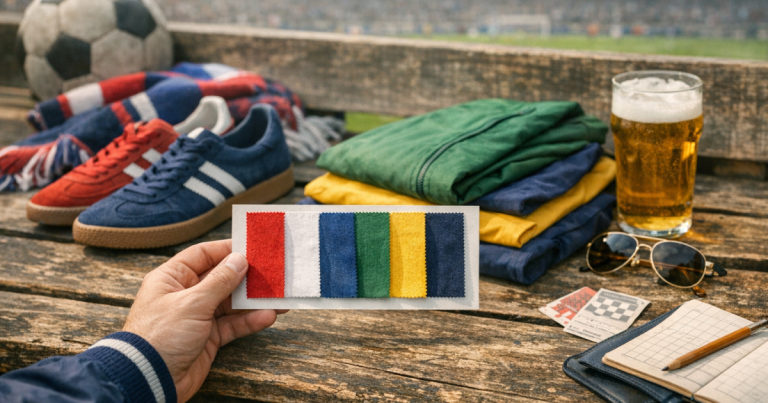
Colour is one of the easiest ways to get the look right. Navy is the safest base because it works with denim, grey, stone and burgundy. Stone and beige bring a softer casuals feel, particularly with suede trainers and knitwear. Burgundy can look excellent in small doses, while green works best when it is deep rather than neon.
Club colours are more complicated. Wearing them in an outfit can look natural if they are already part of your life, but forced if they are added purely for effect. On a non-matchday, a subtle colour echo usually lands better than a full red-and-white or blue-and-white statement. For more detail, the terrace colour guide breaks down the core shades and how to combine them.
Regional taste still shifts the details. One city might favour sharper designer outerwear; another leans into sportswear and trainers; another keeps things darker and more minimal. Away-day photographs are useful because they show what people actually wore, not just what later nostalgia decided was important.
How to wear it now without overdoing it
- Start with one anchor piece. Choose the track top, trainers or jacket as the main reference, then quieten everything else down.
- Use modern fits carefully. Too skinny can feel dated, but oversized can drown the sportswear lines. Aim for relaxed and clean.
- Limit obvious logos. One prominent logo is usually enough. More than that starts looking like a brand board.
- Mind the fabric. Shiny polyester, brushed cotton, nylon and knitwear all give different signals. Mix textures rather than wearing one synthetic surface from neck to ankle.
- Keep it wearable. If the outfit only works in a posed photo, it probably is not doing the job.
Care matters too. Vintage and reissue track tops can lose shape if they are washed aggressively, and older zips or ribbed cuffs deserve a bit of patience. Use a gentle wash, avoid unnecessary heat and let synthetic pieces dry naturally where the care label allows. A well-kept jacket looks intentional; a tired one just looks tired.
Vintage, reissue or modern interpretation?
Original vintage has charm: older labels, period cuts, uncommon colourways and the feeling that the garment has lived a life. The trade-off is condition. Check zips, elastic, lining, stains, bobbling, odour and whether the size label still reflects the real fit. Vintage sizing can be inconsistent, so measurements matter more than the tag.
Reissues are easier to wear day to day. They usually remove some of the risk around fragile fabric and uncertain condition, while keeping the shape familiar enough for the look. The downside is that the most recognisable reissues can feel obvious if styled without imagination.
A modern interpretation might be the smartest route for many wardrobes: a simple retro-leaning track jacket, clean trainers, plain tee and straight trousers. It nods to the culture without trying to recreate a specific away end from a specific year.
Things readers ask
Is terrace style the same as casuals?
They overlap, but they are not identical. Casuals refers more directly to the football subculture, while terrace dressing can describe the broader clothing language that came from it and still influences everyday style.
Can you wear the look if you are not going to football?
Yes, as long as it feels natural rather than performative. Keep the outfit practical, avoid fake matchday signals, and lean on good sportswear, trainers and restrained colours.
Are full tracksuits too much?
Not always, but they are harder to get right. A full set works best when the fit is relaxed, the colours are calm and the rest of the outfit is very simple.
Which colours are easiest to start with?
Navy, grey, stone, burgundy and dark green are the most forgiving. They pair well with denim, suede trainers, plain tees and understated outerwear.
Does the look have to be vintage?
No. Vintage adds character, but reissues and modern retro-inspired pieces are often easier to maintain and wear regularly.
Why it matters
The appeal is not just nostalgia. Terrace style survives because it gives sportswear a social code: what you choose, how loudly you wear it, and whether the outfit feels earned rather than assembled from clichés. It can be sharp, comfortable and culturally loaded without needing to shout.
The strongest version today respects the history but does not get trapped by it. Wear the track top because it looks good, choose the trainers because they suit the shape of the outfit, and let the football references sit in the background unless the day genuinely calls for them.