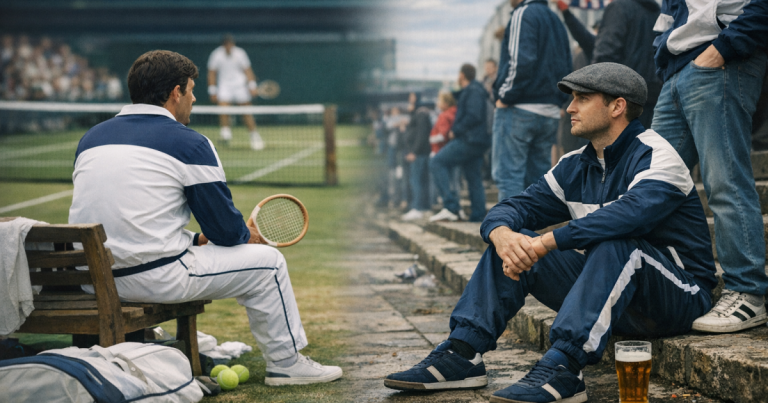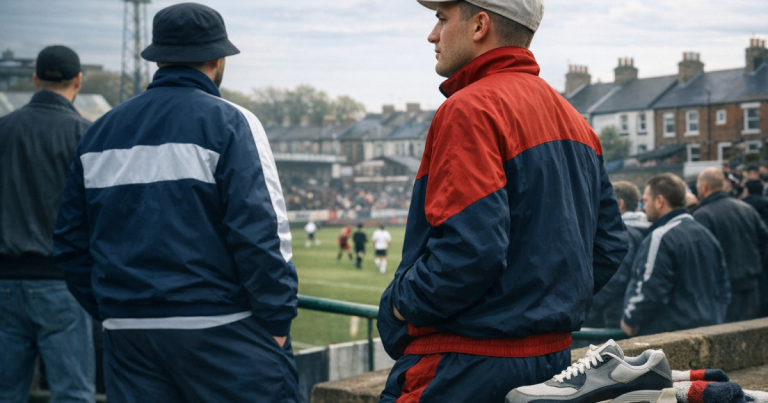
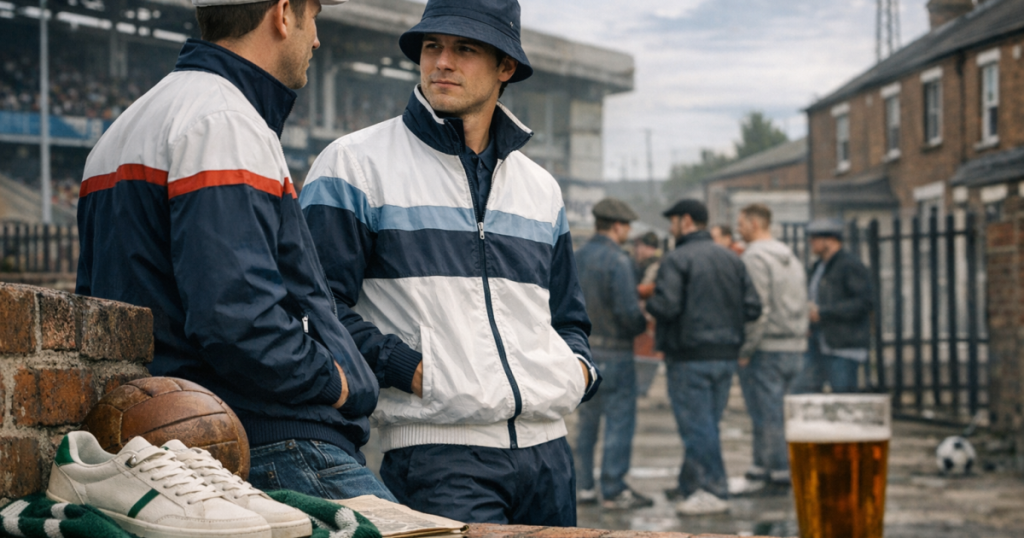
Before it became shorthand for British away-day sharpness, Sergio Tacchini tenniswear belonged to a very different stage: the tennis court. Its move into casual culture was not random. It was a mix of Italian colour, televised sport, import appeal, football travel and the casuals’ instinct for making athletic kit look quietly expensive.
The useful way to understand it is not as “tennis clothes worn at football”, but as a code. The right Tacchini piece suggested taste, knowledge and access, while still being wearable enough for trains, pubs, shopping streets and Saturday afternoons.
What to know first
- Sergio Tacchini was founded in Italy in 1966 by the former tennis player Sergio Tacchini.
- The brand helped move tennis style away from plain white tradition and towards stronger colour, panelling and graphic sportswear.
- British casuals adopted it because it looked continental, expensive and different from standard high-street sports gear.
- The most useful modern reference points are track tops, warm-up jackets, polos and knit-style layers rather than head-to-toe costume looks.
- For wider context on the codes around football clothing, read our guide to what terrace style means.
Step 1: Start with the court, not the terrace
Sergio Tacchini’s importance begins with tennis. In the mid-20th century, tennis clothing was still tied to a fairly conservative visual language: whites, clean lines and club respectability. Tacchini’s brand identity pushed against that restraint without abandoning elegance. Colour blocking, contrast panels and bold-but-balanced logos made the kit feel more modern, more European and more television-friendly.
That matters because British casuals were not simply chasing sportswear; they were chasing signals. A jacket or track top linked to continental tennis had a different status from generic gym gear. It carried a suggestion of travel, leisure, money and taste. When worn away from its original sporting setting, it became sharper rather than sloppier.
The player associations helped, too. John McEnroe, Jimmy Connors and other high-profile tennis names gave the brand visibility to audiences who might never have set foot in a tennis club. On television, Tacchini looked clean, graphic and confident. On a British high street, the same visual language could feel rare and quietly flash.
Step 2: Understand why British casuals wanted Italian tenniswear
The casuals scene developed around selection. It was not only about wearing sports brands; it was about knowing which sports brands, which lines, which colours and which sources. Italian and continental labels had an edge because they were harder to find, less familiar and less tied to school PE kit or domestic sports shops.
Sergio Tacchini fitted that perfectly. It had enough recognisable branding to be noticed, but it was not as obvious as the biggest three-stripe or swoosh-led choices. Its tennis roots also made it feel slightly more refined than football training wear. That balance was crucial: polished, sporty and not too formal.
Football travel amplified the effect. Away days and European fixtures exposed supporters to different shop windows, different cuts and different brand hierarchies. Whether bought abroad, found through independent menswear shops or passed around through local networks, a desirable Tacchini top could say that the wearer knew where to look. For a broader view of how sportswear crossed between football, music and street culture, see our piece on tracksuit culture in Britain.
Step 3: Read the look: colour, collar, cut and logo control
The best Sergio Tacchini casuals pieces tend to work because they sit between sports kit and leisurewear. They are rarely anonymous, but they do not need to shout. When you are trying to read the look, pay attention to four things.
Colour
Tacchini’s strongest terrace appeal often comes from deep navy, white, red, green, burgundy, cream and royal blue combinations. These colours feel sporting but still sit well with denim, cords, track pants or simple trainers. The key is contrast that looks designed, not random.
Collar shape
A stand collar, funnel neck or neat fold-down collar can change the whole attitude of a track top. Tenniswear often brings a smarter neckline than running or football training gear. That is one reason it transfers well into casual outfits.
Panel layout
Chest panels, sleeve stripes and shoulder blocks are part of the visual appeal. The best examples create shape without looking like fancy dress. If every part of the garment is competing for attention, it is harder to wear today.
Logo placement
The Sergio Tacchini wordmark and ‘ST’ logo can look excellent when the rest of the outfit is restrained. A logo on the chest with clean trousers and low-profile trainers reads differently from a full outfit covered in competing badges.
Step 4: Know the pieces that translate best now
You do not need to dress like a museum photograph to make Tacchini work in 2026. The easiest route is to take one strong tenniswear reference and let it lead the outfit.
- Track tops: A clean archive-inspired top is the most direct terrace route. The Sergio Tacchini Damarindo Track Top is a useful name to compare when looking at the brand’s retro direction, but always check current fabric, fit and colour options before buying.
- Warm-up jackets: These often carry the court-to-casual feel well because they were designed to be worn before or after play, not only during sport.
- Polos: A tennis polo can soften a terrace outfit, especially under a lightweight jacket or with straight-leg jeans.
- Full tracksuits: They can look strong, but they need restraint. Choose cleaner trainers and avoid stacking too many obvious era references at once.
- Archive-inspired reissues: These are often easier to wear and care for than true vintage, but check sizing, fabric composition and branding details rather than assuming every remake captures the original mood.
Step 5: Wear it without looking like a costume
The most common mistake is treating Sergio Tacchini as a complete uniform. A full retro track top, retro track pants, period trainers, cap and football scarf can be fun for a themed night, but it rarely looks natural day to day. British casual style works best when the references are controlled.
Start with one focal piece. If the jacket has strong colour blocking, keep the rest of the outfit calm: navy trousers, washed denim, plain track pants or a neutral overshirt. If the top is subtle, you can add more texture through a polo, knit or suede trainer.
Logo balance matters. Tacchini already carries visual history, so do not drown it in other loud brands. A small trainer logo is fine; three competing chest badges and a branded cap can tip the outfit into parody. If that is the problem you are trying to avoid, our guide to balancing logos in terrace outfits is a useful next step.
Fit is just as important as nostalgia. Vintage pieces may sit shorter, boxier or wider through the sleeve than modern sportswear. Reissues may be cut differently from originals. Neither is automatically better. The right choice depends on whether you want an authentic silhouette or something easier to wear with today’s trousers and trainers.
Step 6: Check vintage and reissue details before buying
Sergio Tacchini has been revived, reissued and reinterpreted many times, so it pays to look closely before treating any piece as a terrace classic. Use these checks as a practical filter.
- Labels and neck tags: Compare the label style, country of manufacture and care information with credible vintage references. A tag alone does not prove an era, but it helps build the picture.
- Zip and hardware: Original jackets may have period-specific zip pulls or different hardware from newer runs. Check photos carefully if buying online.
- Fabric feel: Older polyester blends can feel different from modern reissues. Ask for fabric composition and close-up images where possible.
- Condition: Look for pulls, bobbling, loose elastic, zip issues and staining around cuffs, collar and hem.
- Measurements: Do not rely only on labelled size. Ask for pit-to-pit, length and sleeve measurements in centimetres.
- Wearability: A rare piece is not much use if the colour, fit or condition means it never leaves the wardrobe.
For modern buyers, an archive-style piece such as the Sergio Tacchini Orion Track Top can be a sensible comparison point against true vintage. The question is not simply which is “more authentic”; it is which one gives you the shape, colour and durability you will actually wear.
Why it became a staple
Sergio Tacchini became a British casuals staple because it solved a very specific style problem. It looked sporty without looking basic, European without looking too formal, and branded without being as obvious as the biggest mainstream sportswear names. That made it ideal for a scene built on small distinctions.
Its tennis heritage gave it polish. Its colours gave it visibility. Its relative scarcity gave it status. On the terraces and around matchday towns, those qualities turned a court brand into a casuals signal.
The lesson for wearing it now is simple: respect the reference, but do not over-perform it. Choose one good Tacchini piece, keep the rest of the outfit controlled, and pay attention to fit, colour and logo balance. That is how the brand still works best: not as nostalgia for its own sake, but as a sharp, wearable bridge between Italian sportswear and British terrace culture.
Helpful questions
Is Sergio Tacchini only associated with tennis?
No. Tennis is central to the brand’s identity, but its British casuals relevance comes from how that tenniswear was adopted beyond the court. In the UK, it became part of a wider language of football casual style, continental sportswear and street-level status.
Is vintage Sergio Tacchini better than a reissue?
Not automatically. Vintage can offer era-correct labels, cuts and fabric feel, but condition and sizing can be unpredictable. Reissues can be easier to buy and wear, though details may differ from original pieces. Check measurements, materials and logo placement before deciding.
What should you wear with a Sergio Tacchini track top?
Keep it simple: straight-leg denim, navy or stone trousers, understated track pants, and clean terrace-friendly trainers. Let the top carry the reference rather than surrounding it with too many other loud pieces.