The better football casual books do more than repeat old tales about labels, away days and one-upmanship. They help you understand how clothes, football, music, travel, class and local identity all fed into a style culture that still shapes modern terrace dressing.
Before buying, the trick is to read the book as an object and as a source: who made it, what evidence it uses, what period it covers, and whether it separates memory from myth.
At a glance
- Start with the author. Look for lived experience, serious research, photography access or a clear editorial method.
- Check the evidence. Reliable books usually show dates, places, captions, interviews, archives or first-hand context.
- Watch the tone. Strong books can be vivid without turning football casual culture into cartoon violence or label worship.
- Know the angle. A photobook, memoir, oral history and academic study are useful in different ways.
- Inspect editions. Reprints, expanded editions and second-hand copies can differ in photos, captions, forewords and print quality.
Step 1: Work out what kind of book it is
Not every reliable book has to do the same job. A memoir can be valuable because it captures mood, voice and social detail from inside the scene. A photobook can show silhouettes, haircuts, trainer choices, jackets, pubs, coaches and streets in a way that prose never quite manages. A broader cultural history should give you chronology, context and links to music, retail, football policing, European travel and regional identity.
The mistake is expecting one format to answer every question. A picture-led book might not provide deep analysis. A memoir may be honest about one city or crew but limited outside that experience. A history book might be stronger on context than on the feel of actually wearing a track top on a wet Saturday afternoon.
If your interest is style, pair the reading with comparison points. For example, understanding fabric and silhouette matters when you move from the page to the wardrobe, so a guide to nylon, tricot, velour and terrace fits can help you decode what a book’s photographs are actually showing.
Step 2: Check the author’s relationship to the culture
Reliability does not only mean academic distance. Some of the most useful writing on casual culture comes from people who were around it, photographed it, collected it or documented it over time. But proximity is not enough on its own. A strong author usually does at least one of these things well:
- Names the time, place and limitations of their own experience.
- Uses interviews rather than relying only on personal memory.
- Credits photographers, archives and contributors clearly.
- Explains regional differences instead of treating one city as the whole story.
- Avoids presenting every anecdote as universal fact.
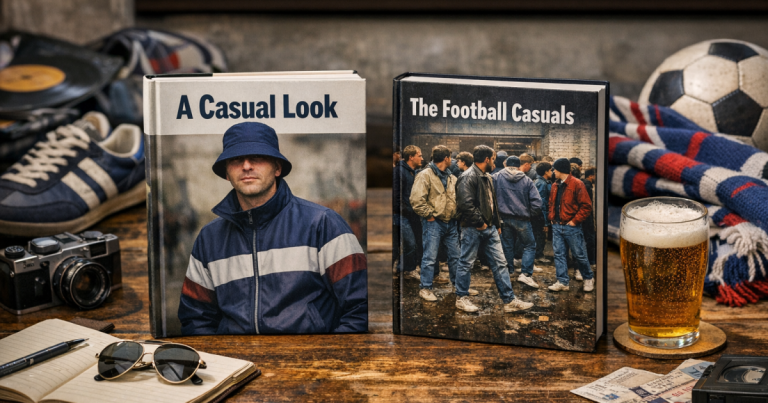
Books such as The Football Casuals: A History are often discussed because they sit close to first-hand culture while trying to frame a wider story. That does not mean any single book should be treated as the final word. It means you should ask what kind of access the author has, what they do with it, and whether they acknowledge competing memories.
Step 3: Look for real dates, places and regional texture
Casual culture was never one flat national uniform. Liverpool, Manchester, Glasgow, London, Cardiff, Birmingham, Sheffield and the North East all had their own reference points, shops, travel routes, music scenes and local status items. A reliable book normally gives you enough geography to see those differences.
Useful details include club-specific context, named towns, named shops, train routes, European away trips, nightclub scenes, market stalls, independent sports shops and the gradual shift between brands. If every page speaks in vague phrases about “the lads”, “the firms” and “the gear” without grounding the story, be cautious.
This matters for style as well as history. Paninaro influence, Italian sportswear, jeans, knitwear and continental labels entered British terrace wardrobes unevenly. If you want to understand that strand, it helps to read alongside a practical breakdown of a 1980s Paninaro-inspired terrace look, because it shows how the cultural references translate into wearable choices.
Step 4: Judge the photography and captions carefully
Photographs can be brilliant evidence, but only when handled properly. A good casual culture photobook gives you more than atmosphere. It should make clear, where possible, who took the images, where they were taken, roughly when they were taken, and what the viewer is looking at.
When browsing a book in a shop or checking sample pages online, look at the captions. Are they specific, or are they just mood-setting lines? Do the clothes in the image match the claimed period? Are the same few images repeated across different sections? Is the print quality good enough to see details such as trainer shapes, jacket cuts, badges and layering?
A Casual Look by Gavin Watson is a useful reference point because its value is strongly photographic: the clothes, postures and social settings are doing a lot of the historical work. With any photobook, though, check the edition and format before buying, because image selection, layout and reproduction can affect how useful it is as a reference.
Step 5: Separate nostalgia from evidence
Football casual culture attracts nostalgia for obvious reasons: the clothes were loaded with memory, risk, status and belonging. That does not make nostalgia useless. It can preserve details that official records ignore. But reliable books usually signal when they are dealing with memory rather than proven fact.
Be wary of books that make every scene sound bigger, harder, sharper and more important than everything else. Overheated writing can be entertaining, but it often flattens the culture into clichés. The more useful books leave room for contradictions: aspiration and insecurity, style and tribalism, humour and ugliness, pride and exaggeration.
A good test is whether the book can talk about clothes without treating brands as magic passwords. Lacoste, Fila, Sergio Tacchini, adidas, Ellesse, Diadora, Kappa and Stone Island all carried meanings, but those meanings changed by place and period. For a label-specific example, the story of Lacoste as a terrace label beyond the polo shirt shows why context matters more than simply naming a badge.
Step 6: Read sample pages for language and balance
Sample pages reveal a lot. Look for clear writing that respects the culture without sounding desperate to impress it. Strong books tend to use precise language: “late 1980s Merseyside”, “Italian sportswear”, “trainers brought back from Europe”, “independent menswear shops”, “acid house crossover”, or “matchday policing”. Weak books lean on broad swagger.
Also check whether the author gives space to ordinary wearers, not just famous names, notorious figures or extreme stories. Terrace style was shaped by thousands of small decisions: saving for a jacket, spotting a trainer in a shop window, seeing what older lads wore, copying a look from a European trip, or mixing sportswear with denim and knitwear. Reliable books notice those everyday mechanics.
Step 7: Check publication details before buying
Once a book looks promising, slow down and check the physical and editorial details. This is especially important with second-hand copies, limited runs, self-published titles and reprints.
- Edition: Check whether it is an original edition, reprint, revised edition or expanded version.
- Publisher: A known publisher is not a guarantee, but it can indicate editing, picture clearance and production standards.
- Condition: For used copies, look for notes on creasing, loose pages, water damage, missing dust jackets and marked pages.
- Image reproduction: Photobooks depend heavily on print clarity, paper and layout.
- References: Cultural histories should show some trail of sources, interviews, acknowledgements or further reading.
- Scope: Make sure the book covers the era, city or style question you actually care about.
For UK readers, availability can vary a lot between mainstream bookshops, specialist sellers, publisher direct stock and second-hand marketplaces. Avoid assuming a scarce copy is better just because it is scarce. Sometimes scarcity reflects a small print run; sometimes it reflects genuine demand; sometimes it is simply opportunistic pricing.
Step 8: Cross-check the book against other sources
No single book should carry the whole story. The most reliable understanding comes from triangulation: books, documentaries, interviews, photo archives, fanzines, local newspaper material, record sleeves, club memories and the clothing itself.
If a book makes a strong claim about when a brand broke through, which city led a trend, or how a look spread, check whether other sources broadly support it. Exact memories will differ, and that is part of the subject. What you are looking for is whether the claim sits within a plausible pattern rather than floating on bravado.
Documentaries and filmed interviews are useful here because they capture voice, body language and contradiction. They can also reveal how people narrate their own past. Treat them as companions to books rather than replacements.
Red flags that should make you pause
- The book has no clear author background, contributors or source trail.
- It uses lots of dramatic claims but gives few dates or locations.
- It treats one club, city or decade as the entire culture.
- It recycles well-known stereotypes without adding fresh evidence.
- It uses photographs without meaningful captions or credits.
- It confuses modern reissue styling with original period detail.
- It presents violence as the whole point and ignores music, travel, clothing, class and community.
Helpful questions
Are memoirs less reliable than researched histories?
Not automatically. Memoirs can be excellent when they are honest about place, period and personal perspective. They become weaker when one person’s memory is presented as the full national story.
Are expensive second-hand casual books always better?
No. Higher prices can reflect scarcity, condition or collector demand, not necessarily better research. Check edition details, content, image quality and whether a newer reprint serves your purpose.
What should a beginner read first?
Start with one broad history and one image-led book. That gives you both context and visual evidence, which is especially useful if your interest is terrace clothing rather than only football stories.
Can documentaries replace books on casual culture?
They are better used together. Documentaries give voice and atmosphere; books usually let you slow down, compare claims, study captions and follow a chronology more carefully.
How do I know if a book is useful for style research?
Look for clear photographs, dated captions, regional detail and discussion of brands in context. A style-useful book should help you understand how clothes were worn, not just which labels were named.
What stands out
Reliable football casual books are not just the loudest, rarest or most mythologised titles. They are the ones that show their working: who is speaking, where the story is set, what evidence supports it, and how clothing fits into the wider culture.
For terrace style readers, the strongest books do two jobs at once. They preserve the atmosphere of a subculture, but they also sharpen your eye for real details: fabric, fit, regional taste, brand timing, trainer pairings and the difference between lived style and later costume. That is the difference between buying a book for a shelf and buying one that genuinely deepens how you understand the culture.