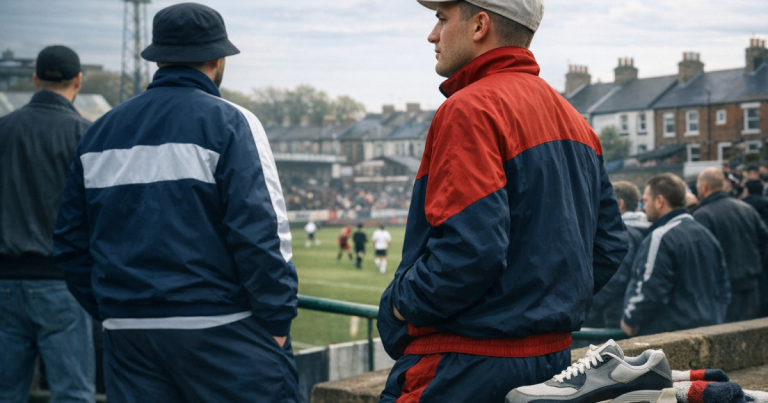
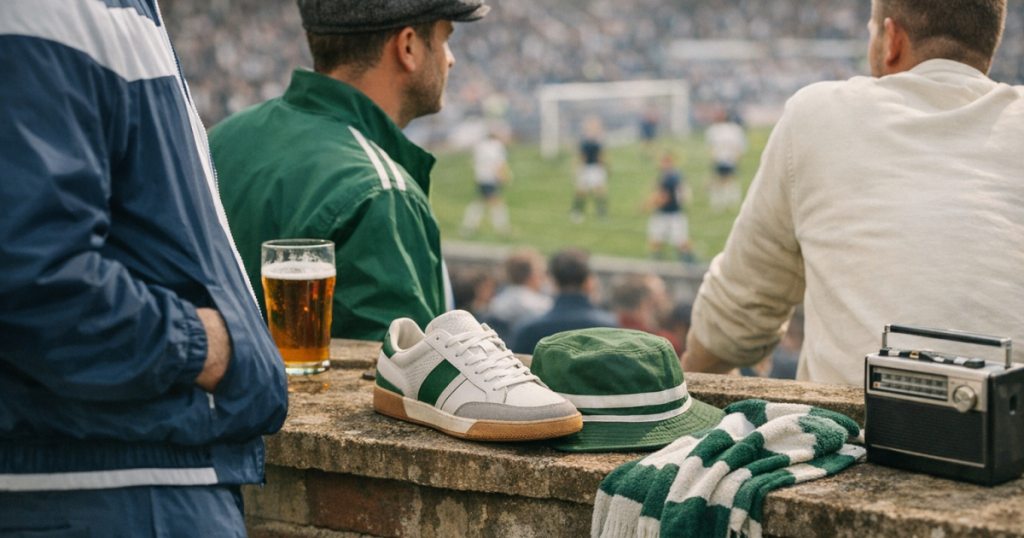
Lacoste is easy to file under tennis whites and neat polos, but that misses why the crocodile travelled so well into football-casual wardrobes. Lacoste terrace style works because the brand sits between sport, leisure, status and understatement: smart enough for the pub after the match, relaxed enough for trains, away days and weekend wear.
The point was never only the shirt. The label’s wider appeal came from how it could soften a tracksuit, sharpen a pair of trainers, or add a small flash of recognition without shouting across the concourse.
The short version
Lacoste became a terrace label because it offered a different kind of sportswear status. Adidas, Nike, Umbro, Fila and Sergio Tacchini often carried obvious performance or football associations, while Lacoste brought tennis club polish, continental leisurewear and a quietly expensive-looking badge into the same wardrobe.
- The crocodile was readable. A small chest logo could say enough without needing a giant graphic.
- It bridged smart and casual. Lacoste worked with denim, cords, track tops, shell jackets and trainers.
- It was sporty without being purely football-led. Tennis heritage gave it a cleaner, less obvious edge.
- It fitted the casual code. The best terrace dressing often turns on restraint, provenance and recognition rather than loud branding.
How Lacoste earned terrace credibility
The roots of Lacoste are in tennis, not football, and that matters. The brand was built around the idea that sports clothing could be practical, elegant and recognisable. The classic polo became the shorthand, but the wider language was just as important: ribbed collars, clean colours, lightweight layers, simple knitwear, zip tops and leisure pieces that looked like they belonged in sport without looking like kit.
For UK football casual culture, that was useful. Casual style has never been only about wearing what players wore. It has often been about taking sportswear from elsewhere and giving it a new setting: Italian tennis labels, French prep, German trainers, American caps, British outerwear, and football-derived training gear all colliding in the same Saturday uniform.
That is why Lacoste sits comfortably alongside labels with more direct football roots. For comparison, the way Umbro’s football heritage fed into British terrace sportswear is a different route into the same culture: one brand comes from the pitch, the other from the club court, but both became useful once lads started judging clothes by cut, badge, rarity and how they looked in real life.
Step 1: look beyond the polo shirt
The polo is the obvious entry point, and it still matters. A Lacoste L.12.12 Polo Shirt gives you the most recognisable version of the brand’s language: pique cotton, a tidy collar, and a badge that can sit under a track top or jacket without fighting the rest of the outfit. But stopping there makes the label feel flatter than it is.
To read Lacoste properly as terracewear, look at how the brand works across layers:
- Track tops and zip layers: useful when you want sportiness without a full matching tracksuit.
- Sweatshirts and knitwear: good for toning down brighter shells, nylon jackets or statement trainers.
- Caps and small accessories: better when the rest of the outfit is already strong and needs a quieter finishing touch.
- Trainers: more subtle than many terrace staples, but effective when the outfit leans smart-casual rather than rave or full tracksuit.
The practical lesson is simple: if the crocodile is the only interesting thing in the outfit, it can look lazy. If it supports the proportions, colour palette and era cues, it starts to make sense.
Step 2: understand the status code
Terrace style is often discussed as if it is only about rare labels, but the real code is more precise. It is about knowing when a garment looks right, why a badge matters, and whether the overall outfit feels worn rather than staged. Lacoste’s power comes from being recognisable while staying compact. The badge is small, but people who know, know.
That made it useful in settings where clothes had to do several jobs. A Lacoste layer could move from match travel to a pub, town centre, record shop or club queue without feeling too formal or too scruffy. It also sat well with the British habit of mixing class signals: a tennis-derived polo under a working casual jacket, a clean knit with jeans and trainers, or a preppy collar peeking out beneath a nylon track top.
This is also why Lacoste can go wrong. Too much pristine preppy styling can make it feel like golf club cosplay rather than terracewear. Too much logo stacking can make it look like a costume version of casual culture. The sweet spot is usually one visible crocodile, balanced by unfussy pieces around it.
Step 3: separate tennis heritage from football-casual styling
Lacoste did not need to become a football brand to become a terrace label. Its value was in the contrast. Tennis gave the clothes a cleaner, more aspirational edge; football-casual culture gave them grit, movement and a new audience.
Think of it as translation rather than copying. A tennis polo on its own can look neat and conservative. Put it under a vintage track top, a wax jacket, a Harrington, or a simple overshirt and it starts to read differently. The collar becomes a styling tool. The logo becomes a quiet badge. The sport heritage becomes part of a broader casual vocabulary.
That approach is similar to how many vintage track tops work today: the aim is not to dress as though you have walked out of an archive photograph, but to keep the useful cues and lose the fancy-dress effect. If that balance interests you, the principles in how to mix vintage track tops with modern terrace style apply neatly to Lacoste too.
Step 4: use Lacoste in a modern terrace outfit
The easiest way to wear Lacoste now is to treat it as the smartening element in a sportswear outfit. It does not need to dominate. In fact, it often looks better when the rest of the fit carries the texture and shape.
For a clean match-day look
Start with a navy, white, bottle green or burgundy Lacoste polo or sweatshirt. Add straight-leg jeans or relaxed track pants, then finish with simple trainers. If you want a modern trainer from the same universe, the Lacoste L003 Neo Shot is worth comparing with more traditional terrace trainers if you prefer a sharper, contemporary shape. Check materials, fit and colour in person where possible, because Lacoste footwear varies by model and season.
For a sharper pub-to-terrace outfit
Use a Lacoste knit or polo under a Harrington, wax jacket or short rain shell. The collar or badge gives just enough formality, while the outerwear keeps it grounded. Avoid pairing too many country, prep and sportswear signals at once; one smart layer is usually enough.
For a tracksuit-led outfit
If the track top is bright or heavily branded, choose a quieter Lacoste base layer. If the tracksuit is plain, a crocodile polo can add a point of interest. This is where the brand works especially well beyond the polo cliché: it can calm down nylon, tricot and velour rather than competing with them.
Key checks before buying vintage or current Lacoste
Because Lacoste has a long history and a wide range, you should judge pieces individually rather than assuming every item carries the same terrace value. A good buy is not just about the crocodile; it is about shape, fabric, condition and how it fits into your wardrobe.
- Check the cut. Older pieces can fit shorter, boxier or slimmer than modern expectations. Measure against something you already wear rather than relying only on the label size.
- Look at the collar and cuffs. On polos, stretched collars and tired cuffs can make even a good colour look worn out.
- Inspect the badge. Vintage authentication is a specialist subject, but poor stitching, odd placement or generally cheap finishing should make you pause.
- Think in outfits, not trophies. A rare colour is not useful if it clashes with every jacket, track top and trainer you own.
- Be careful with full preppy styling. Chinos, boat shoes and a bright polo may be classic Lacoste, but they do not automatically read as terrace.
- Wash with restraint. Follow the care label, avoid aggressive heat, and dry knitwear or cotton pieces carefully so they keep their shape.
If you are building from scratch, start with colours that already exist in your wardrobe: navy, off-white, grey, forest green, burgundy or black. Then add bolder pieces only when you know what they will sit with. That is the same logic behind building an authentic terrace wardrobe: buy for combinations, not isolated badges.
Where Lacoste sits next to other terrace labels
Lacoste is not the same kind of terrace label as adidas Originals, Fila, Sergio Tacchini, Ellesse or Nike. It is quieter, more preppy, and often less obviously linked to tracksuit culture. That can be a strength. In a wardrobe full of loud track tops and classic trainers, Lacoste gives you a cleaner register.
Against Fred Perry, Lacoste usually feels less subculture-specific and more sports-club polished. Against Stone Island, it is less technical and less militaristic. Against adidas, it is less training-ground and more leisure. Against Sergio Tacchini, it shares tennis DNA but often reads more restrained. None of that makes it better or worse; it just tells you how to use it.
The mistake is treating all crocodile-badged clothing as instantly casual. The best pieces for terrace-leaning outfits tend to have useful colours, clean proportions and enough sport in the design to avoid looking too formal. A plain navy sweatshirt may be more wearable than a loud seasonal graphic. A simple polo may work harder than a novelty colourway. A clean trainer such as the Lacoste Carnaby Pro may suit some outfits better than a bulkier runner, but it is worth checking whether the shape works with your jeans or track pants before buying.
Helpful questions
Is Lacoste really a terrace brand?
Yes, but not in the same direct way as football kit suppliers or classic tracksuit labels. It became part of terrace style because casual dressers adopted its tennis and leisurewear codes, then mixed them with trainers, outerwear and track tops.
Does Lacoste only work as a polo?
No. Polos are the most recognisable route in, but sweatshirts, knitwear, zip tops, caps and some trainers can all work if the colours and proportions are right. The brand is strongest when it adds a neat, understated layer rather than becoming the whole outfit.
What colours are safest for a terrace-leaning Lacoste piece?
Navy, white, grey, burgundy, forest green and black are the easiest to wear. They sit naturally with denim, dark track pants, classic trainers and British outerwear without looking too styled.
Main lessons
Lacoste became a terrace label beyond the polo because it gave British casual style something valuable: sport heritage without obvious football branding, status without massive logos, and a smart-casual edge that worked away from the stadium as much as near it.
The most convincing way to wear it now is with restraint. Pick one good crocodile piece, make sure the cut is right, and build around it with the same eye you would use for any terrace outfit: clean colours, believable layers, proper trainers, and no need to prove too much.