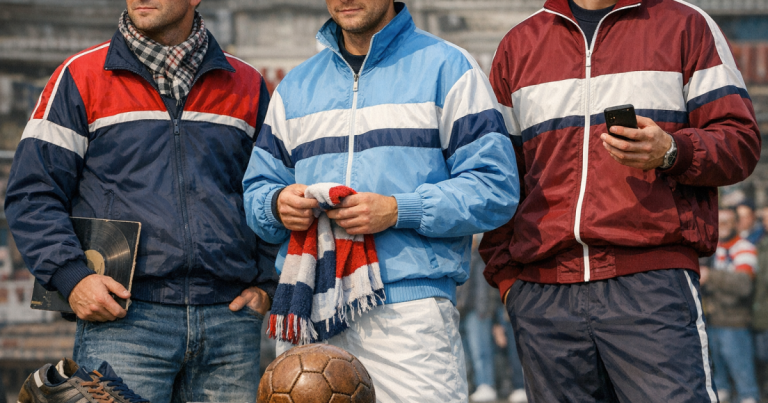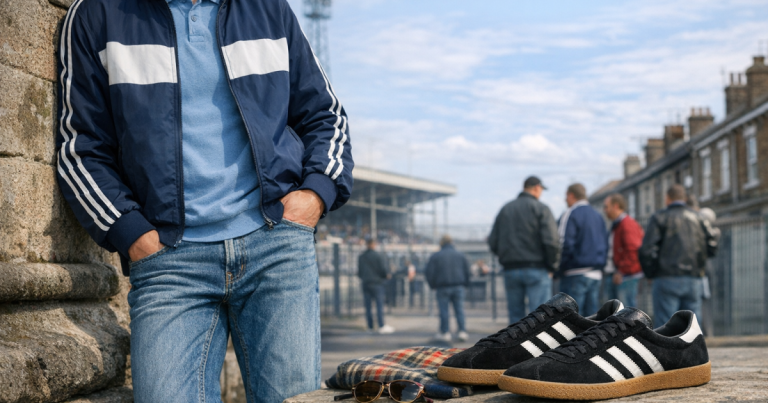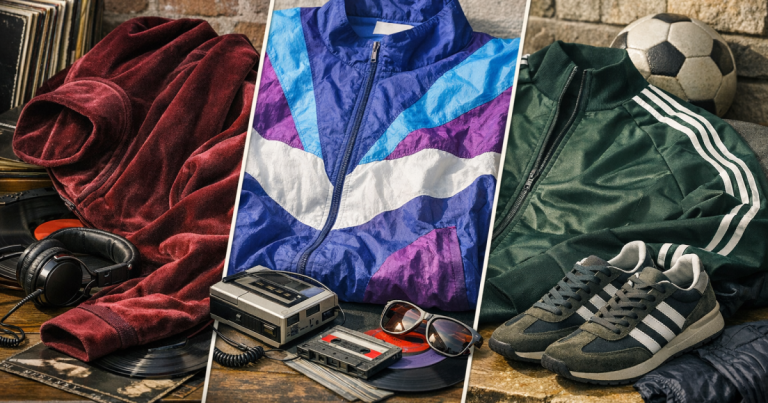
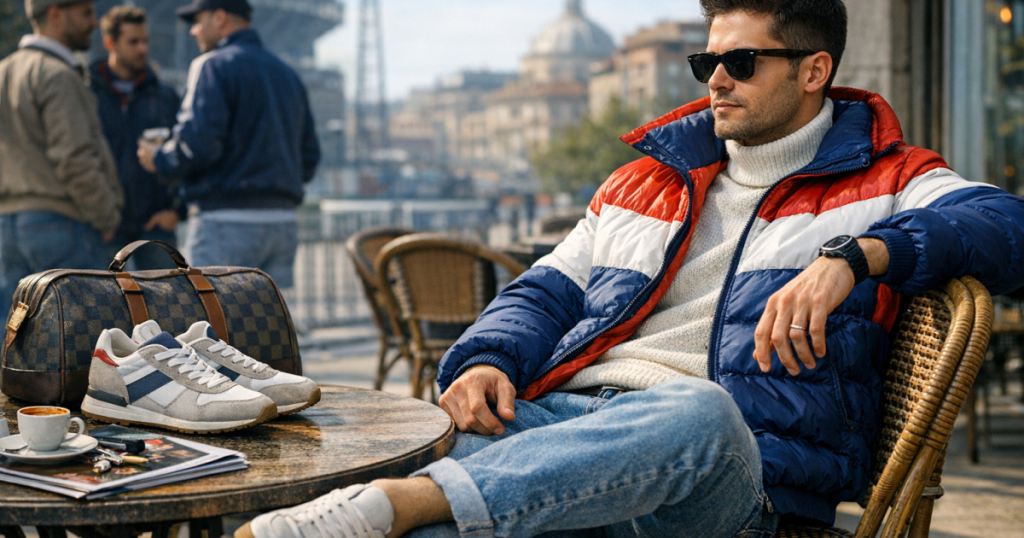
A Paninaro terrace look works when it feels like Milanese café culture has been filtered through a British away-day wardrobe, not when it becomes fancy dress. The trick is to keep the 1980s signals sharp — padded outerwear, washed denim, glossy trainers, brave colour — then control the fit so it still looks wearable on a UK high street or outside a ground.
Paninaro style came from youth scenes around Milanese sandwich bars and cafés, where American workwear, premium Italian casualwear and visible branding became a uniform of confidence. The UK terrace angle is slightly different: less polished, more weather-aware, and more likely to mix a status piece with something practical.
The short version
- Start with one big 1980s statement: a padded jacket, bright track top, bold knit or logo-heavy sweatshirt.
- Ground it with straight denim, clean trainers or sturdy boots rather than stacking every reference at once.
- Keep the silhouette boxy up top and neat below; too slim looks modern, too oversized loses the period cue.
- Use colour confidently, but limit the palette to two or three strong tones.
- Make it terrace-compatible with rain-ready layering and a touch of British restraint.
Step 1: Understand the Paninaro cues before copying them
The Paninaro look was never just “Italian casual”. It was a youth uniform built from recognisable labels, glossy surfaces and a kind of consumer bravado. Think padded outerwear, stonewashed denim, branded sweatshirts, chunky boots, baseball caps, sunglasses and café-ready confidence. The look had a deliberate new-money sharpness that separated it from older mod, skinhead or traditional football dressing.
For a British terrace version, you need to soften the Milanese flash without removing its point. UK casual culture also cared about status labels, continental travel and one-upmanship, but the clothing had to work in drizzle, stations, pubs and concrete concourses. That is why the strongest version is not a museum copy. It is a translation.
If you are still building the foundation of your wardrobe, it helps to cross-check the wider terrace basics first: outerwear, knitwear, track tops, trainers and denim. The broader principles in building an authentic terrace wardrobe are useful before you add the louder Paninaro details.
Step 2: Choose the outerwear that sets the era
Outerwear does most of the work. For a Paninaro-inspired outfit, the jacket should create shape before anything else does. A padded jacket, quilted bomber, glossy nylon blouson or short technical parka gives the right 1980s energy. The fit should sit slightly boxy through the body, with enough room for a sweatshirt or knit underneath.
Moncler-style down jackets are one of the classic reference points, but you do not need to chase a perfect archive piece. The useful lesson is the silhouette: cropped or hip-length, padded, visible, and a little more expensive-looking than a plain football raincoat. C.P. Company and Stone Island references also sit naturally here, especially for a UK reader, because they bridge Italian sportswear with football-casual credibility.
Keep the jacket in control. Bright red, royal blue, bottle green, navy, cream and black all work, but avoid dressing head to toe in high-saturation colour unless you want the outfit to read as costume. If the jacket is loud, make the rest calmer.
Step 3: Build the middle layer with café confidence
The middle layer is where Paninaro style can become genuinely fun. A sweatshirt with a strong chest logo, a chunky knit, a half-zip, a rugby-style top or a clean polo can all work. The aim is to suggest status and leisure rather than gym wear.
Lacoste belongs naturally in this space because it crosses tennis, casual dressing and terrace culture without needing a full tracksuit. A polo under a padded jacket, or a knit layered over a shirt, gives the look a smarter European edge. For more on why the crocodile became bigger than the polo itself in British casual culture, read why Lacoste became a terrace label beyond the polo shirt.
If you use a track top, avoid making the whole outfit too “sports day”. A Sergio Tacchini-style zip top or Fila-influenced colour block works best when it is treated as casualwear, not kit. Wear it under a padded jacket with denim, or over a plain tee with a rain shell close to hand.
Step 4: Get the denim and leg shape right
Paninaro dressing is strongly tied to denim, especially straight-leg, stonewashed and cuffed styles. The jeans should not be spray-on skinny, and they should not pool heavily over the shoe. A straight or relaxed-straight leg gives the right 1980s line, especially with a boot or substantial trainer.
Useful reference points include Levi’s 501 Original Fit Jeans, not because every outfit needs that exact model, but because the straight shape and cultural familiarity make the era easy to understand. A pale wash pushes the look more Paninaro; a darker wash makes it easier to wear in a British terrace setting.
Track pants can work, but they shift the outfit closer to sportswear. If you choose them, keep the top half less athletic: padded jacket, knit or polo rather than full matching set. For understanding why different fabrics read differently, the guide to nylon, tricot, velour and terrace tracksuit eras helps separate period accuracy from modern styling.
Step 5: Pick footwear that holds the outfit down
Footwear decides whether the outfit feels Milan café, British terrace, or confused. The Paninaro side loves American workwear and bold trainer culture; the terrace side prefers recognisable casual footwear with enough understatement to avoid looking staged.
- Chunky boot route: A boot in the Timberland family gives the strongest American workwear cue. Timberland 6-Inch Premium Boot is a familiar reference, though readers should check current materials, fit and finish before relying on any one version.
- Clean trainer route: White leather court-style trainers keep the look sharp and café-ready. They work well with stonewash denim and a bright padded jacket.
- Terrace trainer route: Low-profile suede or leather trainers pull the outfit back towards Britain. Think gum soles, muted uppers and a shape that sits neatly under straight denim.
Avoid overly futuristic trainers with the rest of this look. They can work in a modern outfit, but they dilute the 1980s signal.
Step 6: Use accessories sparingly but deliberately
Accessories are where Paninaro styling can tip from character into caricature. Sunglasses, caps, belts and bags should look like finishing touches, not props. A pair such as Ray-Ban Original Wayfarer Classic gives a useful 1980s frame reference, but only if it suits your face and the rest of the outfit. Do not force sunglasses into a grey February away day just to prove the theme.
A cap can work if the jacket and jeans are simple. A leather belt, small shoulder bag or sports holdall can also nod to the era. Keep logos visible but not screaming from every angle. One obvious badge is enough; two can work; three or four starts to look like a mood board.
Step 7: Build three wearable versions
The clean café version
Use a navy padded jacket, white or cream polo, pale straight denim and clean white trainers. Add a simple belt and keep the hair, grooming and accessories neat. This is the easiest way to carry the Italian café influence without looking like you are heading to a themed night.
The terrace-weather version
Start with a dark padded or nylon jacket, a mid-weight sweatshirt, straight dark denim and terrace-leaning trainers. This version suits UK weather better and feels closer to football-casual practice. If the jacket has a badge or arm detail, keep the sweatshirt plain.
The louder 1980s version
Choose a bright puffer or colour-block track top, stonewashed jeans, cuffed hems and boots or white trainers. This is the most obviously Paninaro-inspired version, so balance it with a plain tee and minimal accessories. The aim is confidence, not costume.
Key checks before you leave the house
- Does one piece lead? The jacket, track top or footwear should be the hero. If everything shouts, nothing lands.
- Is the shape right? Boxier upper half, straighter leg, neat hem. Modern slim cuts can make the references feel accidental.
- Are the colours controlled? Use one strong colour, one neutral and one supporting tone.
- Does it work in Britain? If the outfit cannot handle wind, rain or a long train platform, it is probably too café-only.
- Would it still look good without the story? The best subculture-inspired outfits work even when nobody knows the reference.
Questions people ask
Is Paninaro style the same as football casual style?
No. They overlap through status brands, sportswear and 1980s confidence, but Paninaro came from Milanese youth café culture while football casual style developed around British terraces, travel and match-day identity.
Can I wear a full tracksuit for this look?
You can, but it usually reads more terrace than Paninaro. For a stronger hybrid, wear a track top with jeans, or track pants with a smarter jacket and plain upper layer.
Do I need Italian designer labels?
No. The spirit matters more than a label checklist. Use the cues: padded shape, straight denim, visible branding, confident colour and clean finishing.
What colours feel most authentic?
Red, navy, royal blue, white, cream, bottle green and stonewash denim all sit well. Keep them disciplined so the outfit feels deliberate rather than chaotic.
How do I avoid looking like I am in fancy dress?
Use one or two era cues, not all of them. Modern grooming, clean proportions and practical UK outerwear make the reference wearable rather than theatrical.
Main lessons
The strongest 1980s Paninaro-inspired terrace outfit is a controlled translation: Italian café flash, British terrace practicality and just enough visible branding to show intent. Start with the jacket, keep the denim straight, choose footwear with cultural weight, and let colour do some of the talking. If the outfit feels wearable before it feels historical, you have probably got it right.