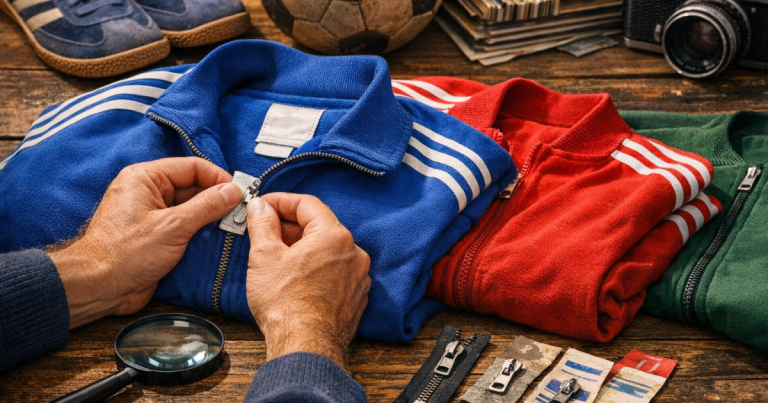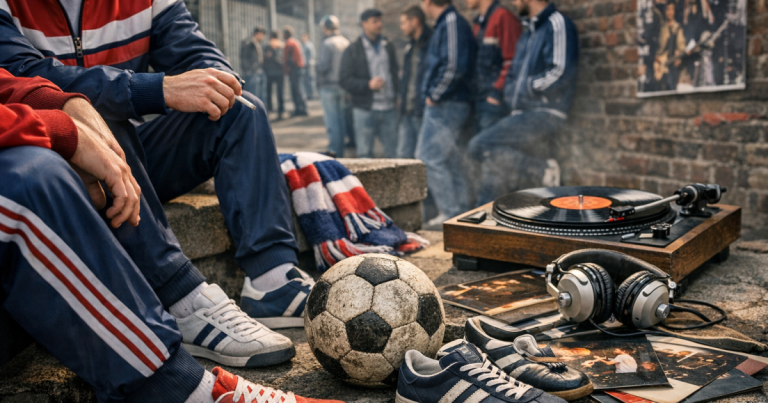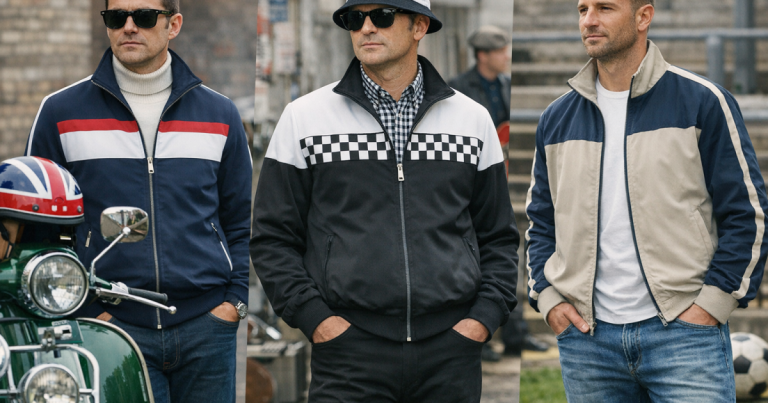
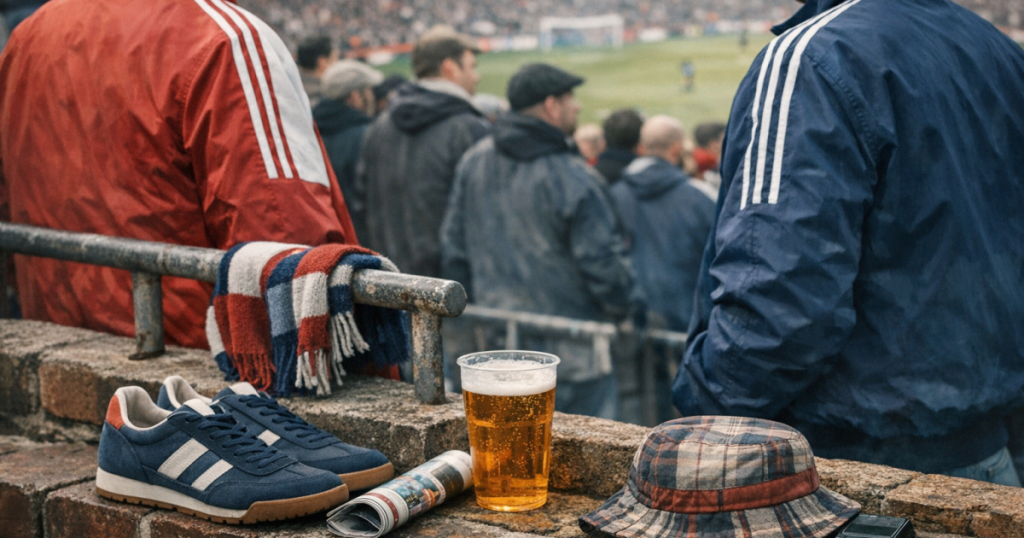
A tracksuit can look simple from a distance: jacket, bottoms, badge, stripes, piping, colour. But the story of tracksuit brands in terrace culture is really about signals — where you went, what you noticed, what you could get hold of, and how confidently you wore it.
On British terraces, sportswear branding became a language long before it became a retro mood board. Labels were read through football travel, scarcity, club colours, music scenes, and tiny differences in fit that separated a sharp look from fancy dress.
In brief
- Tracksuit brands became symbolic because they carried social information: taste, access, allegiance, era and confidence.
- The logo mattered, but so did the cut, fabric, colour blocking, collar shape and how the set was worn with trainers or outerwear.
- Football travel helped introduce European tennis, ski and leisurewear labels into UK casual culture.
- Different brands came to suggest different moods: understated heritage, Italian flash, athletic familiarity, local pride or revival nostalgia.
- Modern terrace-inspired dressing works best when it borrows the codes without turning them into costume.
Why a sportswear label became more than a logo
Terrace culture did not treat clothing as neutral. A track top was judged by its brand, but also by how difficult it was to find, whether it looked imported, whether it sat right over denim or track bottoms, and whether it connected to a wider football or music moment.
That is why two jackets with similar colours could carry very different meanings. One might suggest a familiar high-street sportswear look; another might hint at an away-day purchase, a European influence, or a deeper understanding of casual style. The difference was rarely announced out loud. It was read.
Branding also offered a way to stand apart without dressing formally. For a crowd used to reading details quickly, a small chest logo, sleeve stripe, contrast panel or funnel neck could say more than a loud slogan. The appeal was not just being seen; it was being understood by the right people.
Travel, scarcity and the away-day effect
The football-casual story is often simplified into a list of labels, but the route those labels took matters. Travelling supporters encountered shops, sports clubs and street styles beyond their own towns. Continental sportswear, tennis gear and ski-influenced leisurewear all filtered back into British football crowds, where they were reinterpreted through local taste.
Scarcity sharpened the effect. Before online retail flattened everything, finding an unusual colourway or a less common label gave the wearer an edge. A jacket did not need to be expensive in today’s sense to feel exclusive; it needed to be hard to get, hard to place, or hard for everyone else to copy quickly.
This is where brands such as adidas, Sergio Tacchini, Fila, Ellesse, Diadora, Kappa and Lacoste Sport earned symbolic weight. They were not all worn in the same way, or for the same reasons, but each could suggest a particular relationship with sport, leisure, Europe, football travel and youth identity.
The brand codes: what different labels came to suggest
adidas Originals and the benchmark effect
adidas became one of the most readable sportswear symbols in terrace style because it balanced sport, street and heritage without needing much explanation. The Trefoil, three stripes and archive silhouettes could sit comfortably with jeans, cords, track pants, suede trainers or a jacket layered over a polo.
The key is that adidas did not rely on one single meaning. For some, it was linked to football training gear and matchday familiarity. For others, it was about classic trainers and European casual influence. That range helped it become a benchmark rather than just another label. The deeper story is worth reading through why adidas Originals became such a terrace sportswear reference point.
Italian leisurewear and controlled flash
Sergio Tacchini, Fila and Ellesse brought a different energy. They carried tennis-club polish, bold panelling, colour-blocked confidence and a slightly more dressed-up sense of leisure. A top such as the Fila Settanta Track Jacket is useful as a reference point because it shows how a sports garment can feel both athletic and social.
Italian-influenced terrace dressing was rarely just about brightness. The strongest looks had balance: a sharp track top with plain legwear, a colourful jacket with clean trainers, or a full set worn with enough restraint to avoid looking theatrical. The symbol was not simply money or loudness; it was knowing when a statement piece had done enough.
Kappa and the 1990s-to-2000s shift
Kappa’s place in terrace culture reflects a later shift towards football kits, slim athletic cuts, visible taping and a more overt sport-fashion crossover. For many UK readers, Kappa also carries memories of televised football, replica culture, continental clubs and the move from casual understatement into bolder branding.
That does not make it less authentic. It means the code changed. A 2000s Kappa set reads differently from an early casual-era Italian track top: more body-conscious, more logo-forward, more connected to the football shirt era and nightlife crossover. The symbolism moved with the crowds wearing it.
Reebok, Nike and local familiarity
Not every terrace symbol came from distant glamour. Reebok’s British roots gave it a different kind of credibility, particularly around Greater Manchester and the North West. Its sportswear could feel less exotic than Italian labels, but more locally grounded — familiar, practical and tied to real sporting memory. The Bolton story is central to understanding why Reebok’s roots matter to terrace sportswear.
Nike’s role is different again. The Swoosh became unavoidable through football, running, basketball, youth culture and later streetwear. In terrace terms, Nike can read as less archive-specific than adidas or Tacchini, but the right retro tracksuit or old-school trainer still carries strong matchday value, especially when the fit is clean and the colour choice is restrained.
Fit, fabric and colour: the details that changed the message
Brand symbolism only works when the garment itself lands properly. A famous logo on a poor shape rarely convinces. Terrace style has always been sensitive to proportion: crop, sleeve volume, trouser width, cuff tension, collar height and how a jacket sits over a layer.
Earlier looks often favoured neater track tops, shorter jackets and trousers that worked with slim trainers or shoes. Later eras allowed fuller shells, shiny fabrics, bolder taping and roomier bottoms. The move from cotton-rich jersey to nylon, polyester tricot and lightweight shell fabrics changed not only comfort, but the whole silhouette.
Colour added another layer. Red, blue, green, claret, black and white were never just design choices in football settings. They could echo club identity, rival colours, national teams, or a deliberate decision to avoid obvious allegiance. For anyone building a modern outfit, this is where cultural awareness matters: some combinations feel neutral in a pub or city centre, but loaded near a ground on matchday.
Music, film and the afterlife of the tracksuit
Terrace symbolism did not stay inside stadiums. It moved through pubs, coaches, nightclubs, record shops, estates, youth clubs and later film and television. Acid house, Britpop, hip-hop, indie, grime and rave scenes all borrowed pieces of sportswear language, then sent them back out with new meanings.
That feedback loop explains why tracksuits can trigger strong memories even for people who never stood in a particular end. A brand might remind one person of an away fixture, another of a club night, another of a music video, another of an older sibling’s wardrobe. The same garment can carry several cultural references at once.
Books and photo archives help ground that memory in real clothing rather than myth. Cass Pennant’s The Football Casuals: A History and Gavin Watson’s A Casual Look remain useful touchpoints because they show clothing as lived culture: imperfect, local, changing and worn in real social settings.
How to read the symbolism today
Modern terrace-inspired style works best when it avoids copying a decade too literally. The point is not to dress like a museum display. It is to understand why a piece works, then wear it in a way that suits present-day life in Britain: train journeys, pubs, city centres, gigs, Sunday football, and cold evenings outside grounds.
- Read the era first: a sleek tennis-style top, a shiny 1990s shell and a 2000s taped tracksuit all tell different stories.
- Check the colour context: club colours can add meaning, but they can also make an outfit feel less neutral around matchdays.
- Let one piece lead: a bold track jacket often works better with plain trousers than with every logo shouting at once.
- Match trainers to the mood: suede terrace trainers, leather classics and bulkier runners all change the signal.
- Respect the fit: oversized can look relaxed; too baggy in the wrong fabric can look careless. Slim can look sharp; too tight can lose the casual feel.
For a deeper breakdown of shapes across eras, the guide to tracksuit fit by decade is a useful next step before putting a look together.
Common questions
Were terrace brands only about status?
No. Status mattered, especially when certain labels or imports were difficult to find, but the appeal was broader than showing off. Brands also signalled taste, travel, local identity, football knowledge and belonging within a particular crowd.
Is terrace style the same across the UK?
Not exactly. The broad codes overlap, but Manchester, Liverpool, London, Glasgow, Leeds, Newcastle and other football cities all developed their own preferences and reference points. Local shops, clubs, music scenes and rivalries shaped what looked right.
Can you wear full tracksuits without looking costume-like?
Yes, but restraint helps. Keep the fit contemporary, avoid mixing too many loud logos, and think about footwear. A full set looks more natural when the trainers, outerwear and colours feel considered rather than copied from one old photo.
Why do club colours matter so much?
Football settings give colour extra meaning. A red, blue, green or claret tracksuit may look like ordinary sportswear in town, but near a ground it can suggest allegiance, rivalry or deliberate neutrality depending on the fixture and location.
Are modern reissues as meaningful as vintage originals?
They can be, but in a different way. Vintage pieces carry age, scarcity and period detail, while reissues are often easier to wear regularly. The strongest choice depends on whether you value authenticity, condition, fit or everyday practicality.
Main lessons
Tracksuit brands became terrace symbols because they gathered meaning from real social use. Football travel gave them reach, scarcity gave them edge, music gave them movement, and local crowds gave them rules that were understood without being written down.
The modern revival is strongest when it respects those layers. A good terrace-inspired outfit is not just a logo on a jacket. It is the right shape, the right colour, the right trainers, the right level of confidence, and enough awareness to know what the clothing is saying before anyone else reads it.