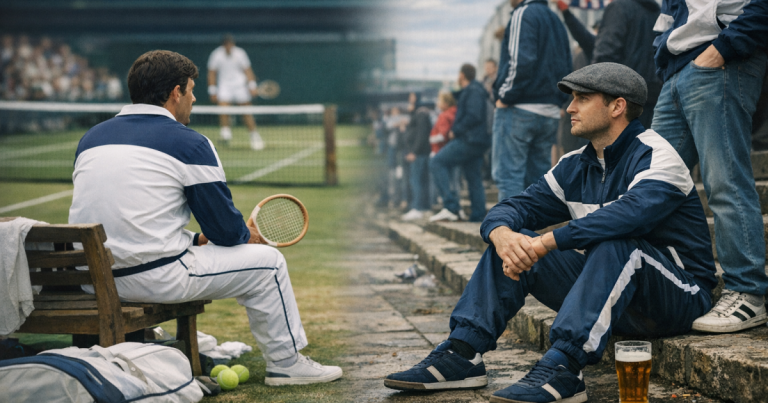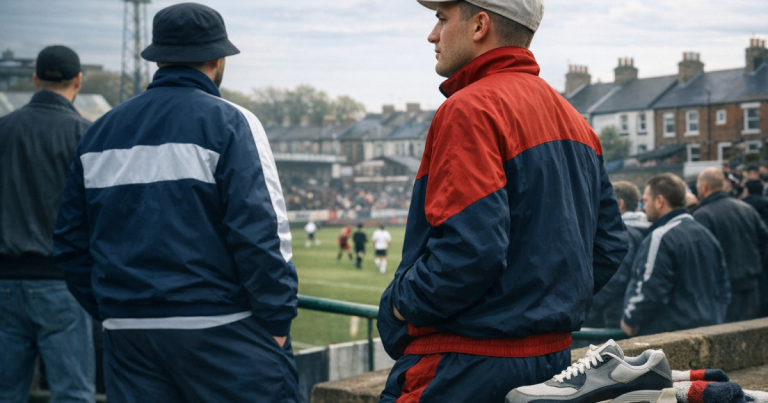
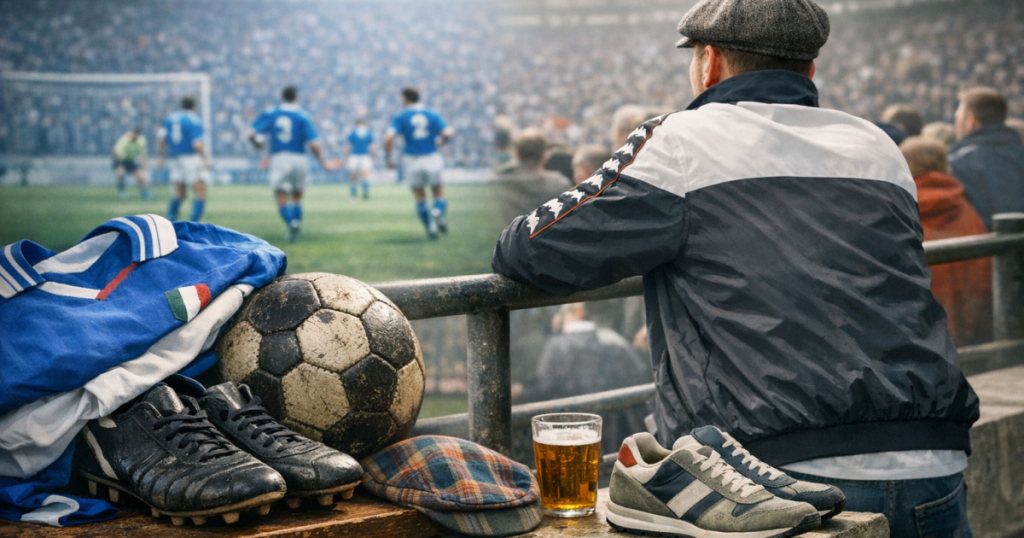
Kappa did not become a terrace name in Britain by accident. Its appeal sits at the crossroads of Italian football glamour, sharp sportswear branding and the UK casual habit of turning continental gear into status clothing. That is why Kappa terrace style is best understood as a journey: from Turin textile roots to Serie A kits, then into British matchday wardrobes, Britpop-era nostalgia and modern retro sportswear.
The short version
Kappa’s UK terrace relevance comes from three things: the Omini logo, its deep connection with Italian football, and the way British casuals absorbed European sportswear as part of a wider look. It was never just about wearing a tracksuit. It was about recognising a code: continental, football-literate, slightly flash, but still casual enough for the pub, the train and the stands.
For today’s wearer, the lesson is simple. Pick one strong Kappa piece, keep the rest of the outfit grounded, and understand the reference before you lean too hard into it. If you are still getting your bearings, it helps to read Kappa alongside broader terrace style codes, because the best outfits are built on context as much as clothes.
Step 1: Start in Turin, not on the terraces
Kappa’s story begins in Turin, a city better known to many British football fans through Juventus, Fiat and Italian industrial cool than through fashion folklore. The company roots go back to the early twentieth century, with the Kappa name emerging later as part of an Italian sportswear identity that moved beyond basic hosiery and underwear into leisure and team sport.
The famous Omini logo, showing a man and woman sitting back to back, became one of the brand’s strongest visual assets. It is simple, symmetrical and instantly readable from a distance, which matters in both sport and streetwear. On a football shirt, a tracksuit sleeve or a taped trouser leg, it gives Kappa a recognisable signature without needing a huge wordmark.
This is important because terrace style has always rewarded recognisable details. A small laurel, a trefoil, a stacked Fila mark or Kappa’s repeated Omini tape can signal taste, era and subcultural knowledge. Kappa’s visual language was bold enough to be noticed, but still rooted in sport rather than pure fashion.
Step 2: Follow the Italian football kit trail
Kappa’s football credibility was built through club and national-team kit culture. Its association with Italian football made the brand feel different from the more familiar British high-street sportswear rails. Juventus, Roma, Sampdoria, Torino and other clubs helped place Kappa inside a world of packed curva ends, sponsor-heavy shirts, glossy Sunday highlights and European away-day imagination.
For UK fans, Italian football in the 1990s carried a particular mystique. Serie A felt tactical, stylish and slightly exotic. Channel 4 coverage made names, kits and stadiums feel part of the weekend routine, even if the matches were played far from the local ground. Kappa benefited from that mood. Its kits looked connected to a more continental version of football culture: smarter, sharper and less obvious than standard training gear.
The brand also pushed football kit design forward. Kappa’s more body-conscious football shirts around the turn of the millennium showed a willingness to rethink fit and movement. Not every terrace dresser wanted to wear a tight football shirt, but the message was clear: Kappa was not simply copying heritage sportswear. It had a football design language of its own.
Step 3: Understand why Britain noticed
British casual culture has always had an eye for imports. The original casuals were not just buying clothes; they were hunting signals. Italian, French and German sportswear could carry more weight because it was harder to find, less obvious and linked to travel, football and knowing where to look.
Kappa’s move into UK terrace wardrobes fits that pattern. The brand had the right mixture: football legitimacy, continental flavour, visible branding and enough tracksuit heritage to sit alongside adidas, Fila, Sergio Tacchini, Ellesse and Diadora. It was not always the quietest option, but that was part of the point. Worn well, Kappa suggested confidence rather than costume.
It also connected with the wider rise of tracksuit culture. By the time retro sportswear had moved through football, rave, Britpop and early streetwear, Kappa had several ways into the British wardrobe. A taped track top could feel football-adjacent, music-adjacent or simply nostalgic depending on how it was styled. For a wider view of how sportswear moved from training ground to social uniform, the history of tracksuit culture gives useful background.
Step 4: Spot the real Kappa codes
Not every Kappa item carries the same terrace energy. The strongest pieces usually have a clear link to football, training wear or archive sportswear rather than random logo placement. When judging a vintage find or a modern reissue, look for the details that make the brand feel specific.
- Omini tape: Repeated logo taping down sleeves or legs is one of the clearest Kappa signatures. It can look excellent, but it is loud, so balance it with quieter layers.
- Track tops: Zip-front track jackets are the easiest way into the look. A piece such as the Kappa 222 Banda Anniston Track Jacket is useful as a reference point for the bold taped style, though availability, fit and fabric should always be checked before buying.
- Football shirts: Club shirts can be brilliant, but they carry allegiance, era and sponsor baggage. Wear them knowingly rather than as generic retro tops.
- Colour blocking: Kappa often works best in strong but simple colour stories: navy and white, black and white, red and white, or club-linked palettes.
- Fit: Vintage pieces may sit shorter, wider or shinier than modern reissues. Check measurements rather than relying on the label size alone.
Step 5: Build a wearable outfit, not a museum display
The most common mistake with Kappa terrace style is trying to wear every reference at once. Full tape tracksuit, football shirt, retro trainers, cap and scarf can quickly become fancy dress unless you are deliberately dressing for a themed event. For normal matchday or weekend wear, restraint is stronger.
Use one loud piece
If the jacket has full Omini taping, keep the trousers plain. If the football shirt is the focus, wear it under a simple overshirt, Harrington-style jacket or lightweight shell. Kappa is graphic enough to carry the outfit without extra noise.
Ground it with familiar terrace staples
Straight denim, dark cords, neutral track pants or a plain knit can stop the look becoming too shiny. Trainers should match the era you are referencing, but they do not have to be Italian. A low-profile gum-sole trainer will often look more natural than a bulky modern running shoe if the top half is already bold.
Avoid mixing too many rival logos
Casual style has always involved brand mixing, but three or four big logos in one outfit can feel chaotic. Kappa works best when it has space. One Omini-heavy piece with quieter staples looks more intentional than a walking archive rail.
Think about the setting
A taped track top might be perfect for a pub before a match, a casual weekend or a retro night. It may feel less natural in a smarter setting unless it is toned down with a plain jacket and dark trousers. The aim is to make the reference wearable, not to look like you are heading to a 1990s changing room.
If you want more help with that balance, the principles in this guide to building a terrace tracksuit outfit without looking fancy dress apply neatly to Kappa as well.
Step 6: Check vintage and reissue pieces properly
Kappa has enough history that you will see both older pieces and modern archive-inspired releases. Neither is automatically better. Vintage can have character, but it may also bring worn elastic, tired zips, pulls, bobbling or fabric shine that has gone from stylish to exhausted. Reissues can be easier to wear, but may not have the exact cut, cloth or detailing some collectors want.
- Check the zip: A sticking or missing zip can make a track top frustrating even if it looks good in photos.
- Inspect cuffs and hems: Loose ribbing changes the whole silhouette, especially on cropped track jackets.
- Look closely at tape: Omini taping can lift, crack or discolour. Photos should show sleeves and side seams clearly.
- Ask for measurements: Chest width, length and sleeve length matter more than a generic size tag, particularly with older European sportswear.
- Consider care: Many track tops use synthetic fabrics. Wash gently, avoid excessive heat and check the garment label before steaming or ironing.
- Be honest about use: A rare football shirt might be better as a collector piece; a robust modern track top may be better for regular wear.
Where Kappa sits in UK terrace style now
Kappa terrace style now works best as a confident accent within a wider retro sportswear wardrobe. It is less universal than adidas Originals and usually louder than Fred Perry or Lacoste, but that gives it a useful role. When an outfit needs a stronger football-European edge, Kappa can do what quieter heritage brands cannot.
The brand also offers a slightly different kind of nostalgia. For some, it recalls Italian football on television, replica shirts and European club culture. For others, it is tied to late 1990s and early 2000s sportswear, logo tape and a bolder streetwear mood. Both readings can be valid, but the styling changes. Italian-football Kappa suits cleaner layers and classic trainers; logo-tape Kappa can handle a more graphic, streetwear-leaning outfit.
The practical test is whether the piece still looks good when removed from nostalgia. If you would not wear the colour, fit or fabric without the memory attached, it may be better left as a reference rather than a purchase. If it works with clothes you already own, Kappa becomes much easier to wear regularly.
Main points
- Kappa’s terrace appeal comes from Italian football credibility, strong Omini branding and the UK casual appetite for continental sportswear.
- The best Kappa pieces for everyday wear are usually track tops, clean football shirts and archive-style separates rather than full head-to-toe looks.
- Omini tape is powerful but loud; let it be the main detail and keep the rest of the outfit calmer.
- Vintage pieces need careful checks for fit, zip condition, fabric wear, tape damage and tired cuffs.
- Modern reissues can be easier to wear, but always compare cut, measurements and styling with how you actually dress.
Why it matters
Kappa’s journey from Italian football kits to UK terrace wardrobes shows how casual style borrows, edits and reinterprets. A shirt made for Serie A, a track top shaped by continental sportswear and a logo born in Turin can all take on a different meaning once worn on British streets, trains and terraces.
That is the strength of the brand’s place in retro sportswear. Kappa is not just a logo from a nostalgic era. It is a reminder that terrace style has always been international, selective and slightly obsessive about detail. Wear it with that in mind and it still feels sharp rather than stuck in the past.