On a wet Saturday outside a ground, the right track top can say almost as much as a scarf. Tracksuit culture is the story of how practical sports kit became a language for belonging, taste and local identity. In Britain, that story runs through football grounds, high-street sports shops, club nights, music videos and the everyday habit of dressing for comfort without giving up status.
The short version
- Tracksuits started as functional sportswear, but their meaning changed once fans, musicians and youth scenes adopted them away from sport.
- In UK terrace style, the look was rarely just about wearing a full matching set; it was about brands, fit, colour, trainers and where you wore it.
- The best modern interpretation is not fancy dress. It usually means one strong heritage piece, good trainers, restrained colours and a fit that works in everyday life.
- The culture carries tension: nostalgia is part of the appeal, but over-romanticising it can flatten the real social history behind the clothes.
Where the story really starts
The tracksuit began as warm-up kit: easy to move in, quick to throw on, and suited to training rather than formal dress. Its early appeal was practical. Athletes needed layers before and after competition, and synthetic sports fabrics helped create a recognisable modern look: zip fronts, ribbed cuffs, contrast piping, shiny finishes, bold colour blocking and visible logos.
Once sportswear left the changing room, its social meaning shifted. A track top could suggest athleticism even if the wearer was heading to the shops. A full set could signal ease, confidence or refusal to dress by older rules. In Britain, where class, football and youth identity have always tangled together, that made the tracksuit more than leisurewear.
By the time football supporters began travelling in numbers, the garment had already become a useful canvas for identity. Tracksuit culture grew because it sat between comfort and display. It was informal, but not invisible. It could be worn on trains, in pubs, on estates, in clubs and outside stadiums. It was accessible enough to be seen everywhere, but coded enough for people to argue about whether it was being worn properly.
How the terraces changed the meaning
Terrace style did not simply adopt sportswear; it sharpened it. Fans used clothing as a way to show taste, knowledge and distance from the obvious replica-shirt uniform. The strongest looks were often built around subtle recognition: a particular Italian sports brand, a neat zip-neck, a rare colourway, a pair of trainers that only other heads would clock.
That is why the phrase terrace style can be misunderstood. It is not just “football clothes”, and it is not a costume assembled from clichés. It is a way of dressing shaped by matchday movement, regional pride, continental influence, music scenes and a certain competitive eye for detail. For a fuller breakdown of the codes, brands and fit, the site’s guide to what terrace style means in practice is the natural next step.
The tracksuit fitted this world because it was both recognisable and adaptable. A top could be worn under a casual jacket. Track pants could work with clean trainers and a plain tee. A matching set could look sharp on one person and cartoonish on another, depending on fit, colour and confidence. That ambiguity is part of the appeal.
The pieces that carried the codes
Not every tracksuit has the same cultural weight. Some pieces became shorthand because they appeared repeatedly in football, music and everyday street life. The key is not just the garment itself, but the associations it gathered.
- The track jacket: The most flexible entry point. Worn zipped, open over a polo, or under outerwear, it lets the wearer nod to sportswear heritage without committing to a full set.
- The full tracksuit: Stronger and riskier. It can look clean and deliberate when the fit is right, but too shiny, too tight or too aggressively branded can tip it into parody.
- The shell suit and nylon set: Loud, bright and divisive. These sit closer to club culture, holiday photos and street memory than neat terrace minimalism.
- The trainer pairing: Often the detail that decides whether the outfit feels grounded. A court-style or gum-soled trainer can soften a bold track top; a bulky running shoe can push the look towards a different era.
- The cap, polo or knit: These supporting pieces can calm down a track top and make it feel wearable rather than archival.
Heritage track jackets remain central because they condense the whole story into one garment: sport, leisure, logo, colour and nostalgia. The Fila Settanta is a good example because it sits between tennis heritage and football-casual memory, and the site’s deeper Fila Settanta track jacket review shows how one piece can move across those worlds without losing its identity.
Football, music and the feedback loop
Football gave the tracksuit visibility, but music gave it rhythm. In the UK, sportswear moved through ska, soul, rave, Britpop, garage and grime scenes, often changing meaning as it moved. The same zip-up top could read as matchday wear in one setting, club gear in another, and everyday estate style somewhere else.
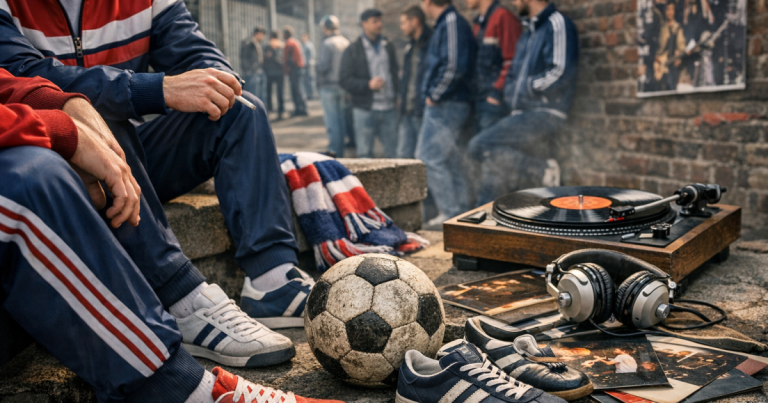
This is why old photographs matter so much. They show how people actually wore the clothes: not as immaculate mood boards, but as lived-in combinations of sports brands, denim, outerwear, trainers and whatever else was available. Books such as A Casual Look: A Photodiary of the 1980s Casual, Terrace and Football Scene are useful because they capture posture, context and attitude as much as garments. Cass Pennant’s The Football Casuals: A History also helps frame why clothing became so bound up with reputation, travel and tribal belonging.
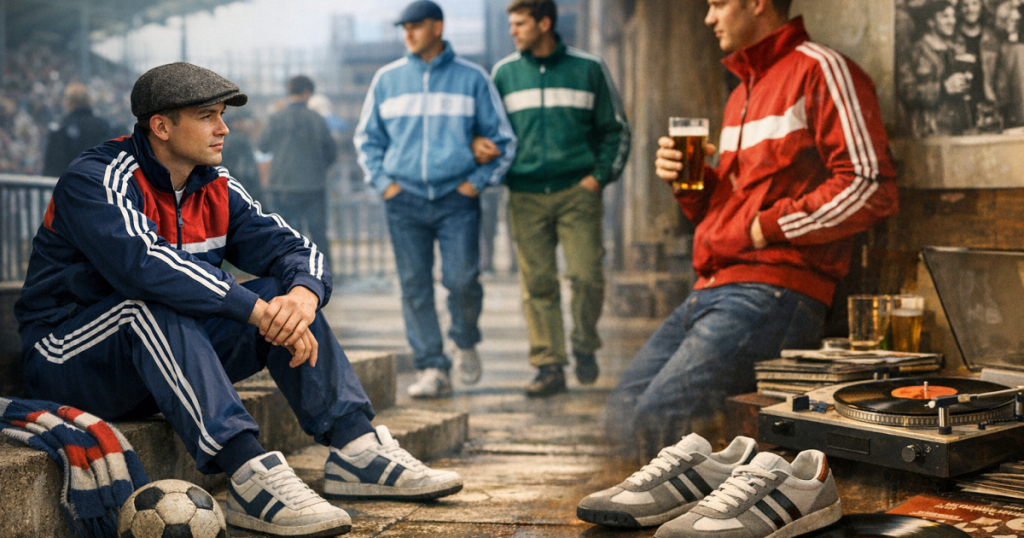
Film and television later amplified the imagery, sometimes with accuracy and sometimes with exaggeration. That has helped keep the look alive, but it has also created a shortcut version: retro track top, stern expression, pint glass, concrete concourse. The real culture is broader, messier and more regionally varied than that.
The authenticity problem
Every revival has a problem: what counts as authentic? Vintage originals have patina, era-correct cuts and scarcity, but they can be fragile, oddly sized or difficult to wear without looking like a collector’s display. Reissues and archive-inspired pieces are easier to live with, but they can feel too polished if the design loses the proportions and texture that made the original interesting.
There is also the question of who gets to wear the look. Some people treat terrace clothing as a closed code; others see it as part of mainstream British style. The sensible position is somewhere in the middle. You do not need a perfect personal backstory to wear a track jacket, but you should understand that the clothing comes with real social history. Reducing it to “hooligan chic” misses the point and usually makes the outfit worse.
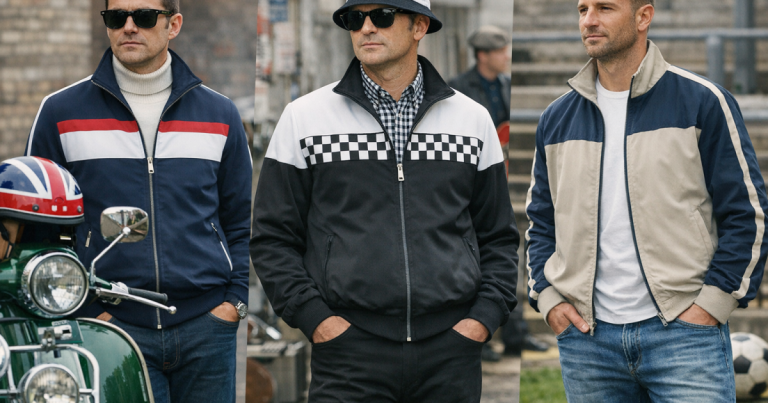
The strongest modern dressers tend to borrow the discipline, not the theatre. They use clean lines, considered colour and good footwear. They avoid dressing like an extra from a period film. They understand that one recognisable piece is usually more effective than five references shouting at once.
How the look works in 2026
In 2026, the tracksuit sits in a different world from its original subcultural moments. Sportswear is normal in offices, on trains, in cafés and at gigs. That makes the codes less secretive, but not meaningless. The difference now is that the wearer has to be more deliberate. If everything is casual, the details matter more.
A modern approach starts with fit. Oversized can work, but sloppy rarely does. Track jackets usually look best when the shoulders sit cleanly and the hem does not fight the rest of the outfit. Track pants need enough shape to avoid looking like gym kit pulled from the washing basket. Colour matters too: navy, cream, burgundy, forest green and black are easier to integrate than very loud primary combinations, although bold colours can still work when the rest of the outfit is calm.
Trainers are the bridge between heritage and now. Classic terrace footwear still has its place, but newer silhouettes can work if they respect the overall balance. The site’s Lacoste L003 Neo Shot review is useful here because it looks at a modern terrace trainer in context, rather than pretending every casual outfit has to be built from the same old reference points.
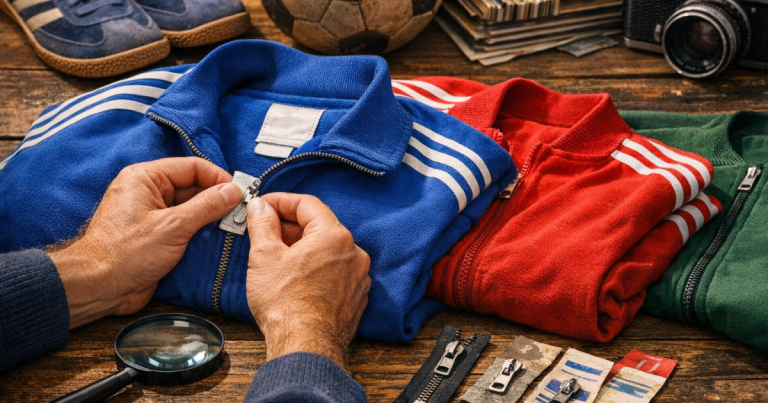
Care is part of the culture as well. Many track tops use synthetic or blended fabrics, so aggressive heat, rough washing and careless drying can damage shape, sheen or trims. Check the care label, wash similar colours together, avoid overloading the machine, and let pieces dry naturally where the label allows. A good track jacket should look worn, not neglected.
Things readers ask
Is terrace style the same as tracksuit culture?
No. Terrace style is one important branch of the wider story. Tracksuits also belong to sport, music, club culture, streetwear and everyday leisurewear.
Do you need to wear a full matching tracksuit?
Not usually. A track jacket with plain trousers or denim is often easier to wear. Full sets can work, but they need the right fit, colour and setting.
Are vintage tracksuits better than reissues?
Not automatically. Vintage pieces have character, but reissues can be more wearable and easier to care for. The better choice depends on condition, cut and how often you plan to wear it.
What trainers work best with a retro track top?
Low-profile court shoes, indoor trainers and clean casual runners usually work well. The aim is balance: let the track top lead without the footwear looking unrelated.
How do you avoid looking like you are wearing fancy dress?
Keep the rest of the outfit simple. Avoid stacking too many period references, choose a contemporary fit, and wear the clothes naturally rather than performing the era.
What stands out
The tracksuit matters because it refuses to stay in one lane. It is sport and leisure, uniform and rebellion, nostalgia and daily wear. In Britain, its route into terrace style gave it a sharper edge: less about pure athletic performance, more about taste, belonging and recognition.
The best way to understand it is not to memorise a list of approved brands. Look at context. Notice how people wore the pieces, what they paired them with, and why certain garments became signals. Then apply that knowledge lightly. A good track top should feel like part of your wardrobe, not a costume borrowed from someone else’s memory.