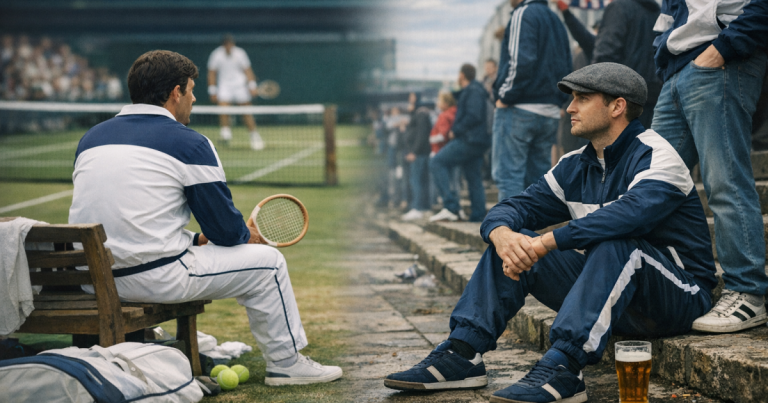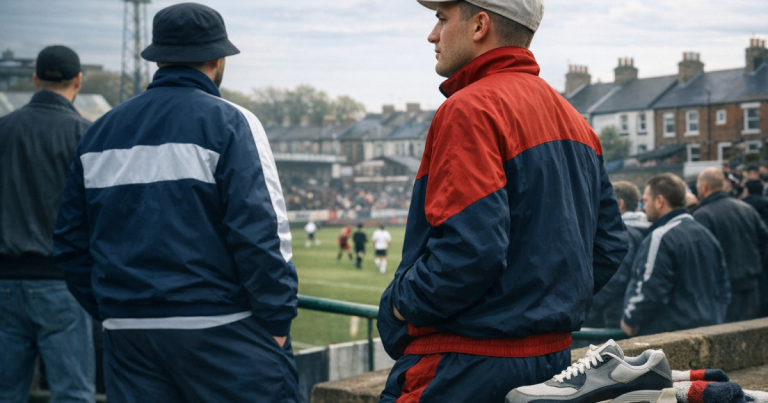
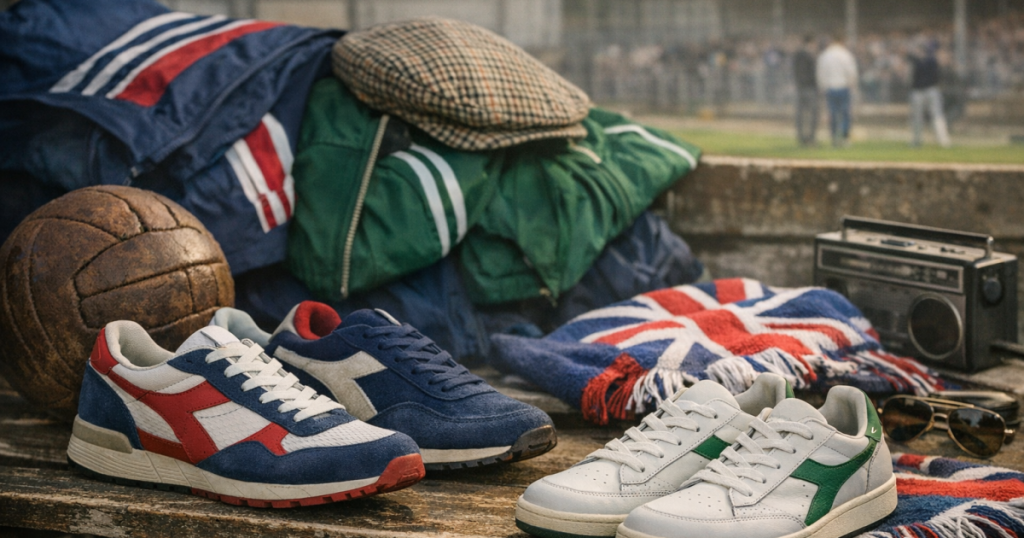
Diadora British casuals is often reduced to one shoe, the B.Elite, but that misses why the Italian brand still makes sense in a UK terrace wardrobe. Its pull comes from a mix of tennis prestige, continental sportswear, sharp colour use and less-obvious running shapes that feel different from the usual adidas-heavy uniform. Read it properly and Diadora becomes less of a single-trainer reference and more of a brand language you can wear without looking like you are dressing for a museum.
The trick is knowing which cues matter: slim shapes, clean panels, sport-first detailing and a bit of Italian restraint. Not every reissue or vintage find carries the same energy, so it helps to judge the wider legacy rather than chasing the most obvious reference.
The short version
- Diadora’s UK casual appeal is bigger than the B.Elite because the brand sits across tennis, football, running and continental leisurewear.
- The best terrace-friendly Diadora pieces usually have low-profile shapes, restrained branding, textured materials and colour combinations that feel archive-led rather than loud.
- Modern wearability depends on fit, condition, fabric and how well the trainers or track top sit with jeans, track pants, polos, caps and outerwear.
- For context on the wider dress code, it helps to understand terrace style and tracksuit culture before judging Diadora in isolation.
Step 1: start with the brand, not just the shoe
Diadora began in the Montebelluna footwear region of northern Italy, an area known for technical sports and outdoor footwear. That matters because the brand’s casual credibility did not come from fashion marketing first; it came from performance categories being adopted off-pitch, off-court and outside the shop window.
By the time UK football-casual taste was pulling in European sportswear, Diadora had useful ingredients: tennis associations, football boots, running footwear, athletic jackets and a visual identity that felt continental without being flashy. That made it attractive to dressers who wanted recognisable quality but not the same choices as everyone else in the pub or on the train to an away day.
Archive influence is central here. Modern reissues often borrow panel shapes, badges, colour blocking and fabric mixes from older sportswear. That does not automatically make every new item a faithful replica, so compare the details rather than trusting the nostalgia. The same principle applies across the scene, as covered in our piece on how sportswear brand archives shape modern retro tracksuits.
Step 2: separate the B.Elite from the wider legacy
The B.Elite earned its status for good reasons. It has the right tennis profile, the right era associations and a clean shape that works with denim, track pants and casual outerwear. But using it as the whole story flattens what Diadora offered to British casuals and what it can still offer now.
Diadora British casuals makes more sense when you see the B.Elite as one entry point rather than the final answer. The same brand language appears in other silhouettes: neat toe shapes, gum or tonal sole options on some releases, side flashes, suede and leather mixes, and colours that can feel richer than standard monochrome trainer choices.
That wider view is useful if you want to avoid the obvious. A B.Elite-style look can be sharp, but a runner or basketball-derived silhouette can give a terrace outfit more personality while staying within the casual codes. The key is restraint: if the shoe becomes too bulky, too futuristic or too colour-saturated, it stops feeling like a natural part of the archive line.
Step 3: read the silhouettes properly
Diadora’s legacy beyond the B.Elite is easiest to understand by looking at the types of footwear and clothing that translate well into modern terrace wear.
- Tennis-led low profiles: These are the safest route if you want a clean casual look. They work with straight-leg denim, cord trousers, track pants and simple polos because the shape does not fight the rest of the outfit.
- Basketball-derived pairs: The Diadora Mi Basket can bring more structure and height, but it needs careful styling. Keep trousers relaxed but not baggy, and avoid pairing it with too many oversized pieces at once.
- Running silhouettes: Archive-inspired pairs such as the Diadora N9000 or Diadora Camaro show how the brand’s runner side can work with terrace clothing. Look for balanced panels and wearable colours rather than treating them like modern gym trainers.
- Track tops and light sportswear: Diadora jackets can suit the look when the cut is tidy, the fabric has a period feel and the branding is not doing all the work. The best examples feel sporty, not costume-like.
Step 4: use practical checks before wearing or buying
Check the shape against your wardrobe
Terrace style is rarely just about the item itself. A Diadora trainer that looks excellent on its own may feel wrong if your trousers pool over it or your jacket is too boxy. Low-profile tennis pairs usually suit tapered or straight-leg fits. Running shapes often need a cleaner top half so the outfit does not become too busy.
Look at colour before branding
Diadora’s badge is part of the appeal, but colour is what decides whether the outfit works. Navy, cream, burgundy, forest green, off-white, grey and black tend to sit naturally with British casual wardrobes. Very bright combinations can work, especially with rave or 1990s influence, but they need confidence and space around them.
Judge fabrics and cut together
For track tops, pay attention to how the fabric falls. Shiny polyester can look brilliant when the cut is sharp, but cheap-looking sheen or a loose hem can weaken the effect. Cotton-heavy layers feel easier day to day but may lose some of the sportswear bite. If you are building outfits around fit and proportion, the terrace style fit guide is a useful next step.
Do not over-stack the references
A Diadora track top, retro runner, football scarf, vintage cap and era-specific jeans can tip into fancy dress if every piece is shouting at once. Pick one strong Diadora cue, then let the rest of the outfit support it. A plain hoodie, simple polo or understated overshirt often makes the archive piece look more natural.
Step 5: decide between vintage, reissue and modern nod
Vintage Diadora has obvious appeal, especially if you care about original labels, period colours and lived-in character. The trade-off is condition. Check zips, cuffs, elastic, lining, staining, sole firmness and whether the item has been altered. Old trainers can look good in photos while being poor choices for regular wear if the sole or upper has deteriorated.
Reissues are usually easier for sizing, returns and day-to-day use, but they need checking too. Look at the materials, the toe shape, the branding scale and whether the colourway feels plausible for the era you are referencing. A modern interpretation can still work if it respects the silhouette; it does not need to be a museum-grade reproduction.
A modern nod is the most flexible route. That could mean wearing a Diadora runner with a plain sweatshirt and straight jeans, or using an Italian sportswear track top under a casual jacket. The aim is not to pass as someone from a particular year. It is to carry the casual logic into clothes you will actually wear.
Straight answers
Is Diadora as important as adidas in UK terrace style?
Not in the same broad, unavoidable way. adidas became a dominant language across many parts of football-casual culture. Diadora’s appeal is more selective: it suits people who like continental sportswear, tennis heritage and slightly less common footwear choices.
Are Diadora runners terrace-friendly?
They can be, provided the shape and colours feel archive-led. Avoid treating every runner as automatically casual-friendly. The best ones sit closer to retro sportswear than modern technical running shoes.
Should you start with the B.Elite?
You can, but you do not have to. If you already own plenty of low-profile trainers, a Diadora runner or basketball-influenced pair may add more variety. If your wardrobe is still developing, a clean tennis shape is easier to style.
The big picture
Diadora’s British casual legacy is not a single-product story. The B.Elite is the headline, but the deeper appeal is the way the brand connects Italian sportswear, tennis polish, football credibility and runner culture without becoming too obvious. That makes it useful for modern terrace dressing: familiar enough to belong, different enough to feel considered.
The smartest approach is to treat Diadora as a set of cues rather than a logo to collect. Check the shape, fabrics, colour balance and condition. Wear one strong reference at a time. Let the rest of the outfit stay grounded. For a broader era-by-era view of where these cues sit, our decade-by-decade guide to retro tracksuit style helps place Diadora alongside the wider brands and silhouettes that shaped the scene.