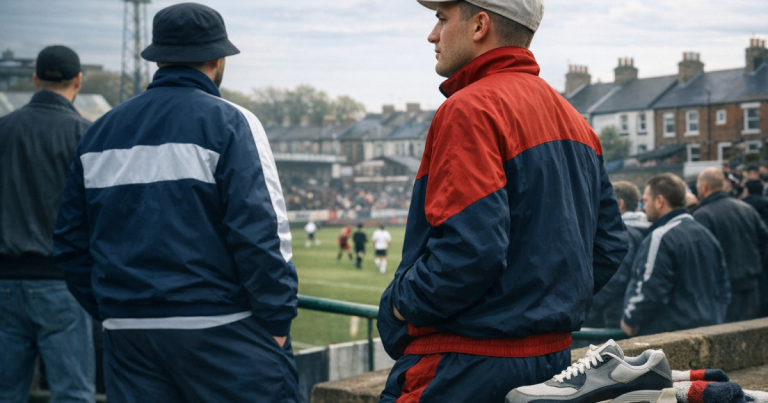
Modern retro tracksuits work best when they feel familiar without turning into fancy dress. The reason many current pieces land so well is that sportswear brand archives give designers a bank of cuts, colours, badges and cultural references to reinterpret for today’s terraces, pubs, gigs and everyday weekends.
For UK casualwear fans, the archive is not just a museum shelf. It is the difference between a track top that quietly nods to an era and one that looks like a generic throwback with a big logo stitched on.
In brief
- Brand archives influence modern retro tracksuits through old catalogues, original garments, teamwear, advertising, colour palettes and badge designs.
- The best reissues usually update fit, comfort and care while keeping the visual cues that made the original recognisable.
- Terrace style rewards restraint: a believable archive-inspired piece often works better than a head-to-toe replica.
- Before buying, check the silhouette, fabric feel, logo placement, colour blocking and whether the piece suits how you actually dress.
Use the archive as a filter rather than a rulebook. If you are buying for matchdays, the pub or daily wear, ask whether the piece still looks right once it is away from the product photo: under a navy mac, with faded denim, next to modern trainers, or layered over a sweatshirt when the weather turns. A strong retro tracksuit should not need the perfect backdrop to make sense.
It also helps to separate nostalgia from usefulness. A colourway might remind you of old catalogues, club trips or music videos, but if the collar sits awkwardly, the fabric clings, or the trousers only work as a full set, it may stay in the wardrobe. The most wearable archive-inspired pieces usually have one clear point of interest — a badge, stripe, panel shape or unusual shade — while the rest of the garment stays easy.
For a first buy, a track top is often safer than committing to the matching bottoms. It gives you the archive reference without making the outfit feel too staged, and it is easier to rotate through a normal UK casual wardrobe.
What a brand archive really contains
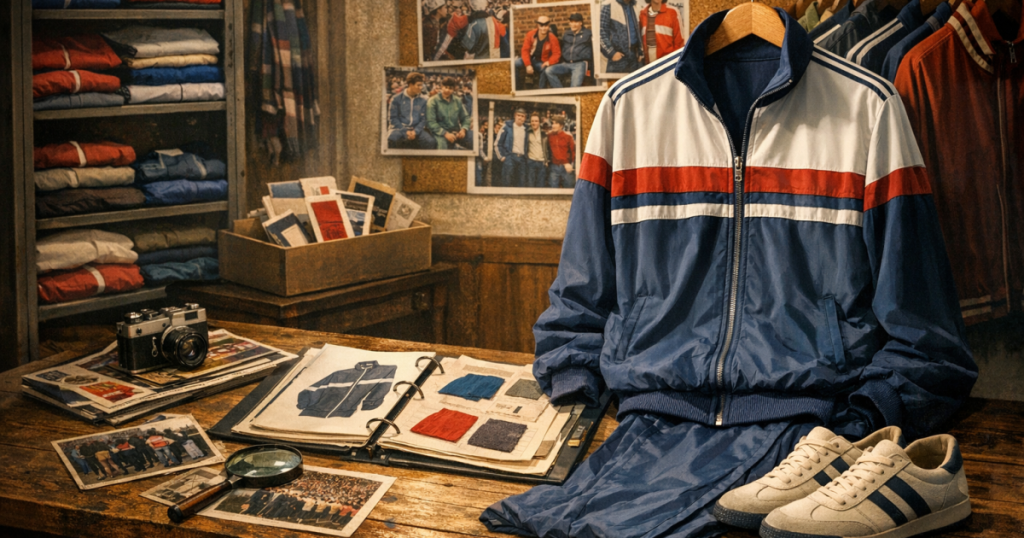
A serious archive is more than a rail of vintage jackets. It can include factory patterns, fabric swatches, campaign photography, athlete contracts, old football kit templates, shop displays, lookbooks, badge variations and regional adverts. Those materials help a brand understand not only what it made, but why people cared about it.
That matters because retro sportswear is unusually sensitive to small details. A collar shape, zip pull, piping line or sleeve stripe can immediately suggest a particular period. Change too much and the garment loses its reference point. Copy too closely and it risks feeling like costume, or simply impractical for everyday wear.
Good modern retro design sits between those points. It keeps the recognisable identity, then adjusts the proportions, fabric handle and styling potential for current wardrobes.
Why terrace culture made archive details matter
In British football-casual culture, sportswear was never just sportswear. The right Italian tennis top, German trainer, British football brand or French polo could signal taste, travel, music allegiance and local knowledge. People noticed details because details were part of the language.
That is why archive-led tracksuits still resonate. Ellesse, for example, did not become important in the UK simply because it had a neat half-ball logo. Its ski and tennis roots gave it a continental glamour that later made sense on British terraces, a shift explored in more depth in the Ellesse terrace story.
Umbro followed a different path. Its history is tied closely to British football kits, club identity and the everyday visual culture of match-going. That gives its archive a different kind of weight: less alpine leisure, more changing-room, touchline and Saturday afternoon. For that lineage, Umbro’s move from football kits to terrace style is a useful companion read.
How old designs become new tracksuits
Most modern retro tracksuits are not exact copies. A brand might take the colour blocking from a 1980s catalogue, the collar from a tennis warm-up top, the leg shape from a football training suit and the badge from a short-lived archive label. The result can feel heritage-led without belonging to one precise year.
This approach is obvious in pieces such as the Adidas Originals Firebird Track Top, which draws on familiar three-stripe sportswear language without needing to be treated as a museum replica. A track top like the Sergio Tacchini Damarindo Track Top works differently: it leans into the tennis-club-meets-terrace mood that made Italian sportswear so appealing to UK casuals.
The important point is not whether a garment is completely original to a single season. It is whether the reference is coherent. A strong archive-inspired tracksuit usually has a clear visual logic: the colours belong together, the branding does not fight the panel layout, and the fit supports the mood rather than flattening it.
The main archive cues to look for
Silhouette
Older tracksuits often had shorter tops, fuller sleeves, higher waists or wider legs than many modern sportswear pieces. Reissues may soften those shapes to suit current expectations, but the overall stance still matters. A slim, stretchy set can look too gym-focused if you are aiming for terrace style, while an oversized replica can tip into fancy dress.
Colour blocking
Archive colour blocking is one of the clearest signals. Navy with white piping, forest green with cream, red and black panels, or deep royal blue with contrast stripes can all evoke particular sportswear periods. The trick is to choose colours you will actually wear with trainers, outerwear and basics you already own.
Badges and logos
A logo can make or break a retro tracksuit. Embroidered badges often feel more considered than oversized printed branding, although that depends on the era being referenced. Archive labels, trefoils, wordmarks and crest-style badges all carry different meanings. Look at placement as much as size: a chest badge, sleeve mark or small leg logo reads differently from a full-width front graphic.
Fabric and finish
Archive inspiration does not mean the fabric has to behave exactly like an old garment. Modern versions may use updated synthetics, brushed jersey or woven shells that are easier to wear and care for. What matters is whether the finish supports the look. A high-shine fabric suits some late 1980s and early 1990s references; a softer matte finish can be better for low-key pub and matchday outfits.
Archive-led does not always mean better
There is a risk in treating the archive as automatically authentic. Some reissues are beautiful but awkward: odd proportions, difficult colours, or details that only work if the rest of the outfit is equally committed. Others use archive language as decoration without much substance.
For most wardrobes, the strongest move is to borrow one or two credible cues rather than chase a full period reconstruction. A classic track top, straight-leg dark denim, clean trainers and a plain hoodie can say more than a full set worn with every era-correct accessory. If you are building from scratch, the principles in building a terrace style wardrobe that actually works help keep the archive references wearable.
A garment such as the Adidas Originals Beckenbauer Track Top shows why restraint can be powerful. Its appeal is not just nostalgia; it is the way a simple shape and recognisable sporting language can sit naturally with jeans, cords, trainers or a lightweight jacket.
Vintage originals versus modern reissues
Vintage originals have charm: the patina, the label, the cut and the sense that the garment has lived a life. They can also bring compromises. Sizing may be inconsistent, elastic can tire, zips can feel fragile, and older synthetic fabrics may require more careful handling.
Modern reissues are often easier for regular wear. You can usually compare sizes more predictably, style them with current basics and care for them without treating every outing like a preservation project. The trade-off is that some reissues smooth away the quirks that made the original interesting.
A sensible wardrobe can use both. Keep a vintage top for the days when you want character, then use a modern archive-inspired tracksuit for regular wear. That balance feels more natural than pretending one route is superior in every situation.
Looking after archive-inspired sportswear
Care is part of making retro sportswear last. Always follow the garment’s own care label, especially with synthetic fabrics, appliqué badges, printed logos and contrast panels. Avoid aggressive heat unless the label allows it, and hang pieces properly so collars, cuffs and hems keep their shape.
For creases in track tops and lightweight shells, a handheld steamer can be useful when used carefully. The Philips 3000 Series Handheld Garment Steamer is one example to compare if you want a simple care tool for sportswear, but always check fabric guidance before steaming printed or delicate details.
Questions people ask
Are archive reissues the same as vintage tracksuits?
No. A reissue is a modern garment inspired by an older design, while a vintage tracksuit is an original older piece. Reissues can be easier to wear and size, but vintage items often have more period-specific character.
Do archive-inspired tracksuits work for everyday UK style?
Yes, if you keep the rest of the outfit grounded. A track top with dark denim, simple trainers and a plain tee usually feels more natural than a full retro set worn without restraint.
Which brands use their archives well?
Adidas Originals, Fila, Ellesse, Sergio Tacchini, Umbro, Diadora, Kappa and Lacoste all have archive stories that influence modern sportswear. The best choice depends on whether you prefer football, tennis, running, ski or casualwear references.
What should I check before buying a retro tracksuit?
Look at the fit, fabric, logo treatment, colour blocking and care label. Also check whether the piece works with trainers, jackets and basics you already own, rather than buying purely for nostalgia.
Final thoughts
The best modern retro tracksuits are not just old ideas reheated. They are edited versions of a brand’s own memory: sporting heritage, terrace adoption, music culture and everyday wear all folded into something usable now.
When you understand the archive cues, you can judge a track top or full set more confidently. You are not just asking whether it looks retro. You are asking whether the design has a reason to exist, whether it suits your wardrobe, and whether it carries enough history without wearing the whole past at once.