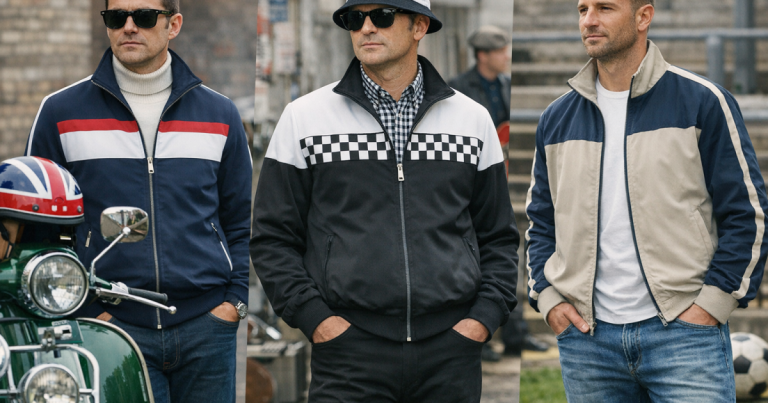
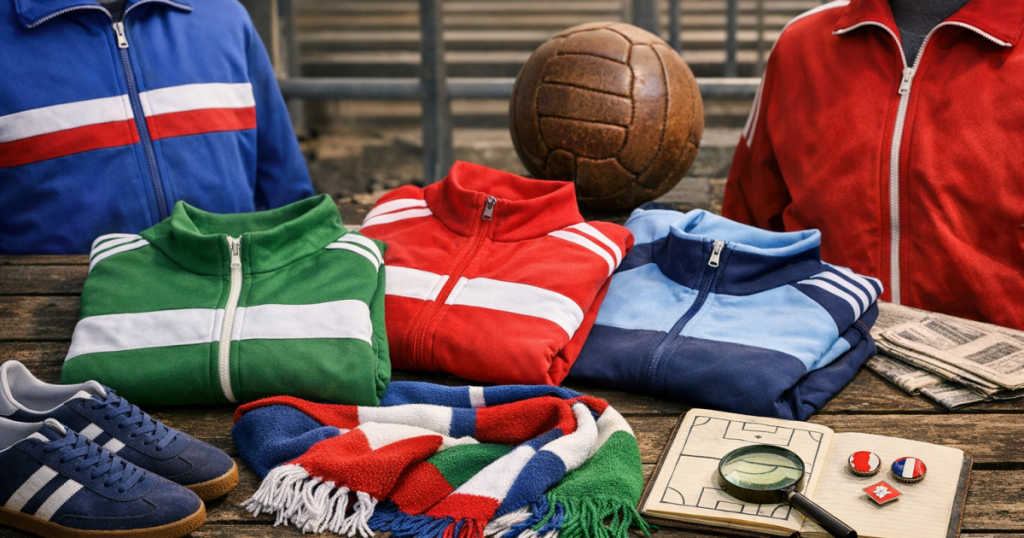
A tracksuit in the wrong shade can say more than the wearer intended, especially around football grounds, pubs and train platforms on matchday. Understanding club colours in terrace culture is less about wearing a scarf on your sleeve and more about reading palette, place and context before you build the outfit. The trick is to let colour nod to affiliation without turning a clean casual look into full-kit theatre.
For UK casuals, colour has always carried layered meaning: loyalty, local memory, rivalry, era, brand status and sometimes deliberate understatement. A red track top is not just red if you are walking towards Anfield, Old Trafford or the City Ground; a sky-blue jacket lands differently in Manchester than it does in a neutral setting.
In brief
- Read colour through place first: the same tracksuit can feel neutral in one city and loaded in another.
- Separate club reference from replica-kit energy: one colour accent is usually sharper than a head-to-toe badge match.
- Know the rivalry map before wearing strong local colours near a ground, on away travel or in mixed pubs.
- Use brand, fabric and fit to calm the message: a clean navy track jacket speaks differently from a shiny full set in a loud club palette.
- When in doubt, go tonal, muted or heritage rather than obvious.
Step 1: Start with geography, not the garment
Terrace colour reading begins with where you are. In Britain, football identity is unusually local: streets, pubs, train routes and family loyalties can make colour feel more specific than it looks on a hanger. Red can suggest Liverpool, Manchester United, Nottingham Forest, Arsenal or Wrexham depending on the place. Blue can mean Chelsea in west London, Rangers in Glasgow, Everton in Liverpool, Cardiff City in south Wales, Birmingham City in the Midlands or Manchester City when the shade is light enough.
That does not mean every colour is a warning sign. It means the wearer should understand the local code before assuming a colour is neutral. A green-and-white combination may feel simply retro in many settings, but in Glasgow it carries obvious Celtic associations. Claret and blue can lean West Ham, Aston Villa, Burnley or Scunthorpe depending on the setting. Black and white stripes instantly bring Newcastle United to mind in the North East, even if the garment is not a football shirt.
The useful question is not “what does this colour mean everywhere?” but “what might people read into it here, today?” That is especially important around derbies, cup days, promotion run-ins and railway stations where supporter movement is more visible.
Step 2: Learn the difference between colour, badge and uniform
Terrace tracksuit culture has never been as simple as dressing in club kit from head to toe. The sharper end of casual style often came from avoiding obvious replica wear while still signalling knowledge. A well-chosen track top, trainers and outerwear could nod to a club, an era or a region without looking like a mascot outfit.
A badge makes allegiance explicit. A colour palette suggests it. A full matching tracksuit in club colours turns the volume up again. That is why a navy track jacket with a small red detail may feel casually connected to a club, while red top, red bottoms and red trainers can look performative unless the setting is openly matchday.
Fit and fabric matter too. A relaxed cotton-blend top, a soft shell jacket or a low-sheen track jacket can make a strong colour easier to wear. High-shine polyester, bright contrast piping and matching bottoms amplify the terrace message. If you want a broader grounding in how these visual codes work beyond colour, the guide to terrace tracksuit fits, fabrics and football-casual meaning is the natural next step.
Step 3: Decode the main colour families
Red
Red is one of the loudest football colours in Britain because it belongs to so many major clubs. It can be classic, confident and easy to style, but it rarely disappears in a crowd. Around Liverpool, Manchester, north London, Nottingham or south Wales, the shade and surrounding details matter. Deep red, scarlet and burgundy do not all read the same. White piping can sharpen an Arsenal or Liverpool association; black trim might send the outfit somewhere else entirely.
Blue
Blue is more complicated than it first appears. Royal blue can lean Everton, Chelsea, Rangers, Leicester City or Birmingham City. Sky blue carries Manchester City, Coventry City and sometimes old-school training-ground associations. Navy is the safest of the blues because it sits closer to general menswear, especially when paired with white trainers, denim or a neutral jacket.
Green
Green can be stylish and underused in retro sportswear, but in certain cities it is not quiet. Green and white can evoke Celtic, Hibernian or Plymouth Argyle, while darker green can feel more outdoors or military if the rest of the outfit avoids hoops, white panels or football-shirt styling. Olive is usually easier to wear if you want the colour family without direct club energy.
Claret, burgundy and maroon
These tones are rich, wearable and strongly connected to clubs such as West Ham United, Aston Villa and Burnley when paired with pale blue. On their own they can feel more fashion-led, especially in a track jacket, knit or hoodie. Add sky-blue accents and the football reading becomes much clearer.
Black, white and monochrome
Black-and-white styling can look clean, but stripes are loaded in the right context. Newcastle United is the obvious reference, though Notts County and other clubs also sit in the same visual territory. Plain black tracksuit pieces are far more neutral, but white contrast stripes can shift the outfit towards football, adidas heritage or a particular era depending on the cut.
Step 4: Use era and brand to soften or sharpen the message
The same colours feel different when filtered through a period. Seventies Italian tennis-inspired track tops, eighties casual silhouettes, nineties rave-adjacent sportswear and modern slimline reissues all carry different levels of football meaning. A Fila-style colour-blocked jacket might read as heritage sportswear first, while a full matching set in a club palette can feel more explicitly terrace.
Brands also change the interpretation. Adidas, Puma, Sergio Tacchini, Fila, Ellesse, Kappa and Diadora all have their own routes into British casual culture. Some are tied to European trips and tennis influence; others sit closer to training wear, hip-hop, rave or later streetwear. If you want to place colour within the bigger timeline, terrace style by era helps show why a shade that looked sharp in one period can feel costume-like if copied too literally now.
Step 5: Check the matchday setting
Colour is not just visual; it is situational. What looks harmless on a normal Saturday in town can feel pointed on derby day. Before wearing obvious club colours near a ground, think through the route, the pubs, the train station and whether you are in a home, away or mixed area.
- Home match, home area: colour nods are usually easier, but a full tracksuit in club shades can still look heavy-handed.
- Away travel: understated colours are often more practical, especially if you are passing through rival towns.
- Neutral pub or big-screen setting: avoid ambiguous rival palettes if the fixture is sensitive.
- Non-matchday wear: you have more room to treat colour as style rather than declaration.
- Festivals, gigs and casual nights out: music and streetwear references may overtake football readings, but local colour associations still exist.
This is not about paranoia. It is about literacy. Terrace style has always rewarded people who understand the room.
Step 6: Balance club reference with wearable style
The cleanest modern approach is usually one strong colour cue and two quiet pieces. If the track top carries the club-related shade, keep the bottoms navy, charcoal, stone or black. If the trainers are doing the colour work, make the jacket more restrained. If a football shirt is involved, reduce the rest of the outfit rather than stacking every matching colour you own.
That last point matters because replica shirts and terrace tracksuits operate by different rules. A shirt is overtly tribal; a track top can be more coded. Mixing the two can work, but it needs restraint. The advice in wearing a football shirt without losing terrace style is useful if you want the club reference to stay sharp rather than souvenir-shop obvious.
Step 7: Read the smaller details
Colours rarely work alone. Piping, stripes, collars, cuffs, zips and trainer accents all contribute to the signal. A navy jacket with a tiny red zip pull is subtle. Navy with red-and-white sleeve taping is much more pointed. Green track pants with white side stripes can say more than a plain green sweatshirt.
Accessories also shift meaning. A cap, scarf, cross-body bag or pin badge can turn a loose colour reference into a direct supporter look. Trainers matter as well: gum soles, white leather, suede uppers and colour flashes all pull an outfit towards different eras of terrace style. The most convincing outfits usually look assembled rather than themed.
Common colour-reading mistakes
- Assuming a colour is universal: football colours are local. Always factor in the city, fixture and setting.
- Matching too literally: club shirt, club-coloured tracksuit and matching trainers can flatten the outfit.
- Ignoring rival readings: wearing the wrong blue, red or green in the wrong place can look naive even when unintentional.
- Confusing nostalgia with accuracy: not every retro colour combination has terrace history. Some are simply sportswear trends.
- Forgetting the rest of the outfit: fit, brand, footwear and outerwear can either refine or exaggerate the message.
Helpful questions
Can I wear rival colours if I am not going to the match?
Yes, but context still matters. Away from grounds and derby days, most colours become easier to wear. In a strongly football-coded local setting, people may still read the palette before they notice your intent.
Are muted colours safer than bright club shades?
Usually. Navy, charcoal, olive, burgundy and off-white are easier to style than bright red, royal blue, green-and-white or claret-and-blue combinations, especially in full tracksuits.
Does a tracksuit need to match my club?
No. Many of the best terrace looks are about era, brand, fit and confidence rather than direct club matching. A neutral tracksuit can look more informed than an overly literal colour scheme.
How do I make a club-coloured track top look less obvious?
Pair it with plain trousers, understated trainers and minimal accessories. Avoid adding the shirt, scarf and cap in the same palette unless you want a clear matchday look.
Is club colours in terrace culture still relevant in 2026?
Yes. Modern casual style is more flexible, but football colours still carry local meaning across Britain. The codes have softened, not disappeared.
Main lessons
Decoding club colours is a practical skill, not a rigid rulebook. Start with place, fixture and rivalry, then look at shade, garment type, brand and the rest of the outfit. A single colour nod can feel sharp and knowledgeable; a full literal palette can feel forced.
The strongest terrace tracksuit outfits leave enough space for interpretation. They understand football culture without shouting it, respect local meanings without becoming nervous, and use colour as one part of a wider casual language built from fit, fabric, trainers and era.