
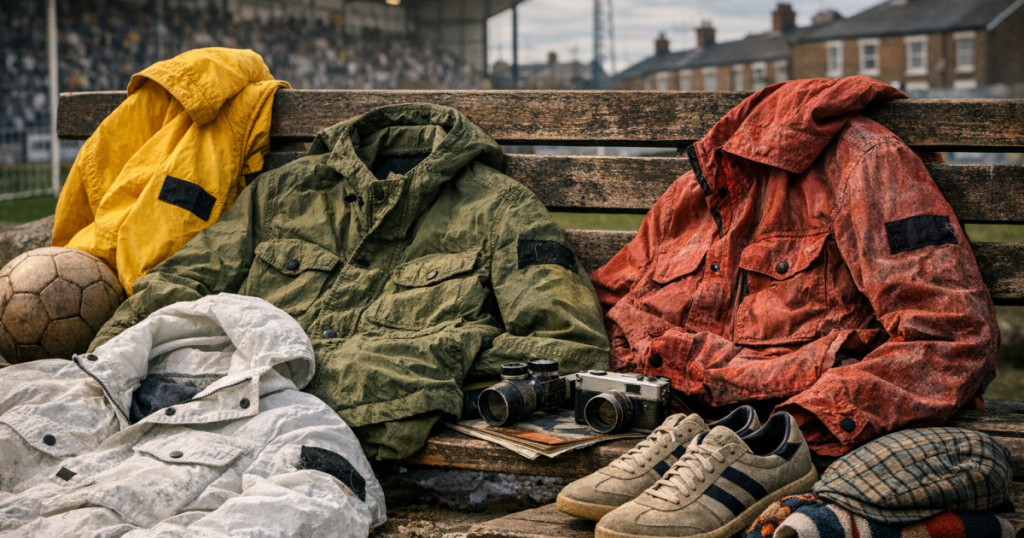
For anyone trying to understand Stone Island archive pieces, the trick is to look beyond the sleeve badge. The garments that shaped British terrace style were not just expensive jackets with a compass patch; they were fabric experiments, sharply coloured outer layers and status signals that travelled well from Italian sportswear into UK football, music and street culture.
That matters if you are studying old photos, buying vintage, or trying to build a modern outfit without drifting into costume. The strongest Stone Island references usually come from fabric, proportion and restraint, not from shouting every logo in the room.
The short version
Stone Island’s terrace influence came from a few recurring ideas: military-inspired outerwear, unusual fabric treatments, garment dyeing, bold but wearable colour, and the removable compass badge. Archive jackets became prized because they looked technical without feeling like conventional sports kit, and because they worked with denim, track tops, knitwear and trainers in a way that felt natural on British terraces.
If you want to read the look properly, follow a simple order:
- Start with the fabric story, not the badge.
- Check the shape: cropped bomber, field jacket, overshirt, smock or parka.
- Look at colour and fading, especially navy, stone, burgundy, sage, olive and black.
- Notice how the badge is balanced against the rest of the outfit.
- Treat vintage claims carefully unless labels, condition and provenance support them.
Why Stone Island made sense on British terraces
Stone Island was founded in 1982 with Massimo Osti’s fabric-led approach at its core. From the beginning, the brand sat in a different lane from standard training wear. It borrowed from military kit, nautical clothing, workwear and sportswear, then pushed those references through unusual dyeing, coating and finishing processes.
That was exactly the sort of thing British casuals were good at spotting. Terrace style has always been partly about wearing something recognisable to those in the know, but not necessarily obvious to everyone else. A rare Italian jacket could say more than a loud full tracksuit, especially when worn with the right jeans, knitwear and trainers.
The brand also fitted the wider shift from classic sportswear into technical outerwear. If adidas, Fila, Sergio Tacchini and Diadora formed the language of track tops and trainers, Stone Island helped define the outer layer: the jacket you kept on in the stand, outside the pub, on the train, or at a night out afterwards. For the broader brand map around that movement, the piece on the brands that built British retro tracksuit culture is a useful companion.
Step 1: read the fabric before the badge
The badge is the easy visual clue, but the archive appeal often starts with material. Stone Island’s reputation was built on fabric experimentation, so the smartest way to understand an old piece is to ask what the cloth is doing.
Tela Stella
The early Stone Island Tela Stella Jacket is the foundation myth for the brand. It came from a heavy, treated cotton cloth associated with tarpaulin and military or nautical references rather than conventional fashion fabric. The point for terrace style is not that every wearer knew the technical backstory; it is that the garment looked tougher, stranger and more purposeful than ordinary casual outerwear.
When looking at Tela Stella-inspired pieces, pay attention to the washed surface, the utilitarian pockets and the slightly rugged character. Modern reissues and archive references can capture some of that mood, but always check the exact product description rather than assuming every similar-looking jacket uses the same cloth or construction.
Raso Gommato
Raso Gommato is another important Stone Island fabric family, broadly associated with a rubberised or coated cotton satin effect. On the terrace, this sort of finish gave a jacket presence without needing huge graphics. It looked premium, slightly military and weather-aware, but still wearable with jeans and trainers.
For a practical read, look for how the fabric hangs. Does it feel structured or soft? Does the surface have sheen, coating, patina or cracking? With older garments, condition is part of the story, but it is also a risk. Coated fabrics can age unpredictably, so do not treat wear as automatically desirable.
Ice and reflective treatments
The Stone Island Ice Jacket became one of the most recognisable examples of the brand’s experimental side because of its temperature-responsive colour-change concept. Reflective jackets, meanwhile, gave Stone Island a night-time, camera-flash presence that connected easily with club culture, awaydays and urban visibility.
These pieces shaped terrace imagination because they felt almost like wearable technology before that phrase became ordinary. Still, they are not everyday purchases for most people. If you are looking at one now, verify condition, authenticity, care requirements and whether the effect remains intact. A rare name alone does not guarantee a good garment.
Step 2: understand the badge as a signal, not the whole outfit
The compass badge is central to Stone Island’s terrace identity, but it works best when it has space. On a strong outfit, the badge often acts as a single point of recognition: sleeve patch, clean jacket, simple knit or polo, good denim, tidy trainers. Add too many competing logos and the look becomes noisy.
This is where Stone Island differs from a full retro tracksuit. A tracksuit can carry stripes, piping and chest branding as part of a set. A Stone Island jacket usually works as the dominant piece, with everything else supporting it. If you are building an outfit around one, the advice in how to balance logos in a terrace style outfit applies particularly well: one clear focal point is usually stronger than three loud ones.
There is also a cultural point here. The badge has carried different meanings in different places: terrace status, fashion knowledge, youth culture, resale value, and sometimes lazy stereotypes about football trouble. A considered outfit keeps the clothing in the realm of style rather than caricature.
Step 3: know the archive families that changed the look
You do not need to memorise every season to understand Stone Island’s terrace role. It is more useful to recognise the recurring garment families that shaped how the brand was worn.
- Military field jackets: Practical pockets, structured fronts and muted colours made these easy to wear over polos, sweatshirts and track tops.
- Bomber and flight-inspired jackets: Shorter shapes worked well with straight denim and terrace trainers, giving a sharper silhouette than a long parka.
- Smocks and overhead jackets: These brought a more technical, outdoor feel while still fitting the casual tradition of distinctive outerwear.
- Marina pieces: The Stone Island Marina Jacket line brought nautical cues, often with bolder branding or striped elements, making it a useful contrast to quieter badge-led jackets.
- Reflective outerwear: More dramatic and less subtle, but important in the way it linked terrace clothing with nightlife, cameras and urban movement.
- Monochrome and Ghost-style ideas: Later badge-tonal pieces show how the brand’s identity can become quieter while still remaining recognisable to enthusiasts.
The common thread is that Stone Island gave the terrace wardrobe another level. It was not replacing the track top; it was the jacket that could sit above it and make the whole outfit feel more deliberate.
Step 4: check details before calling something archive
Archive language gets used loosely. Not every older Stone Island piece is rare, and not every rare-looking jacket is valuable or even authentic. If you are assessing a garment, use a practical checklist rather than relying on one photo of the badge.
- Labels: Look for care labels, country-of-origin information and any internal codes. Label formats vary by era, so compare carefully with reliable references.
- Art number: Many Stone Island garments use an art number system that can help identify season, product type, material and colour. It is useful, but it should be read alongside the garment, not in isolation.
- Badge and buttons: Check stitching, button quality, placement and wear. Replacement badges exist, so a correct-looking badge does not prove the whole garment.
- Fabric condition: Coatings, linings, zips, cuffs and dye can age differently. A jacket can look good in photos but feel tired in hand.
- Provenance: Receipts, original tags and long-term ownership details can help, but treat seller stories as supporting evidence rather than proof.
- Modern authentication tools: Later garments may include authentication systems, but early archive pieces need traditional checking because they pre-date many modern verification features.
If you are buying to wear rather than collect, be honest about maintenance. Some archive fabrics need more care than a standard cotton overshirt or nylon jacket. Specialist cleaning advice may be worth seeking for high-value pieces, especially where coatings, dye effects or bonded fabrics are involved.
Step 5: wear the reference without looking like fancy dress
The easiest mistake is to copy the loudest version of the look: badge, big branding, aggressive trainers, matching attitude. Terrace style works better when it feels lived-in. Stone Island is strongest when it looks like part of a wardrobe, not a costume hired for a theme night.
Start with colour. Navy, stone, burgundy, olive and dark green sit naturally with the brand’s military and nautical roots, and they also work with classic British casual staples. If you are unsure how to build a palette around one strong jacket, the terrace style colour guide gives a more detailed route through those shades.
Then control the layers. A Stone Island field jacket over a plain sweatshirt, fine knit or polo usually feels sharper than stacking it over another heavily branded top. With track tops, keep the era conversation sensible: a neat retro adidas or Fila top can work under a jacket, but the colours need to speak to each other.
Finally, keep trainers grounded. Terrace footwear does not have to be rare to work. Low-profile suede, classic leather court shapes and understated runners can all sit under Stone Island outerwear. The main check is proportion: bulky jackets usually need a trainer with enough presence, while slimmer overshirts can take a cleaner shoe.
Common mistakes when chasing the Stone Island archive look
- Buying the badge rather than the garment: A poor fit or failing fabric will not become better because the sleeve patch is present.
- Assuming old means good: Some archive pieces are historically interesting but difficult to wear, fragile, or simply not flattering.
- Ignoring colour fade: Fading can add character, but uneven bleaching, collar staining and dye transfer are different issues.
- Overloading the outfit: Stone Island, a huge trainer, a logo cap and a loud track top can fight for attention.
- Forgetting the British context: The terrace look is about codes and restraint as much as labels. It is not just luxury sportswear with football attached.
Fast answers
Which Stone Island pieces most influenced terrace style?
Fabric-led outerwear had the biggest impact: Tela Stella, Raso Gommato, Ice, reflective jackets, Marina pieces, field jackets, bombers and smocks. The exact piece matters less than the combination of technical cloth, strong colour and badge recognition.
Is Stone Island terrace style or football casual clothing?
It can sit in both, but the terms are not identical. Football casual culture is rooted in match-going identity and status codes; terrace style is the broader visual language that has travelled into everyday menswear. Stone Island became important because it worked in both settings.
Are modern Stone Island pieces still relevant?
Yes, but the strongest modern outfits usually borrow archive principles rather than pretending to be vintage. Look for considered colour, good outerwear shape, restrained branding and layers that make sense with the jacket.
The big picture
Stone Island archive pieces matter because they changed what a terrace jacket could be. They brought experimental Italian fabric, military and nautical references, and a badge that became instantly readable without relying on traditional sportswear branding.
The best way to use that history now is not to chase every hyped garment. Learn the fabric families, check authenticity carefully, respect colour and proportion, and let one strong piece carry the outfit. That is how Stone Island keeps its terrace edge in 2026: not as nostalgia alone, but as a practical language for wearing archive sportswear with intelligence.