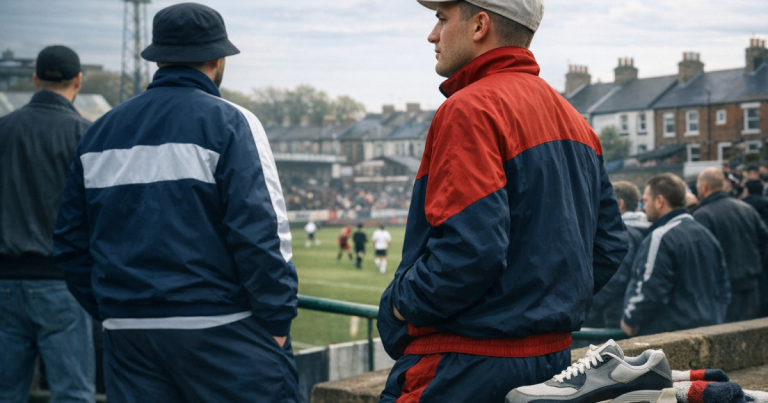
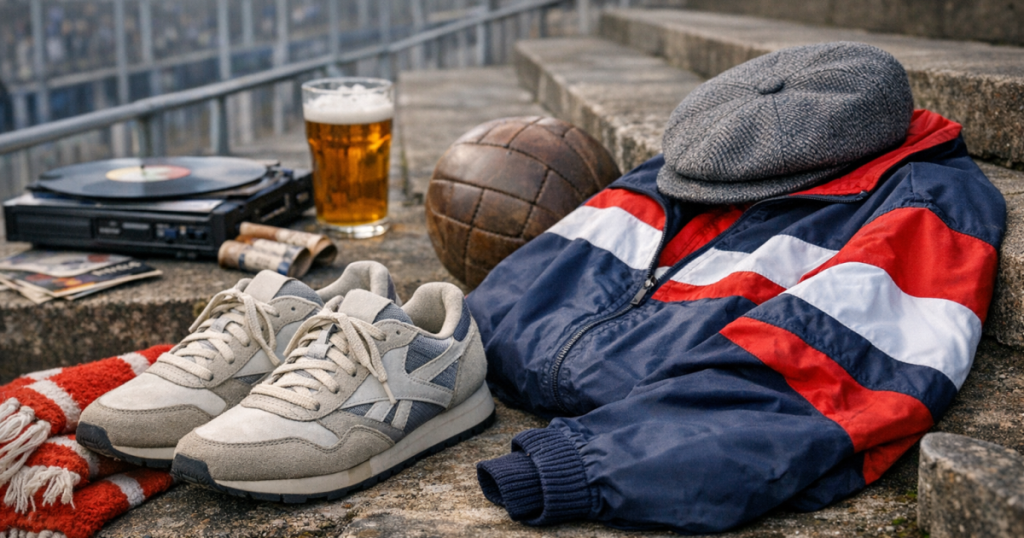
Reebok never had to pretend it belonged in British sportswear culture. The brand grew out of running craft in Bolton, moved through court shoes and fitness booms, then found a second life in the everyday language of Classics, track tops and low-key trainers. Reebok Classics history is useful because it explains why some pieces feel properly rooted, while others look like vague retro sportswear with the badge doing too much work.
What to know first
Reebok’s appeal is different from the Italian tennis brands and the German football giants. It is not just about continental glamour, nor only about three-stripe terrace symbolism. Its strongest British pull comes from familiarity: school corridors, sports shops, gym bags, local five-a-side, mainstream football culture and trainers that could sit under jeans without shouting.
- Bolton matters: Reebok’s story starts with J.W. Foster and Sons, a running-shoe maker associated with Bolton and early spiked footwear.
- The Classics line works because it is wearable: leather court shoes, simple runners and understated tracksuits are easier to build into modern outfits than loud archive pieces.
- Terrace relevance is selective: some Reebok pieces fit casual style naturally; others belong more to gym, basketball, school sportswear or general 90s nostalgia.
- Condition and cut matter: a sharp vintage track top can look brilliant, but a tired, shiny, misshapen set can drift into fancy dress territory.
From J.W. Foster to the Reebok name
The roots go back to J.W. Foster and Sons, a family firm in Bolton known for running footwear. That origin gives Reebok a different kind of credibility: not a marketing story bolted on later, but a practical performance background built around making shoes for athletes. The Reebok name itself arrived later, in the late 1950s, and the brand would eventually grow far beyond its Lancashire beginnings.
That matters to British readers because Reebok is not an imported fantasy of sport. It has a genuine UK thread, even though its later success became international. By the time the Classics language became familiar, the brand had already travelled through running, aerobics, tennis, training, football-adjacent leisurewear and mass-market sports fashion.
For terrace-style collectors, the key is to avoid flattening that history. Reebok was never just one thing. It could be a running brand, a fitness brand, a court-shoe brand and a high-street sportswear staple depending on the year, the product and the subculture wearing it.
The trainers that made Classics feel credible
Reebok’s strongest retro appeal often begins with footwear. The brand’s classic trainers are not all terrace icons in the same way as a suede adidas silhouette, but several have the right qualities: low profile, clean shape, neutral colours and enough everyday familiarity to feel authentically British.
- Reebok Classic Leather: introduced in the 1980s and still one of the easiest Reebok models to understand. It works because it is simple, soft-edged and not too technical-looking.
- Reebok Club C 85: a court-style shoe with a cleaner, smarter feel. It suits denim, track tops and polo shirts without making the outfit look over-referenced.
- Reebok Workout Plus: more robust and gym-coded, but still useful for casual outfits where you want a plainer alternative to the obvious terrace trainer choices.
- Reebok Freestyle Hi: strongly tied to fitness and aerobics culture, so it tells a different Reebok story rather than a straight football-casual one.
The important point is not that every Reebok trainer is a terrace classic. It is that the best ones give you a grounded British sportswear look without leaning on the most predictable references. If you already own suede terrace staples, a clean Reebok leather shoe can change the mood of a tracksuit or track jacket instantly.
Where tracksuits enter the story
Reebok tracksuits do not carry one single uniform meaning. In Britain, they often sit between performance kit, leisurewear and 90s high-street sportswear. That is exactly why they can be useful now: they are recognisable without being as heavily coded as some Italian or German archive pieces.
Older Reebok track tops with Vector branding, contrast piping, panelled shoulders or lightweight synthetic fabric can work especially well. The better examples tend to have a proper sports shape rather than a fashion-only cut: enough room through the body, a clean collar, zipped pockets or practical ribbing, and colours that feel connected to sport rather than novelty retro design.
For a broader sense of how matchday clothing became a language of identity rather than just kit, the background to tracksuits, music and matchday identity helps place Reebok alongside the better-known terrace names.
Reebok and British terrace style: what fits, what does not
Reebok’s terrace role is best understood as adjacent rather than dominant. It was not the only badge that carried status, and in some scenes it would not have had the same pull as adidas, Fila, Sergio Tacchini, Kappa, Lacoste or Diadora. But British casual style has never been a museum display with one approved uniform. It has always mixed aspiration, local taste, availability, sport, music and the desire to look sharper than the obvious crowd.
Reebok fits that mix when the piece has the right restraint. A navy, forest green, burgundy or white-accented track top can sit comfortably with jeans and a court trainer. A full shell suit in a loud colourway might be historically interesting, but it needs more care if you want it to look wearable rather than costume-like.
The same applies to branding. A small Vector logo or classic wordmark can look sharp. Huge logos, overly glossy fabric or novelty colour blocking can push the outfit towards retro party wear. If you are judging whether a piece has genuine roots rather than surface-level nostalgia, the checks in spotting genuine terrace influence in retro tracksuits are worth using before you buy.
Why the brand still works in a modern wardrobe
Reebok is useful because it can tone down an outfit. If a track top is already bold, a plain Club C-style trainer keeps it grounded. If you are wearing a simple navy Reebok jacket, you can add denim, a plain white T-shirt and a cap without looking like you have copied a full archive photo. That flexibility is a real advantage for anyone who likes terrace references but does not want the full matchday reconstruction.
There is also a practical reason: Reebok’s classic shapes are widely understood by people who are not deep into casual culture. They read as normal sportswear first, then retro reference second. That makes them easier for the pub, the train, the gig, the school run or a weekend away than some louder archive pieces.
Vintage versus reissue: the sensible checks
When looking at vintage Reebok, focus on condition before romance. Check cuffs, zip function, pocket stitching, collar shape, lining, elastic and fabric shine. Synthetic sportswear can look excellent when it has been stored well, but it can also hold odours, snag easily or lose shape around the hem. A rare label is not much use if the jacket hangs badly.
Reissues and modern Classics pieces are often more straightforward for regular wear. They may not have the same collector appeal, but they are usually easier to size, clean and replace. Before buying, check the fit on the actual product page, look at fabric composition, compare the colour in several photos and make sure the cut suits how you plan to wear it. A boxier track top works well over a T-shirt; a slimmer one may be better under a jacket.
Care is part of the decision too. Many retro and archive-inspired tracksuits use synthetic fabrics that dislike heavy heat. Gentle steaming can help with creases, but always follow the garment label and test cautiously. For a care-focused next step, the Tefal Access Steam Easy review looks specifically at whether a handheld steamer makes sense for retro tracksuits.
Different readings of Reebok’s legacy
One view is that Reebok’s strongest cultural moment belongs to fitness and American-influenced sportswear rather than British terrace style. There is truth in that. The Freestyle, Pump-era visibility and gymwear associations are not the same story as away-day casual clothing.
Another reading is more generous: because British sportswear culture absorbed whatever looked sharp, available and slightly ahead of the crowd, Reebok deserves its place. It may not sit at the centre of every casuals conversation, but it has enough Bolton heritage, classic trainer credibility and 90s visibility to belong in the wider story.
The balanced answer is the most useful one. Reebok is not a shortcut to terrace authenticity, but the right Reebok pieces can absolutely work within a terrace-inspired wardrobe. The badge alone is not the point; the shape, colour, era cues and styling are what make it land.
Questions people ask
Is Reebok a British brand?
Reebok has British roots through J.W. Foster and Sons in Bolton. The brand later became a global sportswear name and is now part of a wider international ownership and licensing structure, but the Bolton origin remains central to its story.
Are Reebok Classics terrace trainers?
Some Reebok Classics suit terrace style, especially clean leather court and running-inspired models. They are not as symbolically loaded as certain adidas or Italian casual staples, but they work well in understated British sportswear outfits.
What makes a Reebok tracksuit look properly retro?
Look for a believable sports cut, restrained branding, period-appropriate colour blocking, good fabric condition and details such as piping, ribbed trims or a sharp stand collar. Avoid pieces that rely only on oversized logos.
Should I buy vintage or modern Reebok?
Buy vintage if condition, fit and era detail matter most. Choose modern Classics or reissues if you want easier sizing, simpler care and regular wear without worrying about fragile fabric or tired elastic.
Main lessons
Reebok’s place in retro tracksuit culture is built on more than nostalgia. The Bolton roots give it British depth, the classic trainers give it everyday credibility, and the tracksuits offer a less obvious route into terrace-inspired style. The best approach is selective: choose pieces with clean lines, believable sporting detail and colours you will genuinely wear.
For collectors, Reebok adds another layer to the wardrobe beyond the usual terrace names. For everyday wearers, it offers a practical way to nod to British sportswear history without looking like you are dressed for a themed night. That is why the brand still matters: not because every Reebok piece is iconic, but because the right ones remain quietly useful.