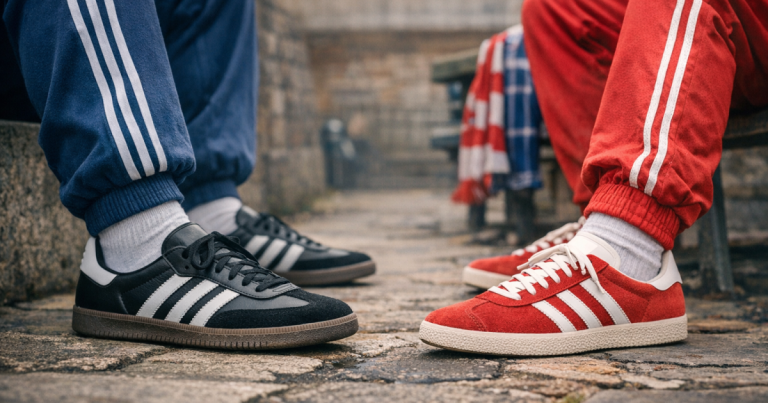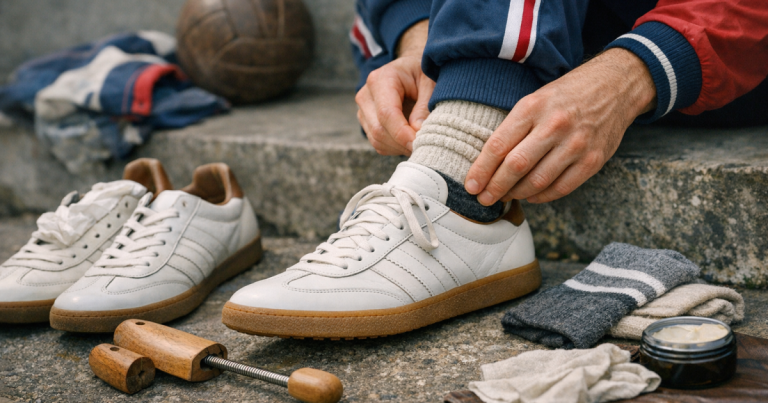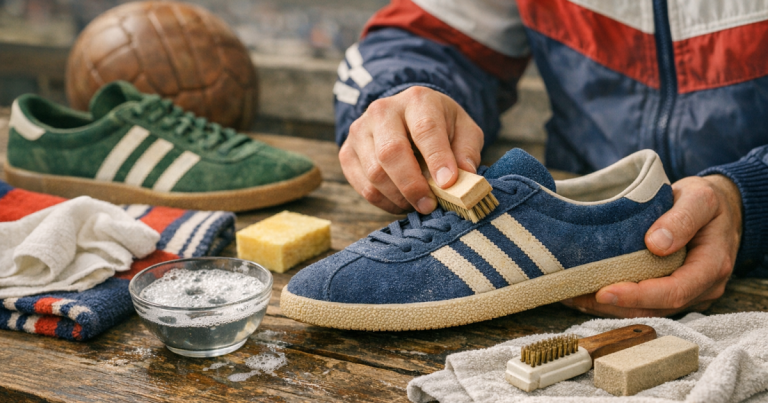
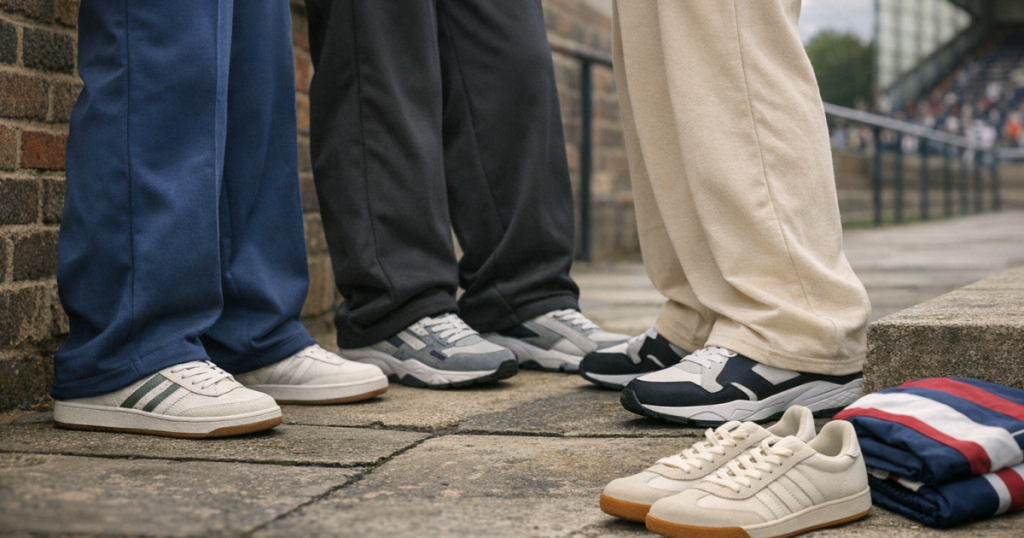
Wide tracksuit bottoms look brilliant when the footwear has enough presence to hold the hem, but they can quickly turn shapeless if the trainer disappears underneath. Picking trainers for wide tracksuit bottoms is less about chasing one fashionable model and more about balancing volume, break, sole shape and era.
Think of the trainer as the anchor. The wider the leg opening, the more important the toe shape, side profile and sole thickness become, because they decide whether the outfit reads as sharp terrace sportswear or just oversized loungewear.
The short version
- Choose trainers with enough width and structure to sit visibly under the hem.
- Avoid very thin, narrow shoes if the bottoms are wide, heavy or long.
- Check the trouser break: a slight stack can work, but fabric should not swallow the shoe.
- Match the trainer’s era to the tracksuit: low-profile terrace shoes for 1980s casual looks, chunkier running shapes for 1990s and 2000s influence.
- Use colour to connect the track top, stripes, piping or logo detail rather than relying on a full colour match.
Step 1: Look at the width and weight of the bottoms
Not all wide tracksuit bottoms behave the same way. Lightweight nylon or polyester track pants can float over a shoe, while heavier fleece or lined bottoms drop more firmly and can cover the trainer if the leg is long. Before choosing footwear, put the trousers on with the waist sitting where you actually wear it, not pulled up for the mirror.
If the hem opening is generous but the fabric is light, you can often use a slim terrace trainer because the cloth moves easily and shows more of the shoe as you walk. If the bottoms are wide and heavy, the trainer needs more sidewall, a more substantial toe box or a slightly thicker sole so it does not vanish.
This is where wide bottoms differ from tapered track pants. Tapered cuffs already frame the trainer. A wide hem needs the trainer to create its own shape.
Step 2: Get the trouser break right first
The break is the point where the trouser hem meets the trainer. With wide tracksuit bottoms, this matters more than brand, colour or logo. If the hem puddles over the toe, even a good pair of trainers will look messy. If the bottoms sit too short, the outfit can lose the relaxed sportswear feel that makes the wider cut worth wearing.
A clean result usually sits in one of three zones:
- No break: the hem just skims the top of the trainer. This looks sharp and works well with smarter track tops and terrace shoes.
- Slight break: the fabric rests lightly on the tongue or toe. This is the easiest option for everyday retro sportswear.
- Soft stack: a little fabric gathers above the shoe. This can work with 1990s-inspired bottoms, but only if the shoe has enough bulk to support it.
If you are building a full set rather than mixing separates, the same principle applies from shoulder to shoe. The guide on making a full tracksuit look sharp rather than sloppy is a useful next step once the trainer shape is sorted.
Step 3: Pick the right trainer profile
Trainer profile is the side view: how high the sole sits, how long the toe looks, and how much shape the upper has. Wide bottoms need a profile that creates a visible base. That does not always mean chunky, but it does mean deliberate.
Low-profile terrace trainers
Classic terrace trainers work well when the bottoms are wide but not overly long. They keep the outfit grounded in football-casual territory rather than gymwear. The key is to avoid a shoe that is too narrow from above, because a broad hem can make it look pinched.
Good reference points include adidas Gazelle Indoor, adidas Handball Spezial, PUMA Palermo and Diadora B. Elite. Each sits naturally with track tops, polos and light jackets, but the exact model you choose should depend on how the hem falls over your foot.
Chunkier running-influenced trainers
If your tracksuit bottoms are broad, long or deliberately baggy, a more substantial trainer can make sense. The 1990s and early 2000s side of retro sportswear often handles more sole depth, especially with shell suits, roomy track pants and heavier outer layers. The risk is going too bulky and turning the look into modern athleisure rather than terrace-inspired casualwear.
Use chunkier shapes when the outfit already has volume: wide bottoms, a roomy track jacket, a cap or a padded outer layer. Keep the colour controlled so the shoe does not fight the tracksuit.
Minimal canvas and very slim trainers
Very slim trainers can work with cropped or lightweight wide bottoms, but they are less forgiving. If the trouser hem is full length, the shoe can look too flat and small. This is especially noticeable from the side, where a wide leg can make a thin sole look like an afterthought.
If you like a cleaner shoe, compensate with a neater trouser break. Let the hem skim the top rather than stack heavily.
Step 4: Match the era, not just the colour
One of the easiest ways to make wide tracksuit bottoms look intentional is to think in eras. A 1980s Paninaro-influenced outfit calls for a different trainer mood from a 1990s Britpop or rave-adjacent look. The clothes do not need to be museum-accurate, but the references should not clash wildly.
- Late 1970s and early 1980s casual: slimmer terrace trainers, clean leather or suede uppers, neat hems and confident colour blocking.
- 1980s Italian sportswear influence: sharper track tops, bold colour panels and trainers that feel polished rather than oversized.
- 1990s sportswear revival: wider legs, more relaxed fits, bigger logos and trainers with a little more sole presence.
- 2000s throwback: broader bottoms can take more volume, but keep one part of the outfit controlled so it does not become costume-like.
If you are wearing adidas Gazelle Indoor or a similar terrace shape, the advice on pairing Gazelle Indoor trainers with retro track tops helps connect the footwear to the top half rather than treating trainers as an isolated choice.
Step 5: Use colour as a link, not a full match
Wide bottoms already create a strong silhouette, so colour matching can quickly become heavy-handed. You rarely need trainers in the exact same shade as the track pants. A better approach is to pick up a secondary detail: the stripe, zip tape, chest logo, collar trim or piping.
For example, navy wide bottoms with white side stripes can work with white leather trainers, navy suede trainers or a gum sole that softens the contrast. A green track top with cream panels can look more considered with off-white trainers than with a loud green pair. Black bottoms are the easiest to wear, but they can look flat if the trainer is also plain black and narrow.
When in doubt, use one of these simple colour routes:
- White or off-white trainers: clean, visible and easy with navy, black, red, green and royal blue track pants.
- Gum soles: useful for softening bright sportswear and adding a terrace feel.
- Tonal suede: good when you want the outfit to feel more grown-up and less matchy.
- Contrast stripes: a trainer with side stripes or branding that echoes the track top can tie the outfit together.
Step 6: Check the view from the side and from above
Most people judge trainers from above when they try them on, but wide tracksuit bottoms are judged from the side. Stand sideways in a mirror and check whether the hem hides the toe, collapses over the tongue or creates too much fabric around the ankle.
Then look from above. If you can barely see the trainer because the trouser opening covers the entire forefoot, the bottoms may be too long for that shoe. If the trainer looks tiny underneath the fabric, try a wider toe shape, a thicker sole or a neater break.
A simple at-home check is to walk across the room and stop naturally. If you constantly have to kick the fabric away from the shoe, the pairing is not working. The right combination should move cleanly without needing adjustment every few steps.
Step 7: Balance the top half
Wide bottoms and the right trainers still need a top half that makes sense. A fitted track top can sharpen the silhouette, while an oversized hoodie can push the whole outfit into baggy territory. Neither is wrong, but the intention should be clear.
If your trousers are the widest part of the outfit, keep the track top or jacket reasonably tidy. A zip track top, polo or compact hoodie usually works better than a very long sweatshirt. If the trainers are chunky, avoid adding too much volume everywhere else unless you are deliberately building a 1990s-inspired look.
For archive-style track jackets, measurements matter because a poor fit up top can make even good footwear choices look unbalanced. The guide on measuring a track top before buying online is worth using before committing to a full outfit.
Step 8: Think about material and weather
UK weather has a habit of making trainer choices more practical than romantic. Suede terrace shoes look excellent with wide track pants, but wet pavements, pub floors and matchday travel can mark them quickly. Smooth leather or synthetic uppers are often easier for regular wear, while suede works best when you are prepared to maintain it.
Wide bottoms can also brush against the upper more than tapered trousers do. Dark hems rubbing against pale suede may leave marks, and wet hems can transfer grime. If you wear wide track pants often, it is sensible to rotate trainers rather than relying on one pair for everything.
For rainy days, consider whether the hem is likely to drag or hold moisture. A slightly thicker sole can lift the fabric a little, but it will not rescue trousers that are simply too long.
Common mistakes with wide bottoms and trainers
- Choosing a shoe that is too narrow: the bottoms overpower it and the outfit looks bottom-heavy.
- Letting the hem puddle: a little break is fine; fabric covering half the shoe is rarely flattering.
- Over-matching colours: exact colour coordination can look forced, especially with bright tracksuits.
- Ignoring the era: a sleek terrace shoe and a huge 2000s-style tracksuit can clash unless the rest of the outfit bridges the gap.
- Forgetting maintenance: wide hems can brush, scuff and dampen trainers more than cuffed joggers.
Common questions
Are chunky trainers better with wide tracksuit bottoms?
Not always. Chunkier trainers help when the bottoms are long, heavy or very loose, but low-profile terrace trainers can look sharper with lighter wide track pants and a cleaner break.
Should the bottoms cover the tongue of the trainer?
A slight cover is fine, especially with relaxed retro sportswear. If the tongue and most of the toe disappear, the trousers are probably too long or the trainer is too low-profile.
Do white trainers work with wide track pants?
Yes, white or off-white trainers often work well because they stay visible under a wide hem. They are particularly useful with navy, black, red, green and blue sportswear.
Can suede trainers be worn with wide tracksuit bottoms?
Yes, but check that the hem does not drag across the suede. Wide bottoms can rub against the upper, so suede needs more care in wet or gritty conditions.
What socks should show with wide bottoms?
Usually very little sock should show unless the bottoms are cropped. If socks are visible, plain white, navy, black or a colour linked to the tracksuit tends to look cleaner than loud patterns.
Main points
The best trainer choice starts with the bottoms: their width, weight, length and break. Once those are clear, choose a footwear profile that gives the hem something to sit on without overpowering the rest of the outfit.
For a sharper terrace look, use structured low-profile trainers, controlled colour and a clean trouser break. For a looser 1990s or 2000s sportswear feel, allow a little more sole depth and fabric movement, but keep the outfit balanced. Wide tracksuit bottoms are not difficult to wear; they just punish footwear that is too small, too flat or too hidden.