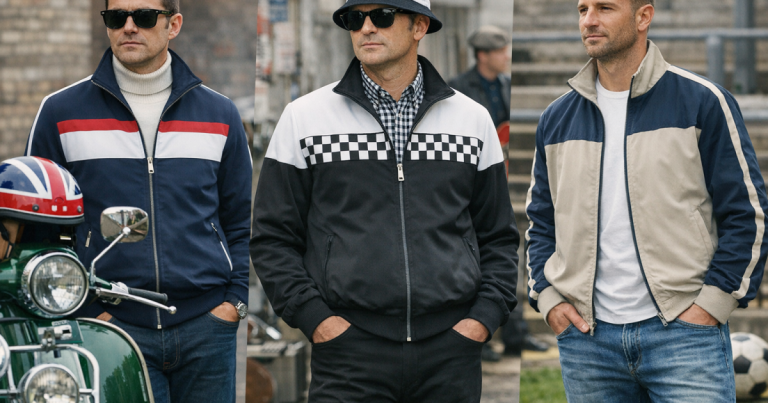
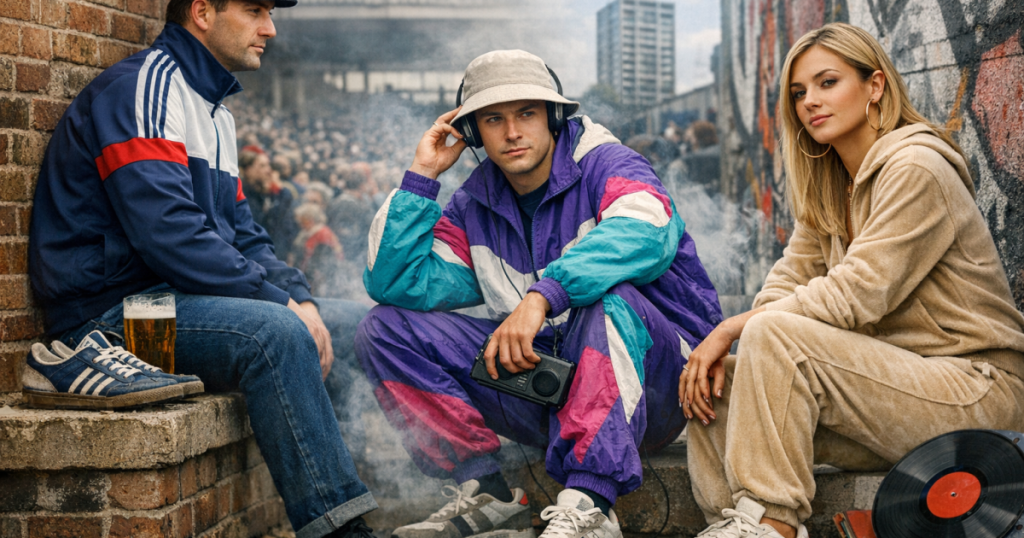
Tracksuits in Britain have never been just gym kit. British tracksuit culture is a story of football grounds, youth tribes, music scenes, brand one-upmanship and everyday comfort, with each era leaving behind different shapes, fabrics and signals.
The point is not to treat every old track top as sacred. Some pieces carry real social history; others simply borrow the look. Understanding the eras helps you read the details better, avoid costume dressing, and build a terrace-inspired wardrobe that nods to the past without pretending you have stepped out of a grainy away-day photograph.
Main points
- The 1970s set the foundation: sport, training wear and club identity became more visible in everyday dress.
- The early-to-mid 1980s turned continental sportswear into a status language on the terraces.
- The late 1980s and early 1990s widened the look through acid house, Madchester, rave and casual weekend dressing.
- The late 1990s and 2000s made retro sportswear more nostalgic, logo-driven and mainstream.
- Today’s strongest outfits borrow from an era without copying it too literally.
If you are still working out which period matches your own taste, the era-by-era breakdown in which retro tracksuit era suits your terrace wardrobe is a useful next step after this wider history.
The 1970s: training gear becomes visible streetwear
The 1970s did not invent the tracksuit, but it helped make coordinated sportswear familiar outside strict athletic settings. Footballers wore training tops in photographs, school sports kit became part of everyday memory, and television brought club tracksuits into living rooms across Britain. The silhouette was usually simpler than later decades: zip tops, slim or straight track pants, contrast stripes, ribbed cuffs and practical synthetic fabrics.
It is easy to over-romanticise the decade because later casual culture looked back at it through a sharper lens. For many people, a tracksuit was still functional leisurewear rather than a coded terrace statement. Yet the foundations were there: sport as identity, brand badges as visual shorthand, and the idea that what happened around football could influence what people wore away from the pitch.
The early 1980s: casuals, travel and continental status
The early 1980s are central to the British terrace story because sportswear became more selective. Casual dress was partly about looking sharper than the opposition, partly about distance from obvious replica kit, and partly about finding garments other people could not easily get. European labels and archive-looking pieces gained appeal because they suggested taste, access and insider knowledge.
Adidas, Sergio Tacchini, Fila, Ellesse, Diadora, Kappa and Lacoste Sport all sit somewhere in this wider memory, though not every brand mattered equally in every town or scene. Regional taste counts. Liverpool, Manchester, London, Glasgow, Leeds and other football cities had overlapping but not identical style codes. A label could be highly prized in one crowd while barely registering in another.
British brands also had their own role. Umbro, for example, carried a direct football association through club and national-team kit, then moved into wider casual memory through the relationship between matchwear, training wear and street dressing. The deeper background is covered in Umbro tracksuit history and its move from British football kits to terrace style.
The mid-to-late 1980s: colour, confidence and the myth of the perfect casual look
By the mid-to-late 1980s, the tracksuit had become more visibly expressive. Colour blocking, shiny polyester, embroidered badges and bold shoulder lines gave the look a sharper presence. The idea of the full matching set became important, but it was not the only route. Plenty of outfits mixed a track top with jeans, cords, a polo shirt or a waterproof layer.
This is also the era where myth starts to blur with memory. Books, old photographs and pub stories can make the period seem neater than it was. Real-life terrace dressing was messy, competitive and local. Some lads chased expensive imports; others wore what they could get from sports shops, market stalls, hand-me-downs or mates. The smartest way to read the period is to look for recurring codes rather than a single uniform.
Two books remain useful for understanding the atmosphere around the era rather than just the clothes: The Football Casuals: A History by Cass Pennant and A Casual Look: A Photodiary of the 1980s Casual, Terrace and Football Scene by Gavin Watson. They are different in tone, but both show why lived context matters more than modern mood-board nostalgia.
The early 1990s: Madchester, rave and looser sportswear
The early 1990s widened tracksuit culture beyond the matchday frame. Madchester, baggy indie, acid house and rave all changed how British sportswear was read. Looser fits, brighter colours, shell suits, track tops and casual trainers became part of a broader weekend language. Football still mattered, but music gave the look a different rhythm.
Manchester is often used as shorthand here, and understandably so, but the shift was not confined to one city. Clubs, all-nighters, student nights, record shops and local scenes helped spread the look. The tracksuit became less about strict terrace hierarchy and more about movement, comfort, attitude and visibility. A zipped track top could sit with baggy denim, a bucket hat, a football scarf or a waterproof jacket, depending on the crowd.
For modern wear, this era is tempting but risky. Too much shine, too much colour and too many period accessories can tip into fancy dress. The better approach is to keep one dominant reference: a relaxed track top, a muted shell jacket, washed denim, or trainers that echo the decade without copying it head to toe.
The late 1990s: Britpop, leisurewear and the mainstreaming of retro
By the late 1990s, tracksuits had moved fully into mainstream British leisurewear. Britpop, football on television, magazine culture and the growth of sports fashion all helped. The look became less secretive and more available. Track jackets could be worn to gigs, pubs, college, five-a-side, away trips or ordinary weekends without needing a full subcultural explanation.
This is where the word “retro” starts to matter more. Older references were recycled with more intention. Three-stripe tops, tennis-inspired jackets, bold logos and archive shapes were no longer just remnants of previous decades; they became desirable because they carried memory. For some wearers, that memory was personal. For others, it came through older siblings, music videos, football photography or film.
The 2000s: logos, nostalgia and the tracksuit as cultural shorthand
The 2000s pushed tracksuits into another role: shorthand for British leisure, nightlife, football identity and sometimes class caricature. That last point needs care. Popular culture often flattened the tracksuit into a stereotype, while real wearers used it in far more varied ways. A full tracksuit could mean comfort, allegiance, nostalgia, local pride, gym-to-pub practicality or simple taste.
Logo placement became more noticeable, and sportswear brands leaned further into archive appeal. Some pieces still felt close to terrace heritage; others were retro in styling but detached from the older codes. That split is important. A reissued track top can look excellent without having deep terrace roots, while a quieter piece may carry stronger historical reference through cut, colour and context.
Why no single explanation is enough
There are competing explanations for why tracksuits became so culturally loaded in Britain. The football explanation is the most obvious: travel, rivalry, regional pride and matchday visibility all gave sportswear meaning. The music explanation is just as important, because scenes from ska and soul to rave and Britpop moved sportswear into clubs, gigs and youth culture. The class explanation also matters, because tracksuits were accessible, practical and sometimes unfairly used as a lazy symbol in media portrayals.
Then there is the brand explanation. Certain labels became symbols because they were recognisable, desirable and, at times, hard to obtain. But brands did not become powerful in isolation. They gained meaning through who wore them, where they were worn, how they were styled and what stories later attached themselves to them.
Reading the eras without falling for marketing
Modern retro sportswear often borrows heavily from terrace imagery, but not every archive-looking piece has the same cultural weight. A good way to judge a garment is to ask what it is referencing: a football training top, a tennis warm-up jacket, a rave-era shell suit, a 1990s leisure set, or just a vague old-school mood.
That distinction matters if you care about authenticity. It also helps with practical styling. A 1980s-inspired Italian track top usually works better with clean denim and understated trainers than with too many competing logos. A 1990s shell jacket can handle a looser silhouette. A 2000s full set can look intentional if the colours are controlled and the footwear is simple. For a sharper filter, read the guide to separating terrace heritage from retro sportswear marketing.
What still works in a modern wardrobe
The strongest modern terrace outfits usually borrow one era at a time. A 1970s reference might mean a slim track top, muted colour and plain trainers. An early 1980s reference might be a premium-feeling zip top with straight-leg denim and a polo underneath. A Madchester-leaning outfit might use a relaxed jacket, washed jeans and a cap, but keep the palette restrained enough for everyday wear.
Full tracksuits still have their place, especially when the fit is right and the colours are not fighting each other. The safest modern route is balance: if the tracksuit is bold, keep the outerwear and trainers quiet; if the jacket is understated, you can afford a stronger trainer shape or cap. The aim is recognition, not reenactment.
Questions people ask
What is British tracksuit culture mainly rooted in?
It is rooted in sport, football fandom, youth style and music culture. The terrace story is central, but rave, indie, television and everyday leisurewear all shaped it too.
Which decade had the biggest influence on terrace tracksuits?
The 1980s are usually seen as the defining terrace decade because continental sportswear, away travel and casual identity became closely linked. The 1990s then broadened the look through music and mainstream fashion.
Is a vintage tracksuit always more authentic than a reissue?
No. Vintage pieces can have stronger period character, but condition, fit and wearability vary. A good reissue can be more practical if it captures the shape and mood without being fragile.
Can you wear a full retro tracksuit without looking costume-like?
Yes, but restraint matters. Keep the fit contemporary, avoid piling on too many era-specific accessories, and choose trainers or outerwear that calm the outfit down.
Were tracksuits only a football casual thing?
No. Football casuals gave tracksuits a strong coded meaning, but British sportswear culture also came through schools, gyms, music scenes, dancefloors, estates, holidays and weekend leisure.
What stands out
The eras that defined Britain’s tracksuit story are connected, but they are not interchangeable. The 1970s made sportswear visible, the 1980s gave it terrace status, the early 1990s loosened it through music, and the 2000s turned it into a nostalgic cultural symbol. Knowing those differences makes the clothes more interesting and the outfits stronger.
For today’s wearer, the lesson is simple: choose the era before choosing the outfit. Once you know whether you are leaning towards understated training wear, sharp casuals, Madchester looseness or logo-heavy nostalgia, the rest becomes easier to control.