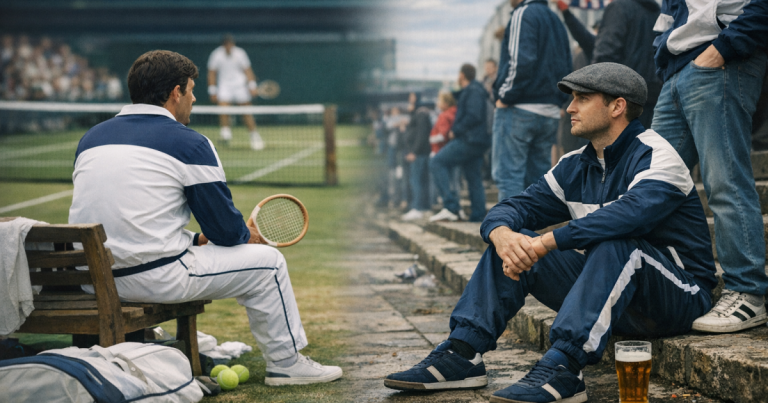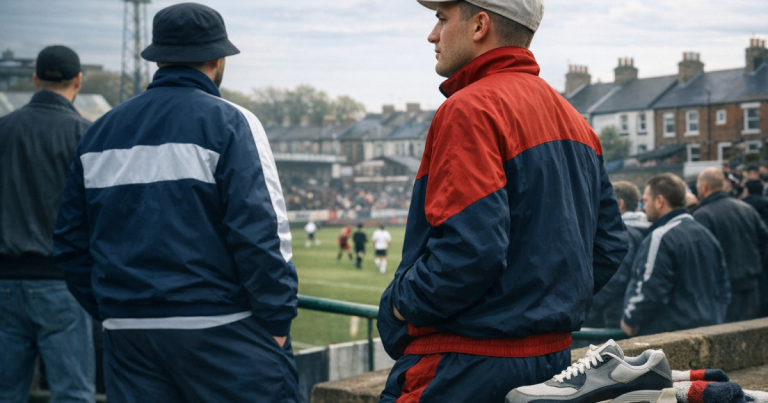
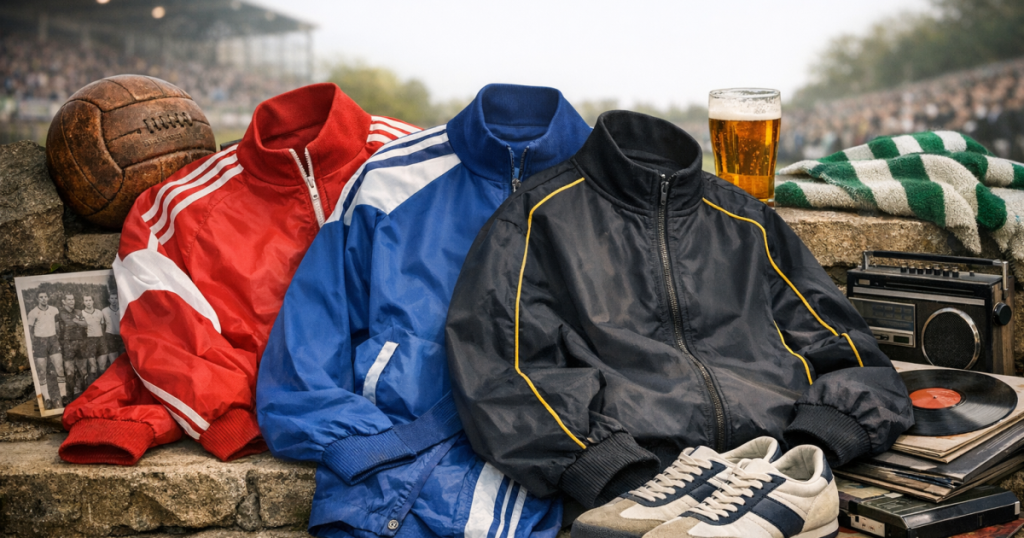
For many British football fans, Umbro tracksuit history is not just a timeline of kits and training wear; it is a story about how a homegrown football supplier became part of everyday matchday dress. The double diamond sat on England shirts, club dugouts, school PE bags, muddy Sunday pitches and, eventually, the retro rail. That journey matters because Umbro occupies a different place from imported casual labels: less exotic, more local, and tightly connected to the actual game.
In brief
- Umbro began as a British football kit maker, founded by the Humphreys brothers in 1924.
- Its credibility came from supplying clubs, national teams and training wear rather than from lifestyle marketing alone.
- Umbro’s terrace relevance is strongest around drill tops, shell jackets, warm-up tracksuits, 1990s football graphics and club training gear.
- It is not the same type of terrace symbol as adidas, Fila or Sergio Tacchini; its appeal is more rooted in British football memory.
- When buying vintage or reissue Umbro, check fit, fabric, print condition, crest placement and whether the garment feels wearable beyond nostalgia.
From Humphreys Brothers to the double diamond
Umbro was founded in 1924 by Harold and Wallace Humphreys, with the name drawn from Humphreys Brothers. Its early reputation was built around football kit rather than general leisurewear. That distinction is important. Umbro did not enter the terrace story as a glamorous tennis label or a continental training brand. It came through changing rooms, club shops, school sport, county leagues and England nostalgia.
The double diamond became a shorthand for footballing legitimacy. Umbro supplied kits and training wear across the professional game, and by the time England won the 1966 World Cup wearing Umbro, the brand already had a deep connection with the national sport. Later generations encountered it through club shirts, tracksuits, windbreakers, drill tops and teamwear catalogues rather than only through fashion retailers.
This is why Umbro can feel unusually democratic in retro sportswear. For some, it brings back elite players and televised football. For others, it recalls five-a-side bags, freezing training nights, local sports shops and half-remembered club tracksuits. That closeness to ordinary British football is exactly what gives the brand its terrace value.
Why the kit room mattered to terrace style
Terrace style often gets simplified into a roll call of expensive trainers, European labels and away-day status symbols. Umbro complicates that story. It was not always the most aspirational name among football casuals, especially when Italian and French sportswear carried more novelty. But it was everywhere football was happening, and that visibility made it culturally sticky.
On the terraces, sportswear worked because it sat between performance clothing and everyday dress. A track top could be warm enough for the train, casual enough for the pub and recognisable enough to signal taste. Umbro’s contribution was practical: zipped jackets, drill tops, poly tracksuits, shell layers and training tops that already belonged around football. If you want the wider context for how labels gained that kind of meaning, the broader story of how tracksuit brands became symbols in terrace culture helps explain why logos, scarcity and football memory all mattered.
Umbro’s Britishness also gave it a different emotional register. Wearing vintage adidas can suggest European travel, specialist trainer knowledge or classic casual codes. Wearing old Umbro can suggest a specific club era, a national tournament, a school-team memory or a rainy matchday in a British town. Neither is more authentic by default; they simply speak different languages.
The eras that shaped Umbro’s retro appeal
1960s and 1970s: kit authority before lifestyle
Umbro’s mid-century identity was about football kit reliability. The garments associated with this period were not terrace fashion in the modern sense, but they laid the groundwork. England’s 1966 kit, club shirts and simple training pieces helped embed the double diamond in the national football imagination. For modern wearers, this era is more about clean logos, minimal design and heritage credibility than about loud tracksuit styling.
1980s: teamwear, nylon and practical training gear
By the 1980s, football training wear had become more visible away from the pitch. Tracksuit tops, lightweight jackets and warm-up layers were functional garments, but they also suited the casual shift towards sportswear as street clothing. Umbro pieces from this era can look understated compared with more flamboyant Italian sportswear, which is part of their appeal. A plain navy, red or royal blue Umbro track top can sit comfortably with denim, cords or simple trainers without feeling like fancy dress.
1990s: peak football graphics and mainstream memory
The 1990s are crucial to Umbro’s revival value. Premier League visibility, England tournament culture, bolder club shirts and graphic training wear all pushed the double diamond into a broader cultural space. Umbro was present on major British clubs and national-team moments, while football shirts became increasingly acceptable as casual wear.
For today’s retro wardrobe, this is where many people start: oversized warm-up tops, club training jackets, contrast panels, zip necks, elasticated cuffs and embroidered or flocked logos. The best 1990s Umbro pieces have enough football character to feel specific, but not so much novelty that they only work on tournament days.
2000s: longer cuts and the shift towards nostalgia
In the 2000s, football silhouettes moved through longer tops, shinier fabrics and more overt sports branding. Not every piece has aged equally well. Some tracksuits now feel highly period-specific, while others have become useful precisely because they capture that post-Britpop, early-digital football look. The key is proportion. A longer training jacket can look strong over straight-leg denim, but a full matching set from the period may need careful styling to avoid looking like a costume.
Umbro on the terrace: authentic, but not automatically casual
One of the mistakes in modern retro sportswear is assuming that any old football item counts as terrace style. Umbro deserves better than that. A club tracksuit top can be full of history yet still look too training-ground specific for a low-key outfit. A plain drill top with a small double diamond, however, can be more wearable than a heavily crested jacket covered in sponsor graphics.
That distinction is where Umbro gets interesting. The strongest terrace-leaning pieces usually have three qualities:
- A football connection without visual clutter: small logos, clean colour blocking and subtle club references are easier to wear than loud all-over branding.
- A practical outerwear function: drill tops, windbreakers and zip-neck training tops work because they were made for movement, weather and layering.
- A fit that suits modern clothes: boxy can be good; shapeless is harder. Watch shoulder width, sleeve length and the waistband.
For collectors and casual dressers, the question is not whether Umbro is authentic. It clearly is. The better question is whether a particular garment has crossed from football memorabilia into wearable sportswear. Some pieces belong framed, some belong on a five-a-side pitch, and some belong under a casual jacket on a Saturday afternoon.
How Umbro compares with continental terrace labels
Umbro’s main difference from brands such as adidas Originals, Fila, Sergio Tacchini, Kappa or Diadora is that it rarely needed an exotic backstory for British wearers. It was already part of the football landscape. That made it familiar, but familiarity can cut both ways.
For some terrace dressers, imported labels carried more cachet because they were harder to find, associated with European trips or connected to tennis, athletics and luxury sportswear. Umbro, by contrast, could feel too close to school kit or official club merchandise. That is why it has sometimes sat slightly outside the most romanticised version of casual culture.
Yet the same closeness now works in its favour. As retro football style has matured, people are less interested in copying a single 1980s casual uniform and more interested in garments with real cultural texture. Umbro offers that. It is British, football-centred and deeply tied to how people actually watched, played and remembered the game.
Buying and wearing vintage Umbro without getting caught by nostalgia
Vintage Umbro can be rewarding, but it needs a sharper eye than simply chasing the biggest logo. Modern retro marketing has made football heritage fashionable, so older-looking design is not always the same as meaningful design. It is worth knowing how to separate terrace heritage from retro sportswear marketing before paying a premium for a piece that only borrows the mood.
Before buying, check the details that affect wearability:
- Label and era: older labels can help date a garment, but do not rely on a tag alone. Compare cut, zip style, fabric and logo execution.
- Print and embroidery: cracked sponsors, peeling numbers and tired flocking can be part of the charm, but they also limit washing and regular wear.
- Club crests: a crest adds story, but it also makes the piece more partisan. That may be perfect for matchday and awkward elsewhere.
- Fabric condition: look for bobbling, pulls, shiny wear, seam stress and damaged elastic, especially around cuffs and hems.
- Fit: vintage sizing is inconsistent. Ask for actual measurements in centimetres rather than trusting the label size.
Styling is best kept grounded. A navy Umbro drill top over a plain white T-shirt, straight jeans and understated trainers is easier to live with than a full retro kit look. If the jacket is loud, keep the rest plain. If the track top is minimal, you have more room for a cap, a polo collar or a better trainer choice. Footwear does much of the work, so a proper read of terrace-style footwear choices can help stop an Umbro outfit drifting into generic sportswear.
Care matters with old polyester and printed details
Many Umbro tracksuits and training tops were built for sport, but vintage condition varies widely. Wash cool, turn printed garments inside out and avoid aggressive tumble drying. Heat is often the enemy of old logos, sponsors and elasticated trims. A light steam can help synthetic jackets hang better, but test carefully and keep distance from prints and badges.
Storage matters too. Heavy creasing can make shell fabrics look tired, while packed wardrobes can damage raised prints. Hang jackets where possible, fold trousers gently and avoid leaving damp gear in bags after matchday. None of this is complicated, but it is the difference between a wearable archive piece and a nostalgic purchase that quickly falls apart.
Why it still matters
The useful way to read Umbro tracksuit history is as a bridge between football kit culture and everyday British sportswear. Umbro was not always the rarest or flashiest terrace label, but it had something harder to fake: proximity to the game. It dressed teams, travelled through club shops, appeared in parks and school changing rooms, and became part of the visual memory of British football.
That makes Umbro especially relevant now. Retro style is at its best when it is not just mood-board nostalgia. A good Umbro track top or drill jacket can carry football history, local feeling and practical wearability in one garment. The trick is to choose pieces that suit your wardrobe rather than buying every double diamond you recognise.
Common questions
Is Umbro considered terrace style?
Yes, but not every Umbro item qualifies. Drill tops, training jackets, shell layers and understated tracksuits are usually more terrace-friendly than full replica kit or heavily sponsored club gear.
Which Umbro era is most wearable now?
Late 1980s and 1990s pieces tend to work well because they balance football identity with strong casual shapes. Look for clean colour blocking, good cuffs and a relaxed but not oversized fit.
Are club-crested Umbro jackets harder to style?
They can be. A crest adds history and matchday meaning, but it also makes the garment more specific. Neutral Umbro training pieces are easier for everyday wear.
Should I buy vintage Umbro or a modern reissue?
Vintage has character, but condition and sizing can be unpredictable. Reissues are often easier to wear regularly, provided the fabric, cut and branding still feel close to the football heritage you want.
What should I avoid when buying old Umbro tracksuits?
Avoid badly perished elastic, peeling prints, warped zips and pieces bought only for a big logo. Measurements, condition photos and return terms matter more than nostalgia.