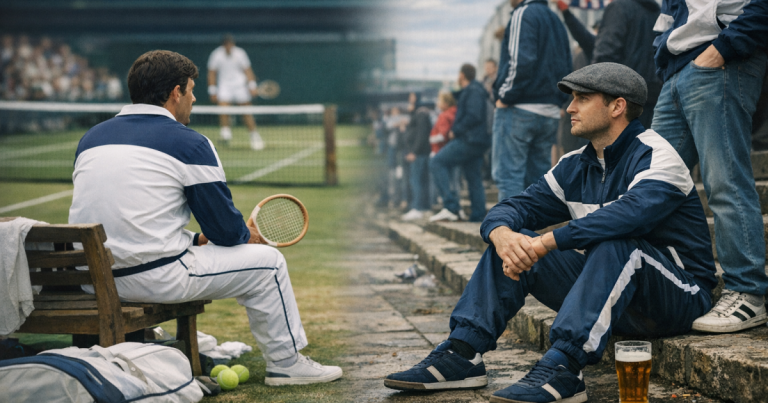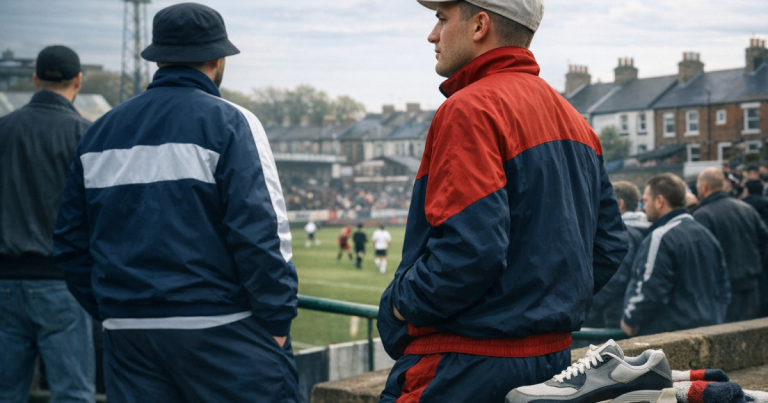
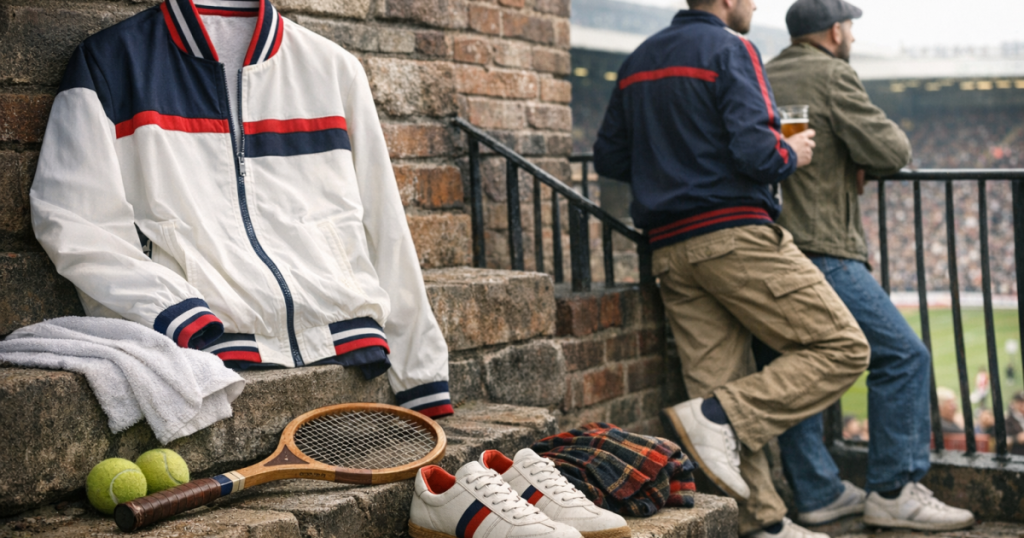
Fila’s move from centre court to the football end was not a random bit of nostalgia. The Fila tenniswear terrace style crossover made sense because the clothes already had the right mix: Italian glamour, sharp colour blocking, visible branding and a cleaner shape than standard training kit. For UK casuals, that meant sportswear that looked expensive without feeling like formalwear.
The important point is that Fila was not simply “tennis kit” borrowed for football. It offered a way to look considered, continental and slightly flash, while still wearing practical sportswear on trains, in pubs and around the ground.
What to know first
- Fila’s tennis image was built around Italian styling, premium leisurewear and elite court visibility.
- Terrace culture valued brands that looked imported, recognisable and harder to place than everyday high-street sports kit.
- The crossover worked because tenniswear shared the same language as casual fashion: collars, zip tops, clean panels, knitted trims and strong colour contrast.
- Not every retro Fila piece has terrace relevance; the most convincing items are usually track tops, polos, warm-up jackets and neatly cut matching sets.
- Modern wearability depends on fit. Too shiny, too baggy or too logo-heavy can look fancy dress rather than casual.
Step 1: Start with Fila’s tennis image, not just the badge
Fila began as an Italian clothing company and became globally associated with sport through a very different visual route from many gym-first sportswear brands. Its tennis clothing, particularly the White Line era associated with Björn Borg, carried a sense of continental sophistication: crisp colours, controlled branding and silhouettes that sat closer to leisurewear than rough training gear.
That mattered because tennis had a social code attached to it. Even when the garments were practical, they suggested club lawns, travel, money and European style. Football casuals were famously alert to status signals, but not always the obvious ones. A track top or polo that looked like it belonged on a champion tennis player could have more edge than a basic football training jacket.
The appeal was visual as much as cultural. Fila’s strongest tennis pieces used panels, stripes, ribbed collars and colour blocks in a way that looked sharp from a distance. On a terrace, where clothing was read quickly, that helped the brand stand out without needing huge graphics.
Step 2: Understand why UK casuals liked non-football sportswear
Terrace style has never been only about football-branded clothing. In fact, the classic casual instinct often ran the other way: avoid obvious club merchandise and find premium sportswear, knitwear, trainers and outerwear that carried status without shouting allegiance. That is one reason brands from tennis, skiing, sailing and running all found routes into the scene.
Fila fitted this pattern neatly. It was sporty, but not tied to a club shirt. It looked aspirational, but not suited-and-booted. It gave young matchgoers a way to dress up while remaining comfortable enough for matchday movement, travel and bad weather layering.
It also sat within a wider hierarchy of sportswear recognition. Adidas had its own deep terrace code, from trainers to track tops, and you can see why Adidas Originals became a terrace sportswear benchmark. Fila occupied a different lane: less rooted in German indoor trainers, more connected to Italian leisure, tennis glamour and bold warm-up gear.
Step 3: Look at the garments that made the crossover believable
The most convincing Fila pieces for terrace style are not random modern logo tees. They are garments with a clear line back to court and warm-up clothing: track jackets, full tracksuits, polos, knitted collars and colour-blocked tops. These items bridge tennis and football casual style because they look clean, recognisable and wearable with denim, cords or track pants.
A piece such as the Fila Settanta Track Jacket shows why the formula still works: a recognisable sportswear shape, contrast detailing and enough retro character to carry an outfit without needing much else. The same logic applies to Fila Vintage track tops and tennis-inspired polos, provided the cut and colours suit the rest of the look.
Fit is crucial. Original terrace looks were shaped by their own periods, and modern reissues do not always copy those proportions exactly. Some contemporary pieces are cut slimmer, while others lean into oversized nostalgia. If you are comparing eras, the guide to tracksuit fit by decade is useful for understanding why cuffs, collars and jacket length change the whole mood of a set.
Step 4: Separate real heritage from easy retro marketing
Fila’s crossover is credible, but that does not mean every garment with a vintage-style logo automatically belongs in a terrace wardrobe. The strongest pieces usually have at least two of these qualities: a courtwear reference, an archive-looking colour palette, a good collar or rib detail, a clean panel layout, and a shape that works beyond the gym.
Use these checks before treating a Fila item as terrace-relevant:
- Does it look like sports leisurewear rather than generic merchandise? A subtle track top, polo or warm-up jacket usually carries the look better than an oversized slogan T-shirt.
- Is the colour blocking controlled? Navy, red, white, cream, green and burgundy combinations often feel more authentic than loud novelty colours.
- Is the branding doing too much? Fila’s logo is part of the appeal, but repeated logos can push the outfit towards costume.
- Can it sit with terrace staples? Think straight denim, track pants, a clean cap, a Harrington, a windbreaker or gum-soled trainers.
- Does the fabric suit the intended use? Smooth synthetic track tops, cotton polos and knitted trims each create a different impression. Check care labels, because older-style sportswear can be sensitive to heat and rough washing.
Step 5: Wear it without making it look like fancy dress
The easiest way to wear Fila tenniswear now is to let one court-inspired piece lead the outfit. A colour-blocked track top over a plain white or navy T-shirt works better than stacking multiple loud retro references. If the jacket is bright, keep trousers simple. If the top is restrained, you have more room for trainers or a cap with personality.
For a low-key matchday look, try a Fila track jacket with dark straight-leg denim and terrace-friendly trainers. For a stronger retro sportswear outfit, wear a matching or near-matching track set, but keep the footwear clean and avoid adding too many extra logos. A tennis polo can also work under a lightweight jacket when a full tracksuit feels too obvious.
Footwear matters because it decides whether the outfit reads as terrace, tennis club or general retro sportswear. Adidas Handball Spezial, Gazelle Indoor, PUMA Palermo, Diadora B. Elite and other low-profile trainers can all work depending on the era you are referencing. For broader pairing logic, the terrace-style footwear guide helps match trainers to the rest of the outfit rather than choosing by brand alone.
Why Fila felt different from other terrace brands
Fila’s strength was elegance. Adidas often brought trainer culture and track heritage. Sergio Tacchini had a smooth Italian club feel. Ellesse and Diadora carried their own links to tennis, ski and European sportswear. Fila sat among them as a brand that could look luxurious without becoming delicate.
That mix suited British terraces because casual style has always balanced contradiction: smart but not formal, sporty but not basic, recognisable but not mainstream in the wrong way. Fila tenniswear gave that balance a clear visual identity. It made sense with a football crowd because it was not football kit; it was a step sideways into a more aspirational sportswear language.
It also helped that tennis clothing translated well into everyday wear. Collared tops, neat zip jackets and panelled warm-ups could be worn in town, at the pub, on away travel or around the estate. A good Fila piece did not need the tennis court to make sense.
Common questions
Was Fila actually worn by football casuals?
Yes, Fila has long been part of the wider mix of brands associated with casual and terrace dressing, though its importance varies by region, era and individual memory. It should be understood as one part of a broader sportswear landscape rather than the single defining brand.
Is Fila tenniswear still terrace style today?
It can be, if the piece has the right shape, colour and restraint. Modern Fila items vary widely, so judge the garment rather than relying on the badge. Track tops, tennis polos and archive-inspired jackets usually work better than heavily branded casual basics.
Should you buy vintage or a reissue?
Vintage can offer better period character, but condition, sizing and fabric care need checking carefully. Reissues are often easier to wear and replace, though they may not have the same cut as older garments. Try to compare measurements rather than trusting label size alone.
Key takeaways
Fila tenniswear crossed into terrace style because it offered the qualities casuals valued: status, European polish, strong colour blocking and sportswear that looked sharper than standard training kit. It was not about pretending to play tennis; it was about borrowing the visual authority of elite court clothing and making it work in a football-casual setting.
For modern wardrobes, the lesson is simple: choose Fila pieces with courtwear DNA, keep the rest of the outfit grounded, and avoid turning heritage into costume. When the fit, trainers and colours are right, Fila still gives terrace sportswear that unmistakable Italian lift.