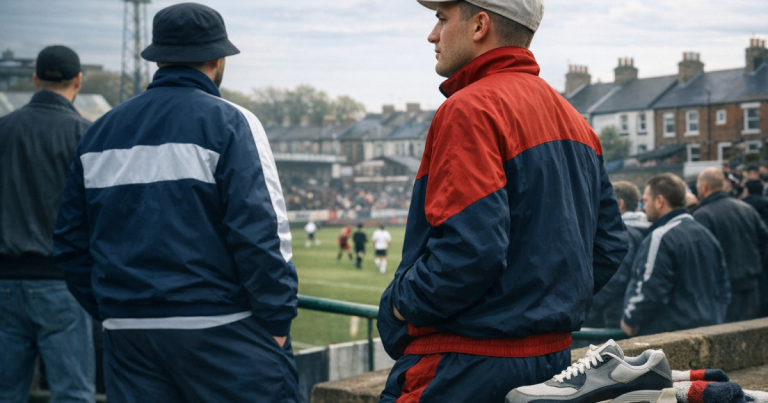
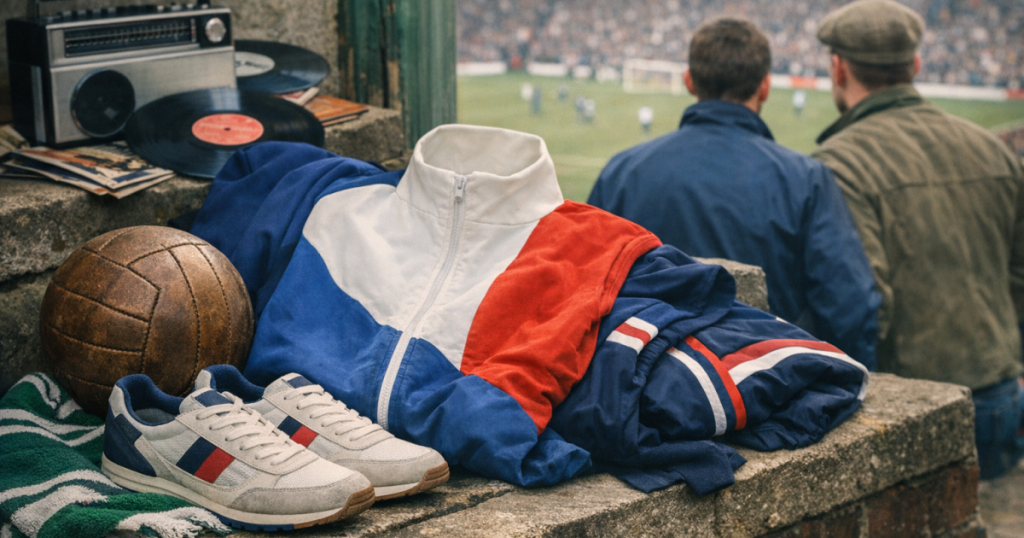
Le Coq Sportif history makes most sense when you see it as a French sportswear story that crossed into British terraces through football, kit culture and a taste for continental track tops. It was never simply a tracksuit brand in the UK imagination: it carried cycling, tennis, rugby and football references, then found fresh meaning when casuals started reading foreign labels as style signals.
For British terrace style, the appeal sits in the gap between obvious and obscure. The cockerel badge is recognisable, but it does not shout like some bigger global sportswear logos. That makes Le Coq Sportif useful for anyone who wants a retro tracksuit look with football history, European colour, and a slightly less predictable angle.
At a glance
- Le Coq Sportif began in France as a sports clothing business founded by Émile Camuset in Romilly-sur-Seine.
- The brand built credibility across cycling, football, rugby and tennis before becoming a recognisable football kit name.
- Its terrace relevance comes from European football culture, national-team nostalgia and the casuals’ appetite for continental sportswear.
- Compared with adidas, Fila or Sergio Tacchini, it tends to feel more understated and slightly more left-field in a UK outfit.
- Modern wearers should focus on colour balance, fabric condition, logo scale and whether a piece reads as sportswear or fancy dress.
From French workshop to sporting badge
Le Coq Sportif was founded in the late nineteenth century by Émile Camuset, whose family business grew from making sports garments in north-eastern France. The name translates as “the sporting cockerel”, with the cockerel itself tied closely to French identity. That matters because the brand’s power has always come from national sporting pride as much as from garment design.
Before football casuals in Britain were hunting for unusual labels, Le Coq Sportif had already built a reputation in continental sport. Cycling was central to that profile, helped by the brand’s long association with race jerseys. Tennis and rugby added another layer of clean, athletic credibility. By the time football became the main reference point for many UK wearers, the badge already carried an established sporting heritage.
That multi-sport background is important when reading old track tops. A Le Coq Sportif piece can look football-adjacent without being a direct club replica. It might carry the mood of a training ground, a school sports hall, a European away match or a national team warm-up. That ambiguity is part of its charm.
Football made the cockerel travel
Football pushed Le Coq Sportif beyond France and into the wider visual memory of European sport. The brand supplied some hugely recognisable national and club kits, including France during their triumphant home European Championship campaign and Argentina during the Diego Maradona era. In Britain, it also appeared on notable club shirts, giving the badge a place in domestic football memory rather than leaving it as a purely French reference.
For UK readers, this is where the brand becomes more than a retro logo. Aston Villa’s European Cup-winning period, Tottenham Hotspur’s early-eighties cup identity and other British club associations helped make Le Coq Sportif visible to supporters who were already paying close attention to kit suppliers. The label was not just seen in catalogues; it appeared in match programmes, on television highlights, in sports shops and, eventually, in the visual language around grounds.
That football visibility helps explain why tracksuit tops and training jackets from the brand still feel connected to terraces. To understand the wider reason tracksuits became part of supporter dress in the first place, the background in why tracksuits became British terrace uniforms gives useful context: comfort, movement, status, club travel and the crossover between sport and streetwear all played a part.
Why it fitted terrace style without dominating it
Le Coq Sportif did not become the single defining casuals brand in Britain. adidas, Fila, Sergio Tacchini, Lacoste, Diadora and later outerwear labels often took up more space in the conversation. But that is exactly why the cockerel has a particular kind of appeal. It sits just off-centre: familiar enough to be understood, but not so common that every outfit looks like a terrace-style mood board.
On the terraces, small differences mattered. A badge, a zip shape, a collar, a sleeve stripe or a slightly unusual shade could separate a sharp dresser from someone simply wearing a tracksuit. Le Coq Sportif offered continental recognition without always carrying the same obvious status coding as the Italian tennis labels or the biggest German sportswear names.
That gives it a useful role today. If you already own classic adidas or Fila pieces and want something with football history but a softer profile, Le Coq Sportif can refresh the rotation. It works especially well for people who like retro sportswear but do not want every outfit to rely on the most expected archive references.
The tracksuit details worth noticing
Not every Le Coq Sportif tracksuit piece tells the same story, so it pays to look closely rather than buying purely on badge recognition. The strongest pieces usually have a few cues that connect back to the brand’s French and football identity.
- Tricolour detailing: Red, white and blue accents often feel natural to the brand. They can be subtle piping, panels, sleeve stripes or zip pulls rather than a full flag effect.
- Clean chest branding: A small cockerel badge on the chest is often easier to wear than oversized logo treatments, especially with terrace-style layering.
- Track-top collars: Ribbed collars, stand collars and zip-neck shapes can push a piece towards training-wear nostalgia rather than fashion sportswear.
- Panel construction: Contrast shoulder panels, sleeve blocks and side stripes can make a top feel more period-correct, but too much contrast can look costume-like.
- Fabric condition: Vintage polyester can snag, shine unevenly or lose shape. Check cuffs, hem elasticity, zip function and any cracking on printed details.
For a modern outfit, restraint usually wins. A navy Le Coq Sportif track top with stone trousers and plain trainers can look sharper than a full bright set. Burgundy, forest green and off-white also work well if you want the piece to feel connected to terrace style rather than general retro fancy dress. The principles in the terrace style colour guide are especially useful here because the brand often looks best when the palette is edited.
Vintage, reissue or modern sportswear?
The best choice depends on what you want from the garment. Original vintage pieces carry the strongest story, but they also bring risk: uncertain sizing, tired elastic, old repairs, colour fade and delicate prints. Reissues can be more wearable day to day, though they may soften or reinterpret archive details. Current sportswear pieces can be practical, but not all of them will have the terrace feel that draws people to the brand in the first place.
For collecting, vintage wins when the condition is genuinely good and the design has a clear period identity. For regular wear, a clean reissue or archive-inspired track top may be the smarter choice. The key is to check the garment in front of you: label era, cut, collar, sleeve shape, zip quality, fabric hand-feel and how it sits with the rest of your wardrobe.
Be cautious with listings that lean too hard on vague claims such as “rare casuals piece” without showing useful photos. Good sellers should show the badge, neck label, zip, cuffs, hem, back, any flaws and the inside care label where present. If the piece is described as a club or national-team item, compare it with reliable comparison points before assuming it is connected to a specific season.
How to wear Le Coq Sportif without overplaying the reference
The easiest route is to let one cockerel piece carry the outfit. A track top with straight-leg jeans, cords or stone chinos can look more natural than a fully themed sportswear set. Trainers should support the era rather than fight it: low-profile terrace trainers, clean court shoes or simple runners usually make more sense than bulky modern silhouettes.
Logo balance matters. A Le Coq Sportif top already gives you a clear badge, so avoid stacking it with several large sportswear marks. If you wear a cap, keep it plain or choose a small logo. If you layer outerwear, a Harrington, simple cagoule or understated casual jacket will usually work better than a heavily branded technical shell.
Colour is the other big decision. Navy with red and white detailing is the classic lane, but black, cream, sky blue, green and burgundy can all work depending on the garment. The danger is chasing every French cue at once: tricolour top, bright trainers, flag colours and a football shirt underneath can quickly become too literal. Terrace style is usually strongest when it hints, rather than announces.
Where it sits among the bigger retro tracksuit names
Le Coq Sportif belongs in the wider story of European sportswear becoming British street language. It is not a substitute for adidas Originals, Sergio Tacchini, Fila or Ellesse; it adds a different accent. Where adidas often brings German football and training heritage, and the Italian labels bring tennis-club glamour, Le Coq Sportif brings French sporting identity and football-kit nostalgia.
That distinction matters for collectors and everyday wearers. If your wardrobe is already heavy on three-stripe track tops, a cockerel badge changes the mood without abandoning the terrace framework. If you are building a small retro tracksuit rotation, it can sit alongside better-known labels as the quieter continental option. For a broader map of how labels earned their place, the piece on the brands that built British retro tracksuit culture helps place Le Coq Sportif in the wider hierarchy.
Different views: cult label or side character?
There are two fair readings of the brand’s terrace importance. The first sees Le Coq Sportif as a cult label: historically rich, visually distinctive and tied to serious football moments. This view values the fact that it is not everywhere. The second sees it as a supporting player: respected, but less central to British casual style than adidas, Fila, Tacchini, Lacoste or Stone Island.
Both readings can be true. The brand was not the universal uniform of the British terraces, but terrace style was never only about universal uniforms. It was also about travel, discovery, regional variation and the pleasure of spotting something slightly different. Le Coq Sportif earns its place because it connects to those instincts.
Common questions
Is Le Coq Sportif a terrace brand?
It is not the most dominant terrace label, but it has a legitimate place through football kits, European sportswear and retro track tops. It works best as a subtle continental reference.
Are vintage Le Coq Sportif tracksuits worth buying?
They can be, if the condition, fit and design are strong. Check elastic, zips, labels, staining and print wear before paying a premium for a vintage claim.
What colours suit the brand best?
Navy, white and red are the most obvious because of the French connection, but green, burgundy, cream and sky blue can look excellent when kept restrained.
Can you wear a full Le Coq Sportif tracksuit casually?
Yes, but it is harder to make subtle. For most UK wardrobes, the track top alone with plain trousers and simple trainers is the safer everyday choice.
How does it compare with adidas or Fila?
adidas and Fila usually feel more central to classic British casual style. Le Coq Sportif feels more French, football-led and slightly less expected.
Main lessons
Le Coq Sportif matters because it carries real sporting heritage rather than borrowed nostalgia. Its strongest terrace appeal comes from football visibility, French identity and the way its track tops sit just outside the most obvious casuals canon.
For today’s wearer, the move is simple: choose the piece for its shape, colour and condition first, then let the badge add the story. When it is worn with restraint, Le Coq Sportif gives retro tracksuit style a continental edge without turning the outfit into a museum display.