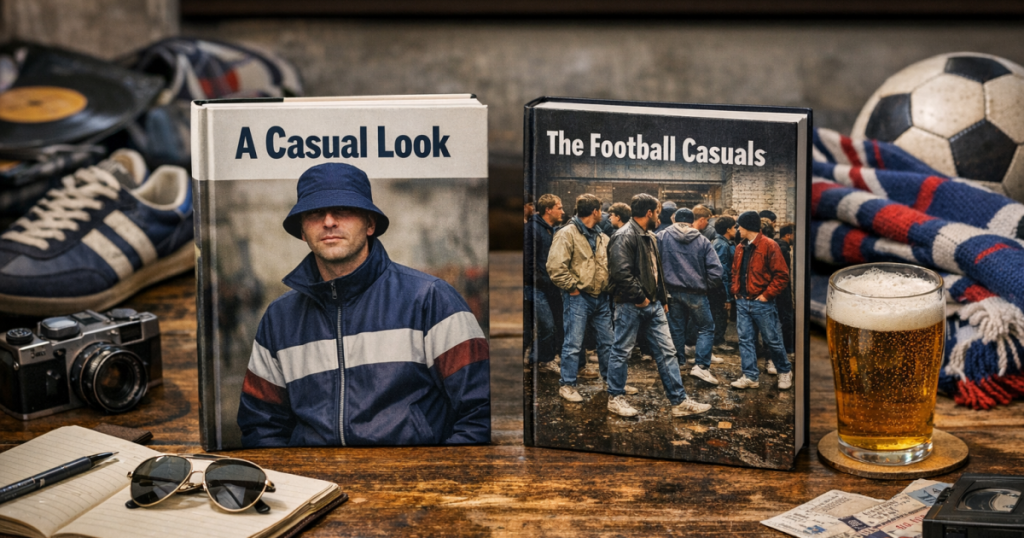
If you are building a proper understanding of British terrace style, A Casual Look vs The Football Casuals is a useful starting dilemma: do you begin with the pictures, or with the history? The short answer is simple. Read The Football Casuals: A History first if you want a framework for the culture, the language and the era. Start with A Casual Look first if your priority is visual detail: haircuts, fits, posture, outerwear, trainers and how the clothes actually sat on real people.
What to know first
These two books do different jobs. Treating them as rivals misses the point. Cass Pennant’s book is a narrative route into football casual culture: how it developed, why clothes mattered, and how status, travel, music, rivalry and regional identity all fed into what people wore. Gavin Watson’s photobook is closer to a visual archive. It lets you study the look without overexplaining it.
For most readers, the best order is: read the history first, then use the photobook to test what you have absorbed. That way, when you see a track top, wedge haircut, ski-style jacket, straight-leg jeans or pair of low-profile trainers in a photograph, you are not just admiring a mood board. You are reading the social signals more carefully.
The exception is the style-first reader. If you already know the broad story and want to sharpen your eye, the photobook can come first. It is particularly useful if you are trying to stop modern terrace-inspired outfits from looking like costume. Real archive photographs show awkwardness, attitude and ordinary weather in a way polished brand campaigns rarely do.
How The Football Casuals helps you understand the culture
The Football Casuals: A History is the more explanatory read. Its value is not that it gives you a neat, sanitised style manual; it helps you understand why clothing became loaded with meaning around football, youth identity and the British high street. For anyone coming to casual culture through retro tracksuits, reissued trainers or online outfit references, that context matters.
Read it with a few practical questions in mind:
- Which brands were treated as signals of taste, rarity or status in different scenes?
- How much of the look came from football travel, and how much from music, clubs, local pride and youth fashion?
- Where does the book separate lived experience from later mythology?
- Which parts of the culture are useful for style understanding, and which are best left as history rather than copied?
This is where a careful reader gains the most. Casual culture is often flattened into stereotypes: violence, labels and a few familiar trainer silhouettes. A history-led book gives you a wider lens. It also helps you avoid the lazy habit of calling every retro track jacket “terrace” without understanding why some pieces look convincing and others feel like fancy dress.
Once you have that background, style choices become easier to judge. If you are looking at a modern archive-inspired track top, for example, you can think beyond the badge and ask whether the cut, fabric and colour sit naturally with the era you are referencing. For more wearable context, the guide to wearing a retro track top with jeans is a good next step after the cultural reading.
How A Casual Look trains your eye
A Casual Look works differently. It is less about being told what mattered and more about seeing it. The strength of a photobook is that it shows proportion, confidence and imperfection. You can study how clothes hang, how people layered pieces, how footwear changed the outline of an outfit, and how the same type of garment could look completely different depending on stance, age, setting and weather.
Do not race through it like a coffee-table flick. Use it almost like a style archive. Spend time with each image and ask:
- What is the first item your eye notices: jacket, trainers, jeans, polo, hair or posture?
- Are the clothes oversized, neat, cropped, boxy or loose in a way modern reissues do not always replicate?
- How many outfits are genuinely “matched”, and how many rely on contrast?
- What does the setting change: street, estate, pub, station, ground, coach or club?
- Which details would still work now, and which only make sense in their original moment?
This is the book to use when you want to refine the visual side of retro sportswear. It helps with the small decisions: whether a track jacket should be zipped, whether jeans should be too slim, whether a cap adds something or tips the look into parody, and why a battered pair of trainers can sometimes look more believable than a spotless box-fresh pair.
If the photos make you want to translate the look into modern pub-to-ground clothing, it is worth pairing that visual research with a practical guide to choosing a track jacket for pub-to-ground wear. Archive inspiration is strongest when it survives real British weather, crowded trains and a long afternoon, not just a mirror photo.
Which should you read first?
Choose your first book according to what you are missing. If you understand clothes but not the culture, start with Pennant. If you know the mythology but cannot quite read the outfits, start with Watson. If you are completely new, begin with the history, then go visual.
Start with The Football Casuals if…
- You want a clearer timeline of how casual culture developed.
- You are interested in football, travel, regional identity and youth culture as much as clothing.
- You want to understand why certain brands became loaded with meaning.
- You need context before interpreting archive photographs.
- You are wary of copying a look without knowing what sits behind it.
Start with A Casual Look if…
- You are mainly researching fit, silhouette and real-world styling.
- You respond better to photographs than long-form explanation.
- You already know the broad story of casual culture.
- You want to notice ordinary details: jeans, cuffs, collars, trainers, bags and hair.
- You are building outfits and need visual calibration rather than another written overview.
The ideal route is not to crown one book as better. Read the history, study the images, then go back to the history with sharper eyes. The two books strengthen each other because one explains why the look mattered and the other shows how it lived away from tidy definitions.
How to read them for style details, not mythology
Football casual culture has always attracted myth-making. That can be part of the appeal, but it can also distort the clothes. A useful reading method is to separate three layers: what the book shows, what the book claims, and what later readers project onto it.
With the history book, note when something is described as a broad pattern rather than a universal rule. Not every town, club or group dressed identically. With the photobook, avoid turning one striking image into a rule for an entire era. A single jacket, trainer or haircut may be important, but it is still one moment in one place.
This matters for modern style because the best retro outfits do not copy archive images too literally. They take the principles: clean sportswear, sharp layering, confidence with colour, weather-aware outerwear, and trainers that suit the line of the trousers. If you want to practise that kind of close viewing, the piece on watching terrace documentaries for style details, not mythology applies the same approach to film footage and interviews.
A simple reading method
Use this sequence if you want the most from both books without turning the exercise into homework:
- First pass: read or browse naturally. Get the atmosphere before taking notes.
- Second pass: mark the recurring clothing themes: jackets, polos, denim, trainers, tracksuits, knitwear and outerwear.
- Third pass: connect the visual details to the social context: travel, music, weather, class, local pride and the high street.
- Final pass: translate only the usable principles into your own wardrobe. Avoid copying full outfits unless they genuinely fit your life now.
That last point is important. A photograph can inspire a modern outfit, but it should not trap you in reconstruction. A reissued track top, straight jeans, suede or leather terrace trainers, and a simple polo can nod to the lineage without pretending you have stepped out of an archive print.
Common questions
Is A Casual Look only useful for fashion research?
No. It is valuable as social documentary as well as style reference. The clothing is central, but the settings, body language and group dynamics are just as revealing.
Is The Football Casuals a style manual?
No. Read it as cultural history rather than a list of rules. It helps you understand why clothes mattered, but it does not replace close visual study.
Which book is better for beginners?
For complete beginners, start with The Football Casuals. It gives you enough context to understand why the photographs in A Casual Look are culturally significant.
Can these books help with modern terrace outfits?
Yes, if you read them carefully. Use them for proportion, attitude, layering and context, not for copying every period detail exactly.
Are documentaries a better starting point than books?
Documentaries are useful for movement, accents and atmosphere, but books let you slow down. Ideally, use both: read for context, watch for detail, then compare the two.
What to remember
If you want the cleanest reading order, begin with The Football Casuals for the story and then move to A Casual Look for the evidence your eyes can test. If your main interest is clothing, the photobook may grab you first, but it becomes richer when you understand the culture around it.
The strongest route is to avoid treating either book as a sacred text. Use them together: one to understand the roots of British casual culture, the other to study how retro sportswear, denim, trainers and attitude looked in real life. That combination gives you something better than nostalgia: a sharper eye for what still works now.