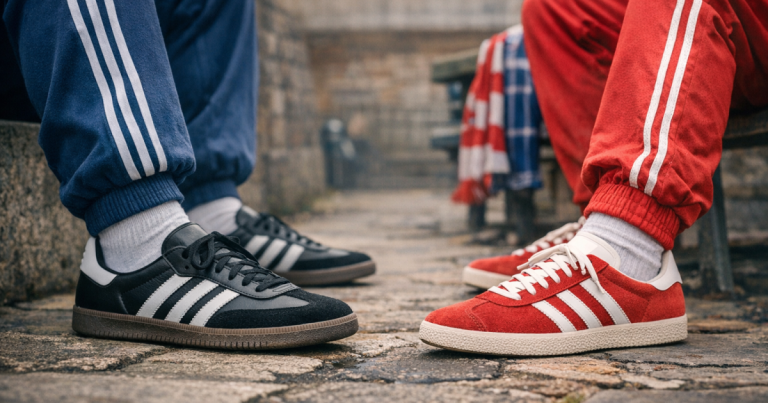
Fresh leather trainers can finish a retro tracksuit properly, but the first few wears are where most heel rub, toe pressure and awkward creasing starts. The aim is to break in leather terrace trainers slowly enough that the shoe learns your foot before your heel pays for it. Done well, they keep their shape, sit cleanly with track bottoms and feel wearable beyond the first Saturday out.
Treating infected blisters, numbness, or recurring foot pain is a healthcare matter and should be assessed by a qualified medical professional in line with NHS guidance and UK clinical standards.
What to know first
Leather does soften, but it does not magically become a different size. A trainer that is painfully tight across the toes, presses hard on the nail, or slips badly at the heel is unlikely to become right through wear alone. Breaking in is about easing stiffness, shaping the upper and reducing friction; it is not a fix for a poor fit.
- Start with short indoor wears before a full day outside.
- Use the socks you actually wear with your tracksuits, not thin dress socks for testing.
- Change the lacing before blaming the trainer.
- Protect known rub points before they turn into blisters.
- Avoid heat, soaking and aggressive stretching, especially on suede or mixed-material pairs.
The terrace look often rewards a slightly sharper trainer: a firm heel counter, a neat toe shape and leather that holds its line under wider track bottoms. That is part of the appeal, but it also means the first few wears need more patience than a soft running-style trainer.
Step 1: Check the fit before trying to soften anything
Put both trainers on in the afternoon or evening, when your feet are closer to their daily swollen size. Lace them as you would normally wear them, stand up, and walk around indoors for ten minutes. You are looking for pressure, not just tightness. Firm leather across the vamp is normal; sharp pressure on the little toe, nail, bunion area or Achilles is a warning.
A simple test is to walk up and down stairs. If your heel lifts with every step, you will probably get rubbing at the back. If your toes hit the front going downstairs, the length is wrong or the lacing is forcing your foot forward. Neither issue is solved by wearing them on a long pub-to-ground walk and hoping for the best.
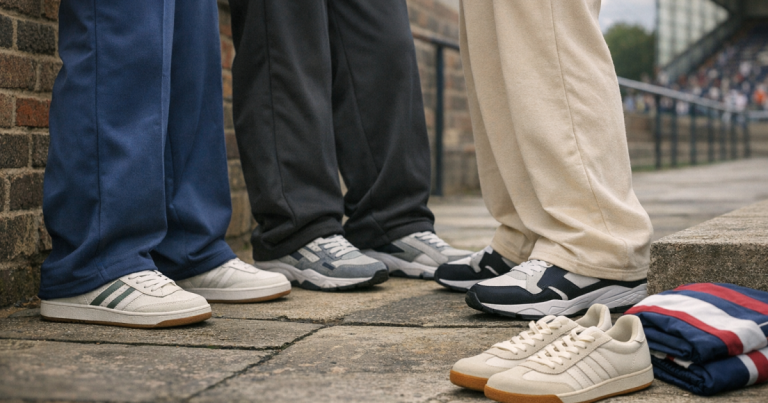
Trainer shape also changes how an outfit sits. Chunkier retro runners, slimmer indoor styles and court-inspired leather shoes all break in differently, and they balance differently with jeans or track bottoms. If you are working out where a pair sits visually, the comparison of retro trainer profiles for terrace style is a useful reference point before committing to a long first wear.
Step 2: Wear them indoors in short, honest sessions
The safest first stage is boring but effective: wear them at home for 20 to 30 minutes at a time. Do normal movement rather than just sitting on the sofa. Walk, bend, go up stairs, stand in the kitchen and notice where the leather resists.
Do this for a few sessions before taking them outside. Indoor wear has two advantages. First, it lets the leather warm and flex without grit, rain or pavement creasing it too quickly. Second, it usually keeps the shoes returnable if you realise the fit is fundamentally wrong; always check the retailer’s return rules rather than assuming.
Do not rush straight to a full matchday, gig or all-day city wander. Terrace outfits are often built around confidence: a good track top, relaxed bottoms, clean trainers. Hobbling after an hour ruins the line of the outfit and the day.
Step 3: Use the right socks for the first few wears
Socks make a bigger difference than most people admit. Very thin socks can make a stiff trainer feel roomy at first, then leave your heel exposed once you start walking. Very thick socks can overload the upper, push your toes into the front and create pressure where the shoe was never designed to stretch.
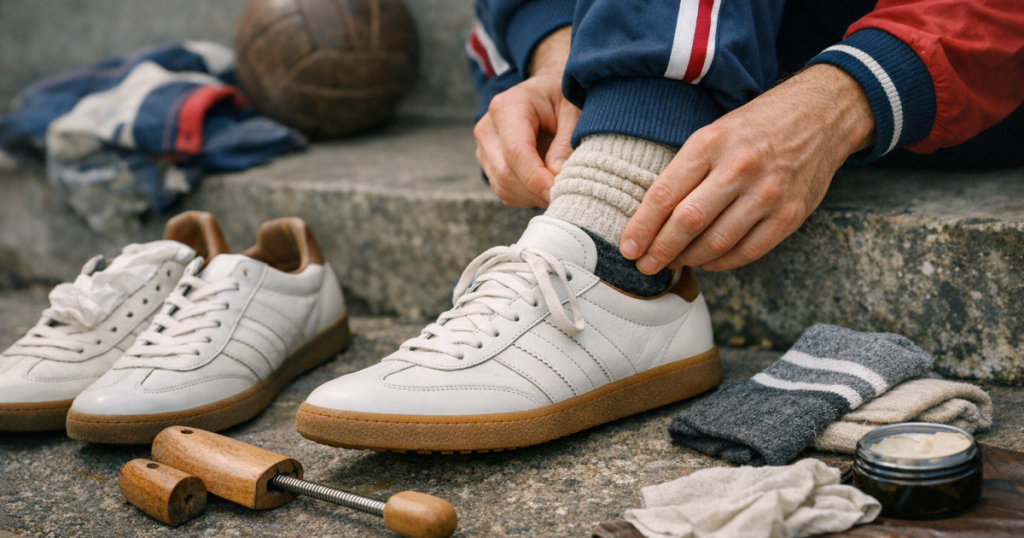
For the first few wears, choose a medium-weight cotton-rich sports sock or casual crew sock with enough cushioning at the heel. If you normally wear white crew socks with track pants, break the trainers in with those. If your style leans more understated with darker socks, use those instead. The aim is to mimic the real outfit, not create an artificial fitting-room result.
If you already know where you blister, add protection before the rub begins. Compeed Blister Plasters are a familiar option for heel and ankle hot spots, but use them as prevention during break-in rather than as a badge of suffering after the damage is done.
Step 4: Adjust the laces to reduce heel rub and toe pressure
Lacing is the quickest non-destructive adjustment you can make. Many leather terrace trainers are worn too loose for the sake of a relaxed look, especially with wider trousers. That can make the heel slide, which is exactly what creates blisters at the back.
For heel slip
Tighten the lower and middle eyelets evenly, then use the top eyelets if the trainer has them and it still looks right. You do not need to strangle the ankle; you just need the midfoot held securely enough that the heel is not travelling up and down.
For top-of-foot pressure
Loosen the section directly over the pressure point and tighten the rest of the shoe around it. Some people benefit from skipping one pair of eyelets over a high instep, but test this indoors first because it can reduce overall hold.
For toe pressure
Re-lace from scratch rather than simply loosening the top. If the shoe is pulling your foot forward, secure the midfoot better. If your toes still hit the front when walking downhill or down stairs, the issue is likely size or shape, not break-in.
Step 5: Flex the leather gently, not dramatically
Natural flexing from walking is better than forcing a shoe into shape. Before wearing them, you can hold the trainer and gently bend it at the point where your foot naturally flexes. Do not fold the toe box in half or twist the shoe aggressively. That can create ugly creases and weaken the structure long before the leather has settled.
Smooth leather can sometimes benefit from a very small amount of suitable conditioner, but only if the material and finish are appropriate. Test any product on a hidden area and avoid heavy application. Suede and nubuck need different care from smooth leather, so do not treat every terrace trainer as if it were an old football boot.
Heat is the classic mistake. Radiators, hairdryers and direct hot air can dry leather, distort glue and leave the shoe looking tired before it has earned a proper crease. British weather already gives trainers enough to deal with; there is no need to cook them indoors.
Step 6: Plan the first outdoor wear
The first trip outside should be short and low-risk: a walk to the shop, a coffee, a casual hour rather than a full day. Avoid heavy rain, muddy parks and long standing sessions. Leather can cope with normal life, but brand-new uppers and damp pavements are not the ideal opening partnership.
Pay attention to how the trainers work with the trousers you actually wear. Wide tracksuit bottoms can catch on bulkier shoes or hide slimmer ones, while cuffed bottoms expose the heel and ankle area more clearly. If the trouser opening is part of the issue, this guide to pick trainers for wide tracksuit bottoms will help you judge the balance before blaming the shoe.
After the first outdoor wear, let the trainers air naturally. Take out removable insoles if they are damp, loosen the laces and allow the upper to relax. Stuffing them tightly with paper can distort the toe; using a light shoe tree can help maintain shape, but it should not force the leather wider than it wants to go.
Step 7: Know which materials need extra patience
Not all terrace trainers behave the same way. Smooth leather often softens and creases in a more predictable pattern. Patent-style finishes can feel less forgiving. Suede can feel comfortable early but is more vulnerable to rain and staining. Mixed-material trainers may flex in one area and stay firm in another, which is why rubbing can appear in oddly specific places.
Heritage styles such as Diadora B. Elite, adidas Handball Spezial and PUMA Palermo are useful reference points because they sit in the broader terrace conversation, but releases, materials and fit can vary. Treat the exact pair in your hand as the truth. Check the label, feel the lining, test the flex and do not assume one model behaves identically across every version.
What not to do
Most blister problems get worse because someone tries to speed up the process. A stiff pair of leather trainers does not need punishment; it needs controlled wear.
- Do not soak trainers in water to stretch them. It can mark leather, affect shape and damage linings.
- Do not wear two pairs of thick socks and force a tight shoe for hours. That often creates pressure rather than comfort.
- Do not use heat to soften leather quickly. Dry, cracked or warped uppers are harder to rescue than stiff ones.
- Do not ignore a hot spot. Stop, adjust the lace, add protection or change shoes before it becomes a blister.
- Do not assume pain is part of the style. Terrace wear has always been about looking sharp, not limping for authenticity.
How to keep the shape while making them comfortable
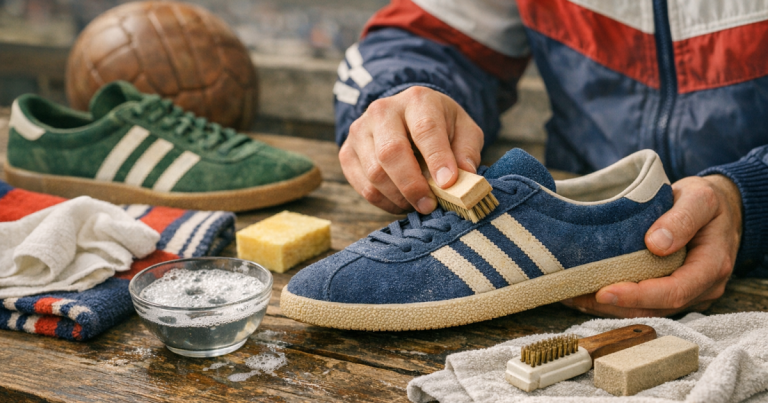
The ideal break-in leaves the trainers looking worn-in, not battered. Clean them after dirty wears, let them dry naturally and brush off surface dust before it embeds into creases. For smooth leather, use an appropriate cleaner or conditioner sparingly and only after checking it suits the finish. For suede, use a suede brush and suitable protector rather than leather cream.
Store them unlaced or loosely laced so the tongue is not crushed to one side. If the heel counter has softened unevenly, use your hands to reshape it gently after wear. Avoid kicking trainers off with the opposite foot; that crushes the heel and is one of the fastest ways to make a sharp pair look lazy.
Comfort also comes from outfit choice. A full tracksuit with clean leather trainers can look deliberate when the proportions are controlled: hems not dragging, jacket not ballooning, shoes not disappearing under fabric. The same thinking applies to making a full tracksuit look sharp rather than sloppy, where trainer shape is part of the whole silhouette rather than an afterthought.
Questions people ask
How long does it take to break in leather terrace trainers?
Many pairs feel better after several short wears, but the exact timing depends on leather type, lining, foot shape and how stiff the shoe is at the start. Judge progress by reduced rubbing and easier flex, not by a fixed number of days.
Should leather trainers feel tight at first?
They can feel firm, especially across the upper, but they should not feel painful. Toe cramping, nail pressure, numbness or sharp rubbing usually points to a fit problem rather than normal break-in.
Can I wear new leather trainers to a match straight away?
It is a risk. Matchdays often mean long walks, standing, queues, trains and wet pavements. Wear them indoors and on shorter outdoor trips first, then use blister protection on known rub points.
Is it better to size up to avoid blisters?
Not always. A shoe that is too big can cause heel slip, which is a major cause of blisters. The better aim is secure midfoot hold, enough toe room and no sharp pressure points.
Can leather conditioner stop trainers rubbing?
It can help some smooth leather feel more supple, but it will not fix the wrong size or shape. Never use standard leather conditioner on suede or nubuck unless the product specifically says it is suitable.
What stands out
The cleanest way to break in leather terrace trainers without blisters is to treat comfort as part of the style, not a separate concern. Start indoors, wear proper socks, lace for hold, protect hot spots early and build up outdoor wear gradually. A good pair should end up with natural creases, secure heels and enough comfort to carry the outfit through real British weekends, not just mirror checks before leaving the house.