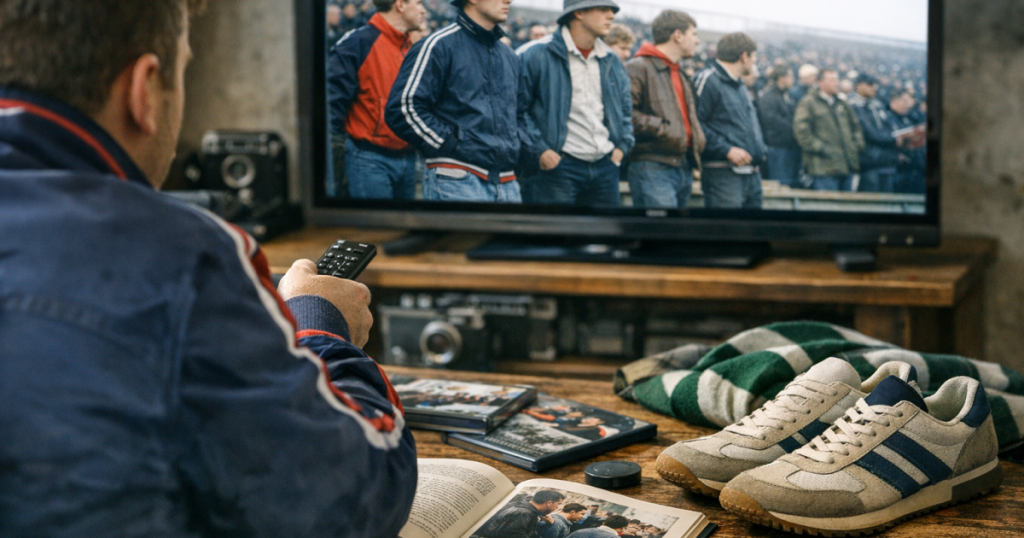
The best way to watch terrace documentaries is with two minds working at once: one listening to the story, the other checking the clothes, settings and dates against what can actually be seen. That is where the useful style detail sits, rather than in the loudest anecdote or the most polished bit of nostalgia.
For anyone into retro tracksuits, terrace trainers and British sportswear culture, the aim is not to turn every programme into a courtroom transcript. It is to separate visual evidence from mythology, so the clothes become clearer: how they fitted, how they were layered, what looked ordinary at the time, and what has been exaggerated later.
The useful way to watch
Start by treating each film as a source, not a rulebook. A documentary can capture valuable details: old photographs, crowd shots, interview clothing, shop fronts, matchday weather, transport, regional accents and the way people talk about status. It can also simplify a scene for pace, drama or television clarity.
The short version is simple:
- Watch the clothing first, then the commentary.
- Separate archive footage from modern interviews and staged reconstructions.
- Note what appears repeatedly, not what one speaker remembers most vividly.
- Look for ordinary outfits as well as trophy pieces.
- Use books, photographs and garment details to cross-check the mood.
This approach stops you copying mythology. It also makes the style more wearable now, because you begin to understand why certain track tops, polos, jeans, caps and trainers worked together rather than just recognising the badge on the chest.
Step 1: Identify what kind of footage you are seeing
The biggest mistake is treating every image on screen as equal. A grainy clip outside a ground, a posed photograph, a talking-head interview and a modern cutaway all tell you different things. Before judging the clothes, ask what the image is.
- Archive street or match footage: often the most valuable for real proportions, weather choices and how people actually moved in the clothes.
- Posed photographs: useful for identifying brands and silhouettes, but people may have dressed up for the camera.
- Modern interviews: good for memory and interpretation, but not proof that every detail was widespread.
- Re-enactments or mood shots: treat these as atmosphere, not evidence.
- Press or police imagery: important historically, but often framed around conflict rather than everyday style.
Once you make that distinction, you can enjoy the storytelling without letting it flatten the clothing history. A single dramatic clip does not prove a whole city dressed one way. Repeated visual patterns across different sources are much more useful.
Step 2: Watch the fit before the badge
Terrace nostalgia often turns into brand-spotting: adidas, Fila, Sergio Tacchini, Ellesse, Diadora, Lacoste, Kappa, Stone Island, C.P. Company and the rest. Badges matter because they signalled taste, money, travel and social knowledge. But the fit often tells you more than the logo.
Look at where track tops finish on the waist, how sleeves sit over the wrist, whether trousers stack over trainers, and how much room there is through the thigh. A vintage track top can look sharp because it is cropped and neat, not simply because it is rare. A full tracksuit can look deliberate when the proportions are balanced, and sloppy when the leg length, jacket width and footwear all fight each other. If you want to translate that observation into modern outfits, the guide to making a full tracksuit look sharp rather than sloppy is a useful next step.
Pause when the camera shows people walking, queuing or standing in groups. Movement reveals things a still image hides: whether the fabric has weight, whether the jacket balloons, whether trousers swing wide, and whether the outfit was worn for comfort, display or both.
Step 3: Separate era detail from modern styling
A documentary may cover one period but be edited for a modern audience. The music, colour grading and interview wardrobe can make everything feel more uniform than it really was. Style scenes rarely change overnight. One lad might still be wearing an older track top while someone else has moved on to a different trainer shape or designer jacket.
Instead of trying to pin a whole look to one neat moment, group details into layers:
- Core silhouette: slim, boxy, cropped, roomy, tapered or wide.
- Outer layer: track jacket, cagoule, Harrington, wax jacket, bomber or knitwear.
- Underlayer: polo, roll neck, sweatshirt, T-shirt or football shirt.
- Bottom half: jeans, cords, track bottoms or smarter trousers.
- Footwear: suede terrace trainers, runners, leather court shoes or more functional footwear.
This makes the viewing practical. You are not asking, “What is the one correct casual outfit?” You are asking, “Which parts of this look still work, and which parts belong to a specific social moment?” That distinction keeps modern retro dressing from becoming fancy dress.
Step 4: Listen for mythology cues
Documentaries about football-casual culture often contain bravado. Some of it is part of the oral history; some of it is performance; some of it is genuinely important context. The trick is not to dismiss it, but to identify when the storytelling is pulling attention away from the clothes.
Useful warning signs include sweeping claims such as everyone wore a certain brand, one city invented a whole look, or one trip changed the entire country. Subcultures spread through travel, shops, magazines, imports, music, football, family networks and local competition. Rarely through one neat origin story.
Also listen for status language. Phrases about being first, being clued-up, having something nobody else had, or knowing which shop to visit can be more useful than the anecdote itself. They explain why certain garments mattered. The clothing was not just fabric; it was social signalling, taste, belonging and one-upmanship.
Step 5: Cross-check with books, photographs and garments
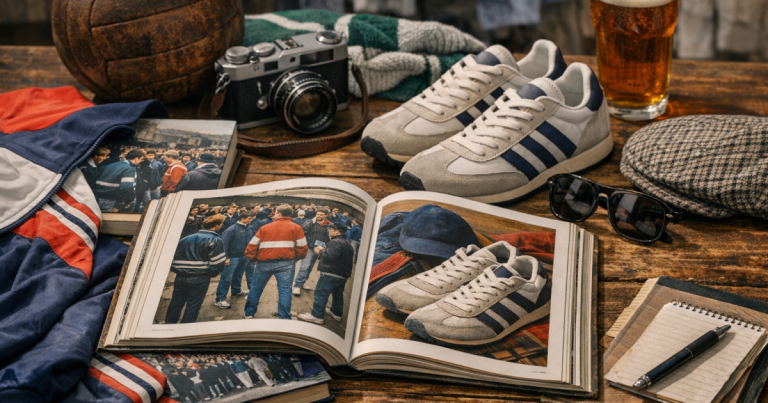
One documentary can set the mood. Several sources help you build a more reliable picture. Photographic books are especially useful because they slow everything down. You can study collars, cuffs, trouser breaks, trainer shapes and how ordinary people dressed when they were not being interviewed years later.
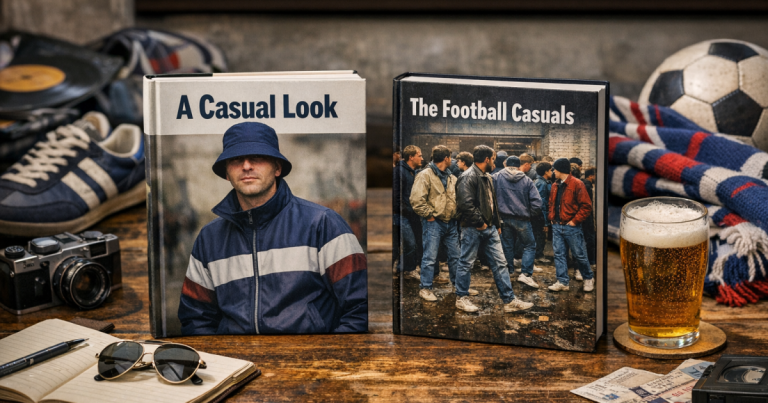
Two useful reference points are A Casual Look: A Photodiary of the 1980s Casual, Terrace and Football Scene by Gavin Watson and The Football Casuals: A History by Cass Pennant. Treat them as companion material rather than final authority: each has its own angle, geography and selection bias. For a more critical reading method, use the advice on spotting reliable football-casual books before taking any single source too literally.
If you already own vintage or reissue pieces, compare what you see on screen with the garment in your hands. Fabric weight, ribbing, zip pulls, pocket shapes and collar height can all change how an outfit reads. A jacket that looks sleek in archive footage may feel very different as a modern remake, and a rare original may not be the easiest thing to wear regularly.
Step 6: Read the weather and setting
British terrace style was never separate from British weather. Rain, wind, cold concrete, train journeys and long walks to grounds all shaped how sportswear was worn. A thin track top on screen might have been layered over a polo and under a coat. A cap might be practical as well as stylistic. A cagoule might be more important to the look than the expensive layer beneath it.
Watch for season and location cues: bare trees, floodlights, breath in cold air, wet pavements, heavy coats in the crowd, or the way people keep hands in pockets. These clues explain layering choices far better than an interview line about looking smart.
Setting matters too. A London club, a Merseyside away day, a Scottish ground, a Midlands shopping street and a seaside station are not interchangeable. Regional style is part of the story. Do not turn every outfit into a universal terrace uniform.
Step 7: Translate detail into wearable choices
The point of close watching is not to copy a still frame exactly. It is to build a better eye. If a documentary shows a neat track top over a polo, the lesson may be proportion: collar visible, zip not too high, jacket short enough to avoid sagging. If it shows wide track bottoms with compact trainers, the lesson may be balance rather than brand loyalty.
When a screen detail catches your eye, ask three practical questions:
- Is the shape doing the work, or is it mainly the logo?
- Would this layer make sense in current UK weather?
- Does the outfit still look strong without the documentary’s music, voiceover and nostalgia?
Fit is the easiest thing to misread online. Old footage can make everything look cooler because the image is soft and the moment feels charged. Before chasing a similar jacket, check your own measurements properly and compare garment-to-garment rather than relying on a size label. The guide to measuring a track top before buying online helps turn a screen reference into a realistic fit check.
A note on respect and context
Terrace style has always carried tension: fashion, football, class, pride, travel, rivalry, music, violence, humour and friendship all overlap. Good viewing keeps those threads separate without pretending they never touched. You can appreciate the clothing without romanticising harm, and you can recognise the edge of the culture without reducing everyone involved to a stereotype.
That matters because the mythology often sells the scene short. The sharper story is not simply trouble in better trainers. It is how working-class and youth cultures used sportswear, imports, leisure brands and local knowledge to create a visual language that still influences how people dress in Britain.
Helpful questions
Are terrace documentaries reliable for style research?
They are useful starting points, not complete records. Treat archive footage, photographs and repeated visual patterns as stronger evidence than single memories or dramatic narration.
What should I pause on when watching?
Pause on crowd shots, station scenes, shop fronts, queues and walking shots. These usually show real proportions, layering choices, trainer shapes and how clothes behaved in normal movement.
How do I avoid copying a costume version of the look?
Copy principles rather than whole outfits: proportion, fabric weight, colour restraint, trainer balance and layering. Leave the over-styled or overly theatrical details on screen.
Do books help more than documentaries?
Books and films do different jobs. Documentaries give voice, atmosphere and movement; books and photo collections let you study details slowly and compare images more carefully.
Which detail matters most for modern wear?
Fit matters most. A good collar, sensible sleeve length and balanced trouser break usually make more difference than chasing the rarest badge.
Main lessons
Watch for evidence before attitude. The most useful style lessons are usually quiet: a jacket sitting cleanly on the waist, a polo collar showing under a zip, trainers balancing wide trousers, a rain layer changing the whole silhouette. Those details explain why the look still has power.
Terrace documentaries are best treated as entry points into a wider visual culture. Enjoy the stories, question the grand claims, cross-check the clothes, and turn the strongest observations into outfits that work on real British streets rather than only in a nostalgic edit.