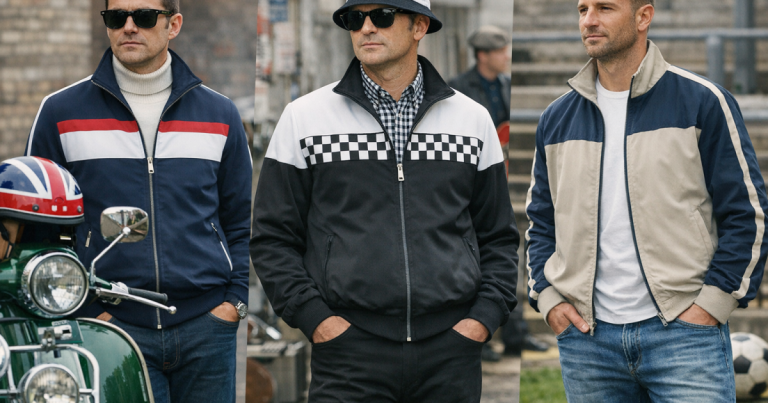

A tracksuit can place a photograph within a few years before you have checked the badge. In Britain, retro tracksuit eras are read through colour, cut, fabric, trainers, music and where the outfit was worn: away end, estate, club queue, college common room or pirate radio flat.
The point is not to dress like a museum display. It is to understand the cues well enough to borrow from them without flattening every decade into the same generic “old-school” look. The best outfits feel lived-in because the proportions, footwear and outer layer all speak the same language.
The short answer: read the whole silhouette
No single logo tells the full story. A trefoil, a big zip pull, a stand collar or a shiny nylon finish might suggest an era, but the outfit only makes sense when the full shape lines up. Jacket length, trouser width, cuff tension, trainer profile and even how the top is fastened all matter.
A slim track top worn with straight denim and low-profile suede trainers carries a very different message from a loose full set worn with bulky running shoes. One might lean towards early terrace casual refinement; the other can point towards late 1990s and 2000s music culture. Used well, retro tracksuit eras become a set of visual clues rather than a costume rail.
Late 1970s to early 1980s: continental sportswear and early casual polish
The late 1970s and early 1980s are often remembered through the football-casual appetite for European sportswear. The appeal was partly practical, partly aspirational. Imported-looking labels, tennis styling, bold panels and clean collar shapes offered a break from ordinary high-street gear. The look was sporty, but not just for sport.
Key cues include fitted track tops, ribbed cuffs, sharp colour blocking and a neat top-half shape. Trousers were not always worn as full matching sets; track jackets might sit with jeans, cords or smart-casual layers. Brands associated with the mood include adidas, Sergio Tacchini, Fila, Ellesse, Diadora and Lacoste, though the exact mix varied by place, availability and scene.
For a deeper decade-by-decade view of how these codes developed on British terraces, the site’s British tracksuit style by decade guide is the natural next read.
Mid to late 1980s: terrace status, sharper layers and away-day judgement
By the mid to late 1980s, tracksuit culture had become less about simply wearing sportswear and more about choosing the right sportswear. Subtle differences mattered. A top could signal taste, knowledge, money, travel, local rivalry or just the ability to spot something before everyone else did.
This is where layering becomes important. A track top under a casual jacket, knitwear over a polo, or a waxed outer layer over sportswear could all shift the signal. The outfit was rarely only about the tracksuit itself. The terrace eye judged balance: not too gym-like, not too formal, not too try-hard.
Look for cleaner proportions, considered colour, and trainers that do not overwhelm the trousers. Low-profile casual footwear tends to make more sense here than chunky modern runners. The mood is controlled rather than loud, even when the colours are strong.
1990s: shell suits, rave energy and broader street visibility
The 1990s brought more visible synthetic shine, bolder branding and a wider spread of tracksuit language beyond matchday. Rave, indie, hip-hop, local leisurewear habits and televised sport all fed the mix. Some looks were deliberately bright and brash; others were more muted, shaped by track tops, football training gear and everyday sportswear worn in schools, parks and town centres.
This decade is easy to caricature, so the detail matters. Not every 1990s tracksuit was a fluorescent shell suit, and not every shell suit belonged to the same social world. Fabric, fit and styling decide whether the reference feels knowingly archival or like fancy dress.
Useful cues include baggier tops, looser trousers, louder panels, elasticated hems, nylon textures and caps. Trainers often gained more visual weight, with running and court silhouettes sitting alongside classic terrace shoes. The outfit had more movement and more volume than the early casual shape.
2000s: garage, grime and the full-set statement
By the 2000s, the tracksuit had become central to several British youth and music scenes. UK garage, grime and pirate radio culture gave the full tracksuit a different authority: less country-club sport, more local presence, MC energy and practical streetwear. Matching sets, track jackets zipped higher, looser trousers and visible branding all became part of the vocabulary.
The context is crucial. A full tracksuit in this period could read as music-scene uniform, local pride, everyday comfort or defiance, depending on who wore it and where. That is why the meaning of the tracksuit in Britain is never fixed. For more on the cultural weight behind the garment, read the meaning of tracksuits in British youth culture.
Modern wearers often get this era wrong by making everything too tight or too polished. The 2000s cue needs ease. It should look like it can move, travel, queue outside a venue and still hold its shape.
Modern revival: archive references without the costume effect
Today’s retro sportswear revival works best when it takes one or two strong cues from an era, then leaves the rest alone. A period-correct track top, current straight-leg trousers and familiar terrace trainers can feel more natural than a head-to-toe replica. The key is restraint.
Current archive-inspired pieces can help readers understand the language without chasing fragile vintage condition. The adidas Originals Beckenbauer Track Top is a useful reference point for a cleaner, heritage track-jacket line. A Fila Settanta Track Jacket can suggest Italian sportswear colour and collar attitude. A Sergio Tacchini Damarindo Track Top points towards the tennis-to-terrace crossover many British casuals still respond to. With any modern reissue or archive-style piece, check the current fit, fabric, colourway and sizing rather than assuming it behaves like an original.
How to read the cues without overclaiming
Subculture clothing is not a laboratory sample. People mixed eras, borrowed older pieces, wore hand-me-downs, bought from markets and styled sportswear according to local habit. A jacket might be early 1980s in design but worn heavily in a later decade. A trainer shape might feel terrace-coded in one city and club-coded in another.
- Start with proportion: slim and neat often reads earlier; wider and more relaxed often reads later, though there are exceptions.
- Check the fabric: cotton-blend jersey, shiny nylon and polyester tricot all carry different associations.
- Look at the collar: stand collars, funnel necks and open zip styling can shift the period feel.
- Match the footwear language: suede terrace trainers, court shoes and chunkier runners all change the story.
- Think about setting: away-day terrace, rave, college, estate, pub and club queue each alters how the same garment reads.
If you are trying to make the look wearable now, proportions matter more than strict authenticity. The site’s terrace fit guide breaks down silhouettes, layering and matchday proportions in more practical detail.
Common mistakes when decoding an era
The first mistake is treating every tracksuit as terrace wear. Plenty of sportswear entered British wardrobes through school PE, family holidays, television, dance music, hip-hop, gyms and ordinary leisurewear. Terrace culture is central, but not exclusive.
The second mistake is assuming logos are enough. A big badge can help with period feel, but cut and styling usually say more. A modern slim remake of an old design will not automatically read like the original. Likewise, a vintage top worn with the wrong trousers and trainers can lose its context completely.
The third mistake is ignoring class and geography. Tracksuit meaning in Glasgow, Manchester, London, Liverpool, Birmingham or a smaller town was not always identical. Local shops, football allegiances, nightlife, policing, weather and music scenes all shaped how sportswear was worn and understood.
Helpful questions
Can one tracksuit belong to more than one subculture?
Yes. A track top can move between football, music and everyday streetwear. The surrounding outfit, the wearer and the setting decide the strongest reading.
Are matching tracksuit sets always a 2000s cue?
No. Matching sets existed earlier, but the looser full-set statement is strongly associated with later youth and music culture. Fit and footwear make the difference.
Is vintage always more authentic than a reissue?
Not automatically. Vintage can have better period character, but reissues are often easier to wear regularly. Check shape, fabric, condition and how you plan to style it.
Which trainers make retro tracksuit styling feel most British?
Low-profile terrace trainers give a classic casual feel, while chunkier runners can push the look towards 1990s and 2000s streetwear. Trouser break is what ties them together.
The big picture
British tracksuit culture is best understood as a set of overlapping signals rather than a clean timeline. Football casuals, tennis labels, rave, garage, grime, local youth culture and modern nostalgia all left marks on the same garment type.
For buying and styling, this means judging pieces by how they will behave in an outfit, not just how they look on a hanger. A boxy top may need straighter trousers to stop it floating above the waist. A shiny nylon jacket can look brilliant with muted footwear, but too loud with equally glossy trainers. A narrow vintage track top might suit denim or cords better than a matching modern jogger.
Condition also changes the signal. Light fading, softened cuffs and a slightly relaxed collar can add believable age; collapsed elastic, bobbled fabric or a warped zip can make the same piece look tired rather than characterful. If you are buying second-hand, check sleeve length, hem tension and whether the trousers still sit properly over trainers. Those small details decide whether the reference feels sharp or accidental.
The strongest modern looks usually leave a little ambiguity. They do not announce one exact year or scene; they suggest a world of football travel, local shops, music, pubs, clubs and everyday wear. That looseness is part of the appeal. British tracksuit history was never perfectly tidy, so the most convincing outfits allow for overlap while still keeping the main cues disciplined.
Read the silhouette first, then the fabric, collar, colour, trainer choice and social setting. That approach keeps the history alive without turning it into costume, and it makes modern retro styling sharper because each cue is chosen with intent.