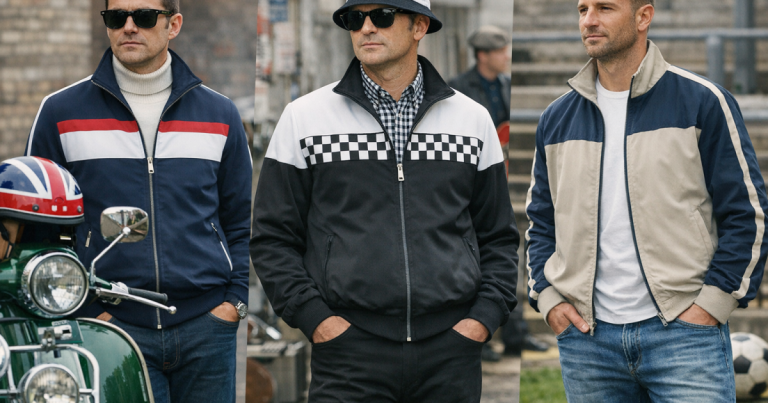
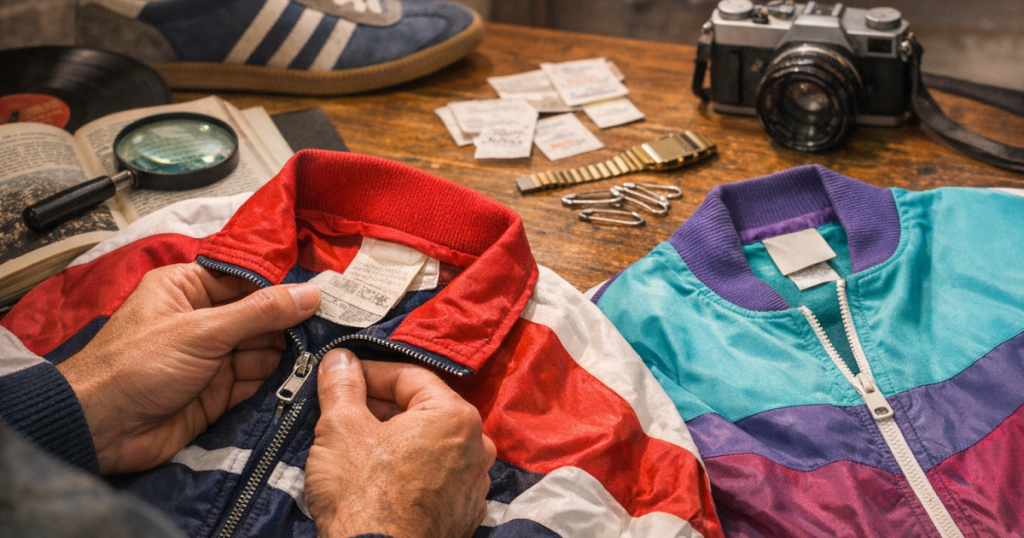
Old track tops tell stories, but the story is often stitched into the label rather than shouted by the colourway. Knowing how to date a vintage tracksuit helps you judge whether a piece is genuinely period, a later reissue, or simply retro-looking sportswear with a good tale attached.
The trick is not to rely on one clue. A neck label can be swapped, care labels fade, zips get replaced, and sellers can misread an era. The most reliable approach is to build a picture from several details: branding, country of manufacture, fabric, construction, hardware, cut and cultural context.
The short version
Start with the label, then test that evidence against the garment itself. A believable vintage tracksuit usually has a consistent set of signals: label design, logo style, care instructions, zip type, fabric feel, stitching and silhouette all point in roughly the same direction.
- Neck labels help identify brand era, country of manufacture and whether the piece is a reissue.
- Care labels reveal fibre content, washing symbols, language spread and sometimes distributor details.
- Logos and badges can expose later reproductions, especially when the branding feels too modern for the cut.
- Zips, cuffs and seams show whether the construction matches the claimed period.
- Fit and styling should make sense within UK football, rave, casual and gym culture rather than just online nostalgia.
Step 1: Read the main label, but do not stop there
The neck or waistband label is the obvious starting point. Look at the logo, typography, background colour, stitching, country of manufacture and whether the label is woven, printed or heat-applied. Older labels often have a simpler, more tactile quality, while many modern reissues use crisp woven branding, multiple language tags and contemporary sizing formats.
For adidas, the Trefoil is a major part of the heritage story, but it is not automatic proof of age because adidas Originals continues to use archive branding. The same caution applies to Fila, Ellesse, Sergio Tacchini, Kappa and Lacoste Sport: old-style logos can appear on modern archive-inspired pieces. Treat the label as a lead, not the whole case.
Country of manufacture can be useful. Vintage European sportswear may show manufacturing in places such as West Germany, Yugoslavia, Italy, France, Portugal or the UK, depending on brand and period. Later pieces may show a broader modern supply chain. This is a clue rather than a guarantee, because brands used different factories and production arrangements across markets.
Step 2: Check the care label for era clues
Care labels are often more revealing than the front badge. Check the fibre content, washing symbols, language order and whether there are distributor names or address details. A simple polyester label with brief instructions feels different from a long modern label carrying many languages, compliance information, recycling references and a web address.
Older tracksuits frequently use polyester, polyamide or cotton blends, but the exact feel varies by brand and intended use. A slinky club tracksuit, a brushed football training top and a shiny shell suit are not the same thing. If the care label claims a fibre mix that does not match the handle of the fabric, slow down and examine the rest of the garment.
Size marking is another clue. A vintage continental piece may use number sizing, while UK-market pieces might use S, M, L, chest measurements or dual sizing. Modern labels often include broader international size grids. None of this dates a garment exactly, but it helps separate original-era sportswear from later retro runs.
Step 3: Match the logo to the cut and purpose
Branding should make sense with the silhouette. A tight ribbed track top with a high collar, narrow sleeves and understated chest logo points to a different world from an oversized, shiny, zip-heavy tracksuit associated with later club, garage or high-street sportswear eras.
UK terrace culture complicates things because pieces were worn outside their original sporting context. A tennis-style Sergio Tacchini top could end up at football, just as an adidas training suit could become pub, away-day or estate wear. For the wider cultural meaning of the garment, it is worth reading about tracksuits in British youth culture, because use and identity often changed faster than the clothes themselves.
Look at how the logo is applied. Embroidery, flocking, printed badges, sewn patches and rubberised details all carry different implications. Heavy modern embroidery on a supposed early piece is not impossible, but it should prompt questions. So should branding that looks too clean, too large or too aligned with current retro trends.
Step 4: Inspect zips, pullers and fastenings
Zips can support or weaken a dating claim. Makers such as YKK have been around for a long time, so their presence alone does not prove much. What matters is whether the zip style, puller shape, tape colour and stitching match the rest of the garment.
Metal zips may appear on older or more robust pieces, while plastic coil zips are common across many later sportswear items. Branded pullers can be a useful detail, but they are also easy to replace. Check whether the zip stitching looks original: uneven thread colour, newer stitching or a different stitch length around the zip can suggest repair.
Also check pocket closures. Some older track tops have simple open pockets or understated zip pockets. Later fashion-led pieces may use more visible pocket furniture, contrast pulls or decorative hardware. Again, no single detail is proof; consistency is the aim.
Step 5: Feel the fabric and look at the lining
Fabric is one of the best reality checks. Older polyester can feel dense, smooth, shiny, dry, brushed or slightly heavy depending on its intended sport and period. Modern reissues may deliberately mimic old fabrics, but they often have a different handle, cleaner finish or updated lining.
Turn the garment inside out. Look for mesh, brushed backing, terry-like texture, bonded layers, loose overlocking or taped seams. A basic single-layer track top reads differently from a fully lined shell suit. The lining should also match the use: a lightweight warm-up set, a training suit and a fashion tracksuit have different priorities.
Condition matters, but do not confuse wear with age. A neglected modern piece can look tired quickly, while a carefully stored vintage tracksuit can look surprisingly sharp. Check elastic recovery at cuffs and waistband, colour loss at fold lines, bobbling under the arms, and fading around the collar where skin and washing do the most work.
Step 6: Judge the silhouette in a UK context
Dating a tracksuit is easier when you understand how it would have been worn. A slim ribbed track top and straight-leg bottoms may sit naturally with late 1970s and early 1980s football-casual references. A louder, shinier, roomier shape may suggest later club, rave, garage or high-street sportswear associations. A modern reissue may borrow the colour and badge but alter the cut for current wardrobes.
adidas Beckenbauer-style tracksuits are a good example of why shape matters as much as branding. The line has deep sporting and terrace associations, but modern archive versions mean you need to check labels and construction, not just the outline. For the cultural backstory, see why adidas Beckenbauer tracksuits became terrace icons.
Trousers are particularly revealing. Older track bottoms may have a higher rise, tighter cuff, stitched crease, zipped ankle or a straighter line than modern casual joggers. If the top looks period-correct but the bottoms feel like a modern fit, the set may be mismatched.
Step 7: Separate original, reissue and custom pieces
Not every non-vintage piece is a fake. Reissues can be excellent to wear, and many are made honestly with archive branding. The problem is when a later piece is sold as original-era without evidence.
Look for modern tells: QR codes, current web addresses, very long multinational labels, recent sustainability wording, modern wash-care formatting, or product codes that lead to current-season listings. These do not make a garment bad; they simply move it away from original vintage.
Customisation adds another layer. Football patches, initials, club embroidery, replacement zips and altered hems can be part of a garment’s life, but they can also blur the date. Check whether added details sit on top of older wear or whether the whole garment looks newly assembled.
Step 8: Use photos properly when buying online
If you are judging from photos, ask for the details that actually help: neck label, care label, zip puller, inside seams, cuffs, waistband, ankle openings and any flaws. A front-on hanger shot is not enough.
- Ask for a close-up of the neck label without flash glare.
- Ask for the full care label, including the reverse side if there is one.
- Ask for the zip puller and zip tape at the collar and pockets.
- Ask for inside-out photos of seams, lining and waistband construction.
- Ask for measurements in centimetres: pit to pit, collar to hem, inside leg and waistband relaxed.
Measurements are especially useful because vintage sizing is inconsistent. A labelled medium might fit closer to a modern small, while some later sportswear runs large. If you plan to wear the piece with terrace trainers, the break at the hem matters too; the principles in getting the right trouser break for terrace trainers apply just as much to vintage bottoms.
Step 9: Build an evidence chain
The best way to date a vintage tracksuit is to write down what each clue suggests, then see whether the clues agree. For example, a label suggesting an older European-made garment, a period-appropriate zip, ageing elastic, simple care instructions and a matching cut build a stronger case than a single old-looking badge.
If the evidence conflicts, do not force it. A vintage top with replacement zip is still vintage if the rest of the garment supports that. A modern reissue with a heritage logo is still wearable and culturally valid, but it should not be described as original unless the details back it up.
For personal wear, the question is not only age. Ask whether the piece is stable enough for regular use, whether the elastic still works, whether the fabric has odour or storage marks, and whether the colour sits naturally with the trainers and outerwear you already own. A beautifully dated piece is less useful if it cannot survive a Saturday train journey, pub seat and drizzle.
Common dating clues and what they usually mean
Woven neck label
Often a strong starting point, especially when typography, logo and manufacturing country match known brand eras. Still check whether the garment is a reissue using heritage branding.
Long multilingual care label
Often points to later production, particularly when paired with modern compliance wording, web addresses or scannable codes. It can still be retro-styled rather than original vintage.
Period-looking logo on a modern cut
Usually suggests a reissue or archive-inspired item. The garment may be perfectly good to wear, but the dating should follow the construction, not just the badge.
Replacement zip or altered hem
Does not automatically ruin the piece. It means you should date the main garment separately from the repair and describe the alteration clearly if selling.
Things readers ask
Can I date a vintage tracksuit from photos only?
You can make an informed judgement, but not a certain one. Ask for label, zip, lining, seam and measurement photos before treating a seller’s era claim as reliable.
Does made in West Germany always mean 1980s?
No. It is a strong historical clue, but you still need the label design, garment construction and brand context to support the date.
Are reissue tracksuits worth avoiding?
Not necessarily. Reissues can be easier to wear and care for. The key is not to pay original-vintage money unless the evidence supports original age.
What matters most for terrace wear: age or fit?
Fit usually matters more if you intend to wear it. A correctly dated piece that sits badly over trainers will look less convincing than a well-cut reissue.
Should vintage tracksuits be washed before dating them?
Check the labels and photograph details first. Washing can fade weak labels or disturb fragile stitching, so record the evidence before any cleaning.
Main points
Dating vintage sportswear is detective work, not guesswork. Labels give the first lead, but the strongest conclusion comes from matching the label to the care tag, fabric, hardware, cut and signs of age.
For UK terrace and retro tracksuit enthusiasts, that matters because the value is not only financial. A properly understood tracksuit sits in a real line of football, music, youth culture and everyday wear. Whether you keep it as an archive piece or wear it on a wet away day, the details decide how honestly its story is told.