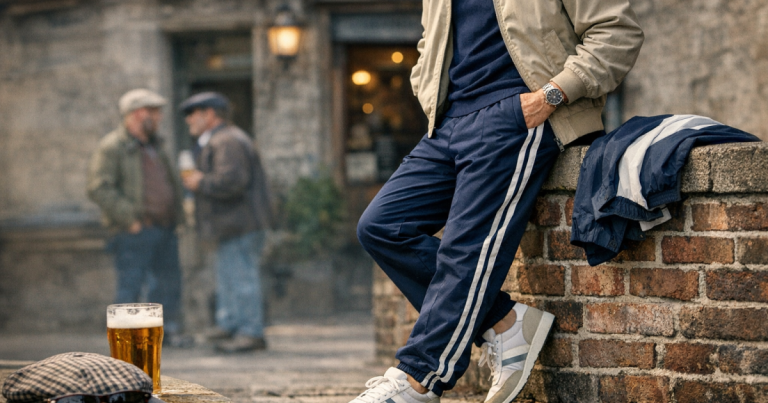
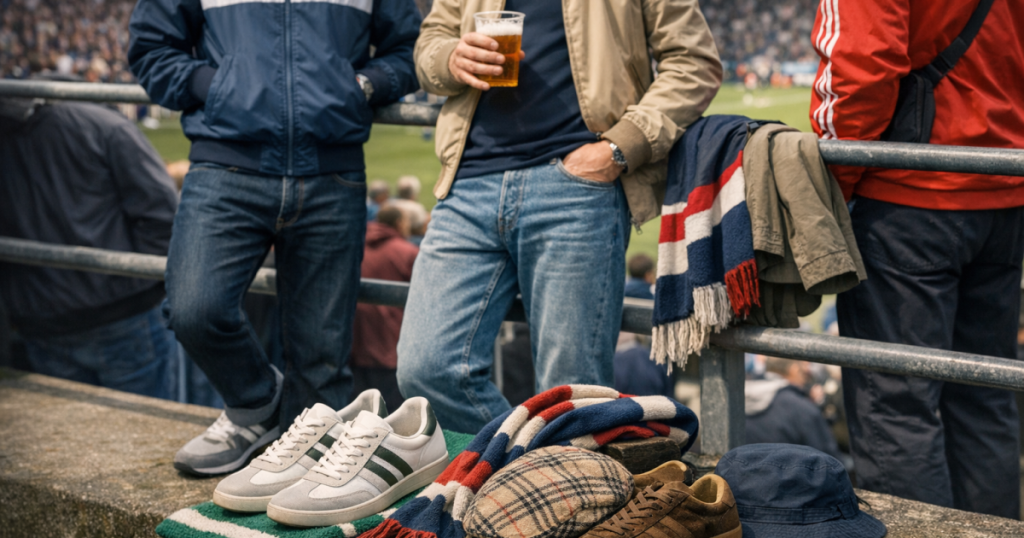
terrace style is British football culture expressed through clothes: track tops, trainers, caps, outerwear and the quiet codes that tell people you know what you are doing. It is not fancy dress, not full-kit behaviour, and not simply wearing a retro tracksuit because it looks good in a photo. Done well, it is considered, local, weather-aware and just understated enough.
The look sits between nostalgia and usefulness. It borrows from football casuals, Britpop, mod sharpness, rave-era sportswear and everyday British practicality, then filters all of that through the question that matters on a Saturday: would you actually wear it to the match, the pub, the train and home again?
In brief
- It is built around sportswear, trainers and outerwear rather than replica shirts and obvious fan gear.
- The strongest outfits look relaxed, but the details are rarely accidental: colour, fit, era and brand all matter.
- Brands carry cultural weight, but context matters more than logos alone.
- Matchday clothes should handle British weather, crowded concourses and long walks without looking overdone.
- The modern version works best when it references the past without dressing like a museum display.
Where the look comes from
Terrace style grew out of football grounds, away days, European trips, record sleeves, club nights and street-level taste. The clothing became a way to signal knowledge without shouting. Instead of wearing club colours from head to toe, lads began leaning into imported trainers, Italian sportswear, premium knitwear, technical jackets and track tops that looked sharper than ordinary sports kit.
That history is why the look still feels different from general retro sportswear. A track jacket on its own is just a track jacket; worn with the right trainers, a rain-ready jacket, a sensible palette and the right amount of restraint, it starts to make cultural sense. For a deeper era-by-era breakdown, the way football casuals shaped retro tracksuit style by era explains why certain shapes and brands still carry weight.
There is no single uniform. A Merseyside-leaning look, a Manchester-influenced Britpop outfit, a London casual take and a Scottish away-day wardrobe can all overlap without being identical. That regional variation is part of the appeal. The point is not to copy one imagined terrace character; it is to understand the codes well enough to build something believable.
The brands that still carry meaning
Brand choice matters because the scene has always been about recognition. Not necessarily expensive recognition, and not always rare recognition, but recognition among people who notice details. Adidas Originals remains central because of its football, training and casual heritage. Track tops such as the adidas Originals Firebird Track Top give an easy reference point, although the smartest outfits avoid letting one big logo do all the work.
Sergio Tacchini, Fila, Ellesse, Kappa and Diadora bring in the tennis, Italian sportswear and continental flavour that helped separate casual dressing from ordinary sports kit. Lacoste and Fred Perry sit closer to polo shirts, mod-adjacent neatness and pub-to-ground layering. Nike has its own British terrace story too, especially through tracksuits, technical jackets and trainers that became part of the everyday uniform rather than a separate performance look.
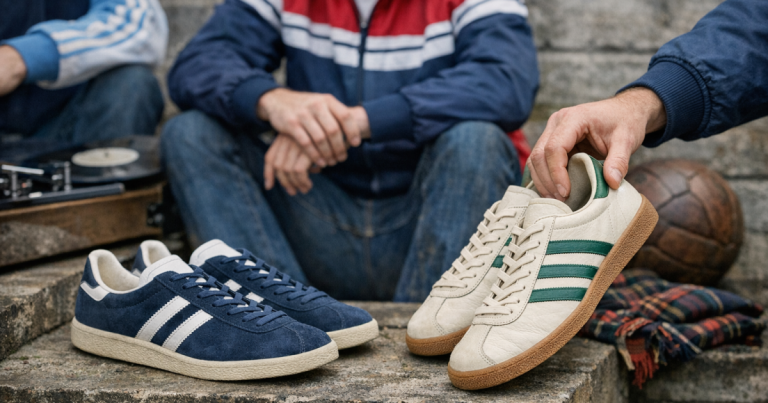
Footwear is where many outfits either click or collapse. Adidas Gazelle Indoor, Samba-related silhouettes, PUMA Palermo, Nike Air Max 90, Diadora B. Elite and similar low-profile or culturally familiar trainers all work in different ways. The Diadora B. Elite, for example, points towards the Italian tennis side of the wardrobe rather than the gym or running shop. The exact choice should match the rest of the outfit, not just the brand list in your head.
Caps and accessories are useful, but easy to overdo. A plain beanie, a simple cross-body bag or a structured cap can make sense; five visible logos rarely does. A New Era 9Forty Cap can sit neatly with a modern casual outfit, provided the colour and proportions work with the jacket rather than fighting it.
The unwritten codes
The first code is restraint. The best matchday outfits usually have one clear focal point: a track top, a jacket, a trainer colour, or a knit. When everything is loud, nothing reads properly. If the jacket has bold panels, keep the trousers and trainers calmer. If the trainers are the statement, let the top half breathe.
The second code is fit. Oversized can work, especially with later casual and rave-influenced references, but baggy is not the same as sloppy. Track pants should sit cleanly over trainers rather than pooling heavily. Track tops should allow a layer underneath without looking like borrowed kit. Modern reissues often fit differently from vintage pieces, so judge the garment on the body rather than assuming the label size tells the full story.
The third code is era discipline. Mixing eras can look excellent, but only when the pieces speak to each other. An 1980s-style Italian track top, very modern chunky trainers and a sharply tailored overcoat can work if the colours and proportions are controlled. Without that control, it looks accidental. Pick a main influence, then allow one contrast rather than three competing stories.
The fourth code is local realism. British matchdays involve drizzle, wind, packed trains, plastic pint glasses, uneven pavements and long spells standing around. A suede-heavy trainer rotation is fine for dry days, but not every fixture is a dry day. Likewise, a pristine vintage track top may be better for the pub than for a wet away end.
Colour rules for matchday dressing
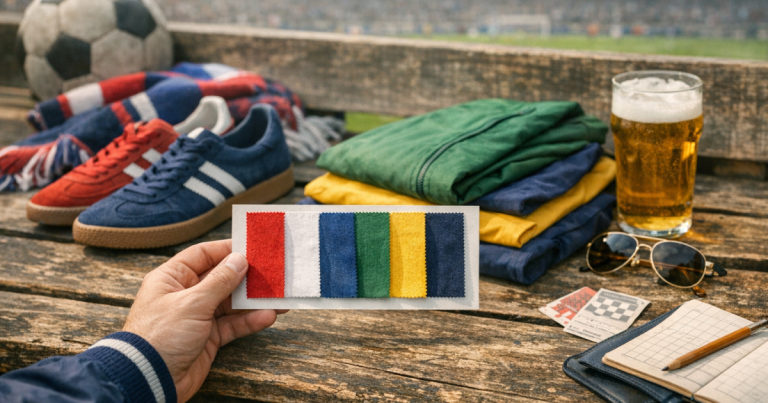
Colour is where many people unintentionally drift into costume. Club colours can be used, but they need handling carefully. A navy jacket with a small red detail can nod to a team more effectively than wearing red from cap to trainer. Earth tones, navy, bottle green, burgundy, off-white, grey and black are reliable because they sit well with heritage sportswear and British outerwear.
Think in threes: base colour, secondary colour, accent. A navy track top, stone trousers and burgundy trainers is easier to wear than five unrelated shades. If you want to bring in club identity, make it the accent rather than the whole outfit. The same logic applies to scarves: a scarf can be the colour hit, which means the rest of the outfit can stay calmer.
If you struggle to make colours feel deliberate, start by learning how to build a matchday palette. It is often the difference between looking like you understand the culture and looking like you bought several nostalgic items that do not quite belong together.
Track tops, track pants and the gym-kit problem
The tracksuit is central to the culture, but a full tracksuit is also the easiest way to look like you are heading to five-a-side rather than the match. The difference is styling. A track top with denim, cords or relaxed trousers usually feels more wearable than a full set. A full set can still work, but it needs the right trainers, outerwear and confidence.
Track pants are the hardest piece to get right. Side stripes, shiny fabric and elasticated cuffs can quickly read as sports kit if the rest of the outfit is too plain. Balance them with a proper jacket, a knitted polo, a clean cap or a trainer with casual heritage rather than obvious running functionality. If that is the area you are trying to fix, the guide on how to style track pants without looking like gym kit is the natural next step.
A useful rule: if the bottom half looks very sporty, make the top half more social. If the top half is a bright track jacket, keep the lower half grounded. That push and pull is what makes the outfit feel like everyday British casualwear rather than costume.
Matchday rules that still make sense
There are no official rules, but there are practical ones. Dress for the journey as much as the ground. A good matchday outfit has to survive the pub, the walk, the queue, the concourse and the weather. That usually means layers: T-shirt or polo, track top or knit, then a jacket that can deal with rain or cold.
Avoid looking too brand-new from head to toe. Fresh clothes are fine, but terrace dressing has always had a lived-in confidence. Mix reissues with older pieces, or pair a new track top with broken-in denim and trainers that do not look like they have been worn only for photos. Vintage can add character, but check zips, elastic, staining, bobbling and fabric condition before treating it as matchday-ready.
Keep club context in mind. Some grounds and fixtures are more relaxed than others, and some pubs have their own informal dress expectations. A low-key outfit travels better than one built entirely around provocation or peacocking. The point is to look sharp and culturally literate, not to perform a stereotype.
Vintage, reissue or modern interpretation?
Vintage pieces offer character: older labels, period-correct cuts, unusual colour blocking and the feeling that the garment has already lived a life. The trade-off is condition. Synthetic fabrics can snag, linings can deteriorate, zips can fail and elastic can lose shape. For collectors, those details are part of the chase. For regular matchday wear, they can become a nuisance.
Reissues and modern archive-inspired pieces are easier to wear often. They usually remove some of the worry around fragile fabric, though you still need to check care labels and sizing. Modern interpretations can be the smartest option if you like the mood but do not want to look too literal. A contemporary shell jacket, relaxed trousers and heritage trainers can carry the same attitude without copying an old catalogue page.
The best wardrobes use all three approaches. One vintage track top, a couple of current sportswear pieces, reliable trainers, a neutral jacket and a few plain layers give more options than chasing rare items every week. For most people, versatility beats purity.
How to avoid looking like fancy dress
The danger with any nostalgic look is turning reference into costume. Avoid stacking too many era signals at once: bucket hat, loud track top, vintage scarf, old-school trainers and period haircut can feel more like a themed night than a normal Saturday. Choose one or two references, then anchor them with current basics.
Do not rely on stereotypes. Terrace culture is tied to football, class, music and place, but dressing well does not require acting out old clichés. The more natural route is to understand the references and wear them quietly. That might mean a muted Italian track jacket under a rain shell, or a simple Adidas top with straight-leg denim and trainers that have a proper casual shape.
Also be honest about your own life. If you rarely wear bright colours, do not start with a very loud full tracksuit. If you spend matchdays walking across wet city centres, do not build the whole outfit around delicate footwear. A believable look starts with clothes you will actually wear.
Questions people ask
Is terrace style the same as football casual style?
They overlap heavily, but they are not identical. Football casual style is the historic subculture; the modern terrace look also includes Britpop, retro sportswear, streetwear and everyday matchday practicality.
Can you wear replica shirts with this look?
You can, but it changes the tone. Traditional casual dressing often avoids obvious replica shirts, using colours, scarves, jackets and trainers to nod to club identity more subtly.
Which brands are most associated with the look?
Adidas Originals, Sergio Tacchini, Fila, Ellesse, Diadora, Kappa, Lacoste, Fred Perry, Nike and PUMA all have credible connections, depending on the era and outfit.
Are full tracksuits still wearable on matchday?
Yes, but they need careful styling. Keep the trainers sharp, avoid clashing logos, add proper outerwear and make sure the fit looks intentional rather than like training kit.
What is the safest beginner outfit?
Start with a heritage track top, straight-leg denim or relaxed trousers, terrace-friendly trainers and a simple jacket. Keep the colours muted until you know what suits you.
Key takeaways
Terrace style works because it is coded but not rigid. The brands matter, yet the outfit matters more. The strongest looks understand football casual history, British weather, regional taste and the difference between a reference and a costume.
Build from useful pieces: a track top you can layer, trainers that make sense with the trousers, outerwear that can handle a damp Saturday, and colours that look deliberate. Once those foundations are right, the labels become part of the story rather than the whole point.