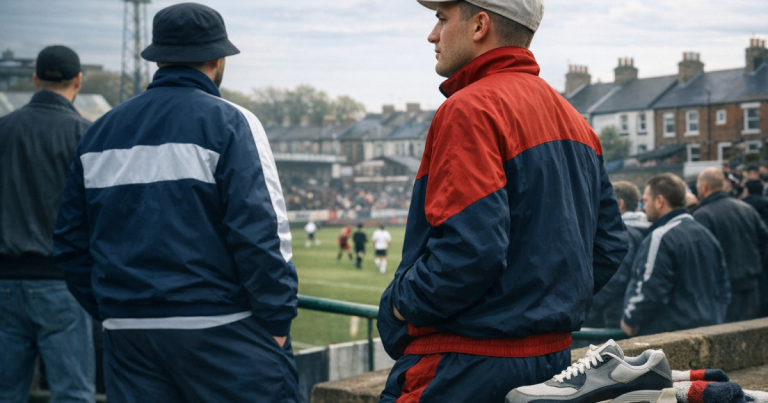

Ellesse terrace style did not arrive in Britain as a neat marketing plan. It came through a mix of Italian sportswear design, football travel, tennis glamour, ski-holiday aspiration and the casuals’ instinct for spotting labels that looked sharper than standard sports kit.
That route matters because Ellesse can be misunderstood as just another retro logo. Its best pieces make more sense when you understand why bright ski colours, clean tennis lines and big chest branding felt so different on British streets and terraces.
The short version
Ellesse moved from Italian skiwear to British terraces because it had three things the casual scene valued: continental credibility, bold design and scarcity. Founded in Perugia in 1959 by Leonardo Servadio, the brand built a reputation through ski and tennis before becoming part of the wider Italian sportswear wave that British football lads adopted through the late twentieth century.
The logo helped too. Ellesse’s semi-palla mark, associated with a half tennis ball and ski tips, visually captured the brand’s dual sporting identity. On a track top or sweatshirt, it looked more premium and more European than a lot of everyday British sportswear. That made it ideal for a scene where the right label could signal taste, travel and knowledge without shouting too loudly.
Step 1: Start with the Italian skiwear roots
Ellesse began as a ski-focused Italian sportswear brand rather than a football brand. That distinction is important. Skiwear brought colour blocking, prominent branding, technical-looking panels and a sense of continental leisure. In Britain, where sportswear was often tied to school PE, club training or plain tracksuits, Italian ski influence felt more aspirational.
The appeal was not only about performance. It was about image. Alpine clothing suggested resorts, travel and a lifestyle beyond the local high street. Even if most terrace wearers were not buying Ellesse for the slopes, the visual language carried across: contrast panels, rich colour, fitted tops and a slightly glamorous sporting mood.
That is one reason Ellesse sits comfortably beside other Italian names in terrace memory. The route is different from British kit suppliers, but it connects with the same desire for clothing that felt informed rather than obvious. For a useful comparison with a brand rooted far more directly in football kit culture, read our piece on Umbro’s journey from British football kits to terrace style.
Step 2: Add tennis glamour, not just football culture
Ellesse’s terrace story is also tied to tennis. The brand gained visibility through tenniswear at a time when the sport had strong style currency: white shorts, zip necks, polos, warm-up tops and clean court silhouettes. Tennis gave Ellesse a sharper, more polished image than pure training gear.
This matters in a British terrace context because casual style was never only about football shirts or club colours. In fact, much of the look was about avoiding obvious replica-kit dressing. Tenniswear, golfwear, skiwear and European leisurewear all offered ways to look sporty without looking like you were heading to a five-a-side pitch.
Fila followed a similar crossover path from court to casual culture, although with its own identity and timeline. If you want to understand that parallel, the piece on why Fila tenniswear crossed over into terrace style helps place Ellesse in the wider Italian sportswear conversation.
Step 3: Understand why British casuals noticed it
The football-casual scene valued brands that carried signals. A piece did not have to be rare in an absolute sense; it had to feel harder to place than ordinary sportswear. Italian labels offered exactly that. They were recognisable enough to be read by people in the know, but not always as common as mass-market British or American sports gear.
For Ellesse, several signals lined up:
- Continental origin: Italian sportswear had a different cachet from domestic training gear, especially among lads aware of European football trips and imported clothing.
- Strong logo identity: the semi-palla badge was easy to spot but still more niche than the most obvious global marks.
- Colour and cut: archive-inspired Ellesse often uses blocks of navy, red, white, sky blue, green or yellow in ways that suit terrace styling without needing club colours.
- Sporting range: because the brand moved across ski, tennis and leisurewear, it never felt trapped in one sport.
That mix helped Ellesse become part of the casual wardrobe rather than just another sporting label. It could sit with jeans, cords, track bottoms, trainers or a lightweight jacket. The key was balance: enough logo to show taste, not so much that the outfit looked like fancy dress.
Step 4: Place Ellesse inside the bigger tracksuit timeline
Ellesse’s British appeal makes most sense when placed alongside changing tracksuit culture. The 1970s and 1980s made European sportswear desirable; the 1990s brought bigger branding, Britpop energy and wider streetwear acceptance; later revivals turned archive logos into wearable nostalgia.
That does not mean every Ellesse piece belongs to the same era. A slim tennis warm-up top creates a very different mood from a bold panelled shell jacket. A navy track jacket with small chest branding can feel understated and casual; a bright colour-blocked top leans much harder into retro statement territory.
For a broader map of how track jackets and full sets moved through British culture, our guide to the eras that defined British tracksuit culture gives the surrounding context. It is useful because Ellesse is not a one-era brand; its appeal shifts depending on whether you are aiming for early casual, late 1980s Italian, 1990s revival or modern retro sportswear.
Step 5: Use real garment cues when identifying the look
If you are trying to build an Ellesse-influenced terrace outfit today, do not start with the logo alone. Look at the garment type, colour and proportions. The strongest outfits usually borrow from the brand’s heritage without dressing head-to-toe as a museum exhibit.
Track tops and jackets
A track top is the easiest entry point. The Ellesse Rimini Track Top is a recognisable modern reference for the kind of zip-front shape that fits the brand’s retro lane, though colourways and availability can vary. Check the collar, sleeve contrast, fabric feel and how loud the chest branding is before buying.
Sweatshirts and hoodies
Ellesse sweatshirts work best when the rest of the outfit is restrained. A bold chest logo can be strong with straight-leg denim and suede trainers, but it can clash if paired with equally loud track pants and a heavily branded cap.
Track pants
Full tracksuit dressing can work, but it needs discipline. Matching top and bottoms gives a clear retro sportswear statement; mixing Ellesse track pants with a plain knit, polo or understated jacket can feel more wearable day to day. Watch the leg shape: overly skinny cuts can lose the relaxed casual feel, while very wide cuts can push the outfit towards costume.
Step 6: Avoid the common styling mistakes
Ellesse’s heritage is strong enough that it does not need every supporting piece to be retro. The easiest mistake is overloading the outfit with too many era references at once: huge logo top, vintage cap, old-school trainers, football scarf and loud track bottoms. That can look themed rather than natural.
Use these checks before you wear it out:
- One statement per outfit: if the jacket is bold, keep the trousers and trainers quieter.
- Let the colour lead: pick one colour from the Ellesse piece and echo it subtly elsewhere, rather than matching everything exactly.
- Choose trainers by era: suede terrace trainers soften a loud track top, while chunkier 1990s-style trainers make the outfit feel more revival-led.
- Respect the setting: a full shiny tracksuit may work for a music night or match-day casual look, but a track top with denim is easier for everyday wear.
- Check condition carefully: on vintage pieces, inspect zips, elastic, lining, bobbling, stains and cracked prints before getting carried away by the badge.
Step 7: Decide between vintage and modern reissue
Vintage Ellesse can have more character, especially if you want a genuine period shape or older label detail. The trade-off is condition. Synthetic sportswear can hold odours, lose elasticity, develop pulls and show wear around cuffs and collars. A piece may photograph well and still feel tired in person.
Modern reissues and archive-inspired pieces are often easier to wear, easier to size and simpler to care for. They may not have the same collector appeal, but they are usually the more practical choice if you want to put the garment into regular rotation rather than keep it as a nostalgia piece.
For most readers, the sensible route is one standout Ellesse layer, then modern basics around it: straight-leg denim, neutral track pants, a plain hoodie, a polo shirt or a clean shell jacket. The outfit feels connected to British terrace history without becoming a reconstruction.
Things readers ask
Was Ellesse originally a football brand?
No. Ellesse is best understood through Italian skiwear, tenniswear and leisurewear. Its place on British terraces came later, through casual culture’s wider appetite for European sporting labels rather than through football kit heritage.
Is Ellesse still relevant for terrace style now?
Yes, when it is worn with restraint. The modern appeal of Ellesse terrace style is strongest in track tops, sweatshirts and archive-inspired jackets paired with simple trousers and classic trainers.
Should I buy vintage Ellesse or a reissue?
Choose vintage if condition, fit and authenticity matter most to you. Choose a reissue or current retro-inspired piece if you want easier sizing, fresher fabric and a garment you can wear often without worrying as much.
What to remember
Ellesse crossed from Italian skiwear into British terrace culture because it offered more than a logo. It carried Alpine colour, tennis polish, European credibility and just enough rarity to mean something within the casual scene. That combination made it adaptable: sharp enough for the terraces, relaxed enough for the street and nostalgic without being locked to one moment.
The best way to wear it now is to treat Ellesse as a heritage accent rather than a costume. Pick the right layer, control the colour, avoid over-branding and let the brand’s Italian sporting history do the work quietly.