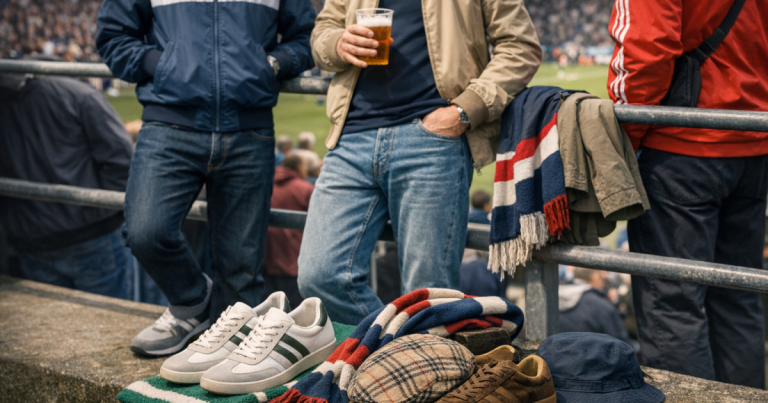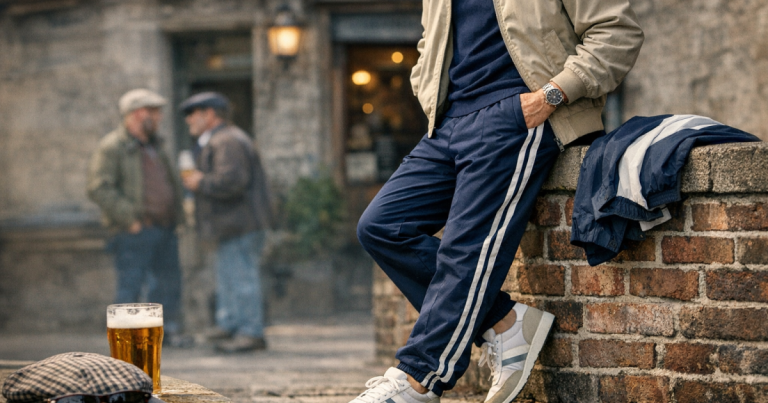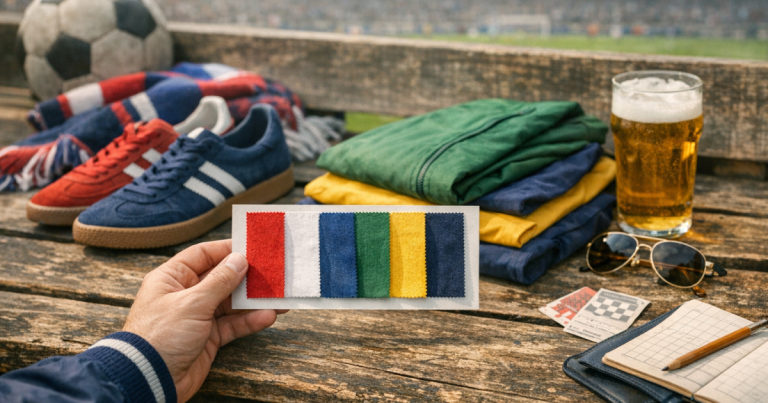
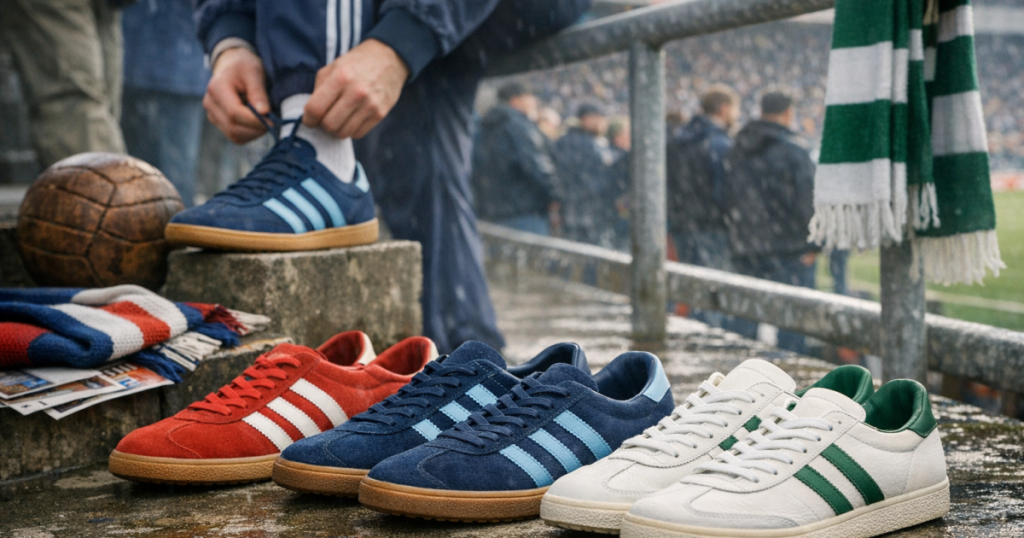
Getting terrace style footwear right is less about chasing hype and more about understanding shape, era and setting. The best trainers for a matchday fit usually do three things quietly: they sit well under track pants or denim, nod to the right football-casual lineage, and survive a day of pubs, platforms, pavements and concrete concourses without looking overthought.
That is why the choice is rarely just “white trainers or black trainers”. A slim gum-sole indoor shoe says something different from a chunky runner. A suede terrace classic behaves differently in British rain from a leather court trainer. Colour can be a clever reference or a risky one, depending on the club, the away end and how loudly the rest of the outfit is speaking.
The short version
- Low-profile suede and leather trainers usually work best with retro tracksuits, tapered track pants and straight-leg denim.
- Indoor football and handball-inspired shapes feel closest to the traditional terrace look; chunkier runners lean more towards nineties and modern casualwear.
- Club colours matter. A tiny accent can look sharp; a full colour-match can look forced or attract the wrong attention.
- For wet UK matchdays, think about material, sole pattern and cleaning effort before choosing pale suede.
- Keep the outfit balanced: loud jacket, quieter trainer; plain tracksuit, stronger trainer.
Why trainers carry so much terrace meaning
In UK football-casual culture, trainers were never just an afterthought. They were part of the code: imported European sportswear, indoor court shoes, suede low-tops, clean runners and later chunky Nike silhouettes all helped mark out taste, knowledge and timing. The footwear often told you whether someone was leaning seventies casual, eighties European, nineties Britpop, or a more current matchday mix.
There is also a practical side. Matchdays involve walking, standing, train travel, wet pavements and crowded pubs. A trainer can look perfect in a mirror and still be wrong for the day if it is too delicate, too bright, too bulky under the trousers or too hard to clean afterwards. If you already understand the wider codes around fits, fabrics and football-casual meaning, our guide to terrace tracksuit codes gives useful context for how the footwear fits into the whole outfit.
The core trainer shapes that work
Indoor court trainers
Indoor football, handball and court-inspired trainers are the safest route into the look because they sit low, keep the profile tidy and pair naturally with track pants. Think gum soles, suede or leather uppers, and a shape that does not fight the hem. They work particularly well with slim or straight track bottoms, vintage-style track tops and lightweight jackets.
Adidas Gazelle Indoor is a strong reference point for this lane: not because every outfit needs the same shoe, but because the shape shows why low-profile indoor trainers work so well. They give you enough colour and texture without pushing the outfit into costume territory. Similar silhouettes from Puma, Diadora, adidas Originals and other heritage sportswear brands can all do the same job if the colourway and fit are right.
Suede terrace classics
Suede trainers bring depth and softness to tracksuits, especially when the rest of the outfit uses shiny polyester or nylon. Navy, forest green, burgundy, brown and off-white can all look more natural than box-fresh bright white, particularly with old-school track tops. The trade-off is care. Suede can mark quickly in wet weather, so use a brush, apply a suitable protector, and accept that a rainy away day may not be the time for your most delicate pair.
PUMA Palermo is a useful modern example of how a football-linked low-top can sit between terrace nostalgia and everyday wear. It has the visual language many casual dressers want: simple lines, strong colour options and a shape that works under track pants without looking too technical.
Italian and European court shoes
Italian sportswear has long had a place in the terrace wardrobe, especially when paired with Fila, Sergio Tacchini, Ellesse or Kappa track tops. A clean European court trainer can make a tracksuit look more deliberate than a generic lifestyle shoe. It is a good option if you want something with heritage but do not want to default to the most common adidas route.
Diadora B. Elite captures that court-shoe feel nicely, although readers should always check current materials, fit notes and colour availability before buying. The point is the silhouette: slim enough for track pants, clean enough for polos and knits, and recognisably linked to the sportswear vocabulary that shaped casual culture.
Chunkier runners
Chunkier runners sit in a slightly different lane. They can work brilliantly with nineties-inspired outfits, shell suits, windbreakers, looser track pants and music-influenced casual looks. They are less natural with seventies or early-eighties track jackets, where the proportion can feel off. If the trainer has a bigger sole or more visible panels, keep the rest of the outfit cleaner.
Nike Air Max 90 is the obvious mainstream reference here, particularly for those leaning towards nineties and 2000s sportswear rather than pure European terrace minimalism. With a full retro tracksuit, it can look strong if the leg opening is wide enough; with a narrow tapered pant, it may look too heavy.
Brands and what they tend to signal
Brand choice matters because terrace style is full of memory. Adidas Originals often points towards indoor courts, European travel, three-stripe track tops and classic casualwear. Puma brings suede football links and a slightly softer, less obvious angle. Diadora suggests Italian sport and a more considered archive feel. Fila, Sergio Tacchini, Ellesse and Kappa sit naturally with tennis, leisurewear and the bright tracksuit language of the seventies and eighties.
Nike and Reebok belong too, especially when the outfit leans later: Britpop, rave-adjacent sportswear, high-street casuals, gym-classics, graphic tees and relaxed weekend fits. The trick is not to treat all brands as interchangeable. A Fila Settanta-style jacket with a low-profile court trainer feels different from a Nike windbreaker with a visible Air runner, even if both can be “retro”. For era-specific pairing ideas, the breakdown of retro trainers by decade is a good next read.
Matchday choices: what works in real British conditions
A trainer that looks good at home has to survive the day. For home matches, you might know the pub route, the pavements and whether you will be standing around outside. For away days, assume more walking, less predictable weather and a higher chance of scuffs. That does not mean wearing boring footwear; it means choosing the right pair for the setting.
- Wet forecast: darker leather or treated suede is usually more forgiving than pale suede. Avoid anything you would be annoyed to stain.
- Long train day: choose a pair you already know feels comfortable. Matchday is not the time to test a stiff new shoe.
- Standing terraces or concourses: low-profile trainers can still work, but make sure the sole has enough grip for slick surfaces.
- Pub-to-ground outfit: go cleaner and less shouty. A smart trainer will carry a track jacket better than an overly loud pair.
- Away colours: avoid accidental full-colour signalling if you are not thinking about the club context.
Colour: reference, restraint and club codes
Colour is where many otherwise good outfits go wrong. A small hit of claret, royal blue, green or yellow can make a trainer sing with a track top. Matching every stripe, badge and lace to the club palette can look too literal. Terrace dressing tends to work best when the reference is understood rather than announced.
Neutral bases are the easiest: off-white, cream, navy, black, grey, brown and muted green. They give you room to wear stronger jackets or caps without clashing. If your tracksuit is already bright, keep the trainer calm. If the outfit is mostly navy or black, a coloured suede trainer can lift it without becoming fancy dress.
Club colours also carry social meaning. Some supporters enjoy subtle nods; others prefer to avoid anything that could be read as colours when travelling. If you want to understand how those signals developed around tracksuits and matchday dressing, read the guide to decoding club colours in terrace tracksuit culture.
How trainers should sit with track pants
The trouser hem decides more than people admit. A narrow track pant needs a slimmer trainer, otherwise the shoe looks like it is swallowing the outfit. A straight-leg pant can handle more structure. A looser shell-suit bottom works with runners, but only if the trainer has enough presence underneath.
- Slim tapered track pants: indoor courts, suede low-tops and slim leather trainers.
- Straight-leg retro track pants: gum-sole trainers, court shoes and modest runners.
- Wide or shell-style bottoms: chunkier runners, bolder colourways and nineties silhouettes.
- Jeans with a track jacket: suede low-tops, leather courts or a clean runner depending on the wash.
- Shorts and track tops: keep the shoe low and simple, or the lower half can look too heavy.
Building a small trainer rotation
You do not need a wall of boxes to dress well. A sensible rotation covers different weather, eras and outfits. Start with one darker everyday pair that can handle poor weather, one cleaner suede or gum-sole pair for sharper fits, and one trainer that brings colour or period character. That gives you more versatility than owning several pairs that all do the same job.
For example, a navy or black low-profile trainer covers wet-weather matchdays. A cream, brown or green suede pair works with retro track jackets and denim. A chunkier runner or bolder court shoe can handle nineties outfits, festival weekends and pub-heavy Saturdays. The aim is not collecting for the sake of it; it is having the right footwear answer when the rest of the outfit changes.
Where to look and what to verify
UK high-street sportswear shops, brand sites, independent trainer retailers, vintage sellers and resale platforms all have a place. New releases are easier for sizing and returns. Vintage pairs can have better period detail, but check sole condition, cracking, odour, lining wear and whether they are actually wearable. Some older trainers are better kept as archive pieces than worn to the ground.
Before buying, verify sizing notes, materials, return terms and care requirements. Photos can make suede look richer than it is, and colour names do not always match real-life shades. If you are choosing footwear to go with a particular tracksuit, look at the trouser opening and stripe colour before deciding. The best-looking shoe on its own is not always the best shoe for the outfit.
Keeping them sharp without making them precious
Terrace trainers should be looked after, not worshipped. Brush suede when dry, wipe leather after wet days, remove mud before it sets, and rotate pairs so one battered trainer does not drag down every outfit. Stuffing shoes with paper after a soaking can help them dry more naturally, but keep them away from direct heat. For synthetic tracksuits and suede footwear, gentle maintenance usually looks better than aggressive cleaning.
Do not chase box-fresh perfection if the whole outfit is rooted in real-world football culture. A slightly worn trainer can look better than a spotless pair that feels too staged. The line is simple: clean and cared for, not pristine to the point of looking unused.
Helpful questions
Are white trainers right for terrace outfits?
Yes, but off-white or cream often looks more natural with retro sportswear than stark bright white. If the tracksuit is shiny or colourful, a softer white usually feels less forced.
Can running trainers work with a tracksuit?
They can, especially with nineties-inspired outfits, looser track pants and shell jackets. For seventies or eighties terrace looks, slimmer court or indoor trainers usually sit better.
Should trainers match club colours?
A subtle colour nod can work, but full matching can look too literal and may carry stronger matchday signals than intended. Neutral bases are safer for away days.
Are vintage trainers worth wearing?
Sometimes. Check the sole, glue, lining and general structure before relying on them. Some vintage pairs look excellent but are too fragile for a full day out.
What is the safest first pair for a terrace wardrobe?
A low-profile navy, black, brown or off-white trainer with a clean court or indoor shape is the easiest starting point. It will work with track pants, denim and jackets.
What stands out
The strongest trainer choices are rarely the loudest. They make sense with the era of the outfit, respect the colour codes around football culture, and hold up to the practical mess of a British matchday. Get the shape, material and trouser break right, and the whole fit feels more authentic without needing to shout about it.