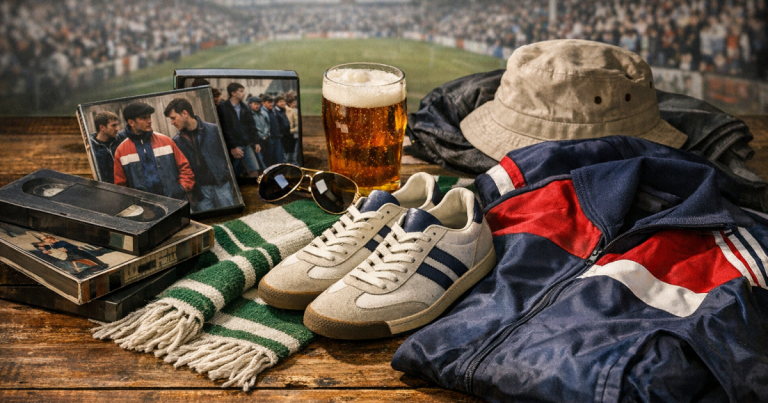
The best outfit ideas rarely come from copying a single photograph head to toe. Read sportswear history books as evidence, not costume manuals, and they become a sharp way to understand colour, fit, trainers, brands and attitude in terrace style.
The aim is to spot repeatable style decisions: why a track top works with certain trainers, how outerwear changes the mood, and which details still feel wearable on a UK match day now.
What to know first
A good terrace outfit drawn from a book should feel informed, not reconstructed. You are not trying to dress as though you have stepped out of a museum plate or a film still. You are using archive material to understand the logic behind the look: practical layers, status signals, regional taste, club-day weather, and the constant tension between sportswear, smart casual dressing and youth culture.
Start by reading across three layers. First, look at the image or description itself: the garment, silhouette, colour and footwear. Second, ask what the clothing was doing socially: blending in, standing out, signalling taste, showing travel knowledge, or borrowing from tennis, running or football training gear. Third, translate only the parts that still work for your wardrobe.
That approach matters because terrace style is easy to flatten into clichés: a track jacket, jeans and trainers with no sense of proportion. The strongest looks usually come from small decisions, such as a navy track top over a plain tee, a muted cap rather than a loud one, or suede trainers that soften a bright jacket.
Step 1: Read the pictures before the captions
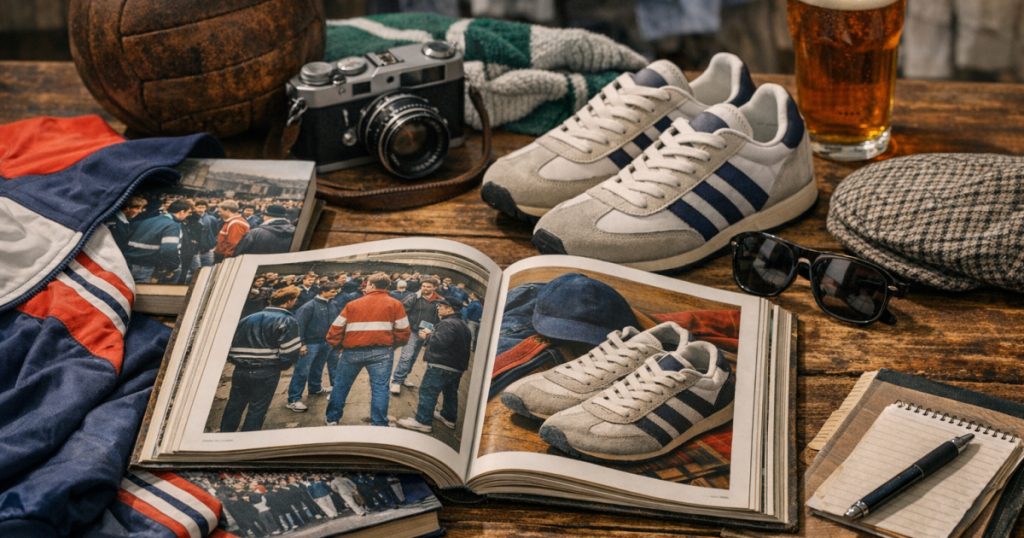
With photobooks and illustrated histories, spend time on the photographs before you read the explanation. Captions are useful, but they can pull your attention straight towards names, places and incidents. For outfit ideas, your first pass should be visual.
- Note the dominant colour: navy, burgundy, bottle green, cream, red, royal blue or black.
- Look at the silhouette: slim track top, loose shell jacket, straight-leg track pants, denim, cords or tailored trousers.
- Check the footwear shape: low-profile terrace trainers, chunkier runners, tennis-inspired shoes or plain leather trainers.
- Notice how much branding is visible: a small chest logo gives a very different feel from oversized sleeve taping.
- Study the setting: coach travel, pub exterior, street corner, stadium steps or holiday photo. The setting often explains the practical choices.
If a photograph works, ask why. It may be the colour balance rather than the individual pieces. A red track top might look sharp because everything else is quiet. A full tracksuit might work because the trainers are understated. A loud jacket may be anchored by dark denim. Write those observations down as outfit rules rather than garment names.
Step 2: Separate era clues from wearable ideas
Books on casual culture often cover scenes where the styling is tied to a very specific moment. That is the appeal, but it is also the trap. Some details have aged brilliantly; others now read as costume unless handled carefully.
Useful era clues include colour blocking, zip-neck shapes, raglan sleeves, contrast piping, funnel collars, shell fabrics and trainer silhouettes. These are easy to translate. Less portable clues include extreme period haircuts, fully matching outfits worn exactly as photographed, or combinations that rely on a now-obscure social code.
A good method is to turn each image into a modern sentence. Instead of “copy this 1980s casual look”, try “navy sportswear top, light denim, gum-sole trainers, short outer layer”. Instead of “full Italian tennis tracksuit”, try “clean white tee, heritage track jacket, relaxed trousers, low-profile trainers”. This keeps the reference alive without making it stiff.
Step 3: Use brand mentions as cultural clues, not shopping lists
Names such as adidas, Fila, Sergio Tacchini, Ellesse, Diadora, Lacoste, Kappa and PUMA appear in terrace histories for a reason. They carried meaning through travel, scarcity, sport associations, continental taste and peer recognition. When a book mentions a brand, do not reduce it to “buy that logo”. Ask what the brand represented in that passage.
If the point is Italian tennis glamour, look for clean colour blocking, contrast panels and a slightly smarter sporting feel. If the point is German sportswear, the line might be sharper and more training-ground led. If the reference is running culture, trainers and technical outerwear may matter more than a tracksuit top.
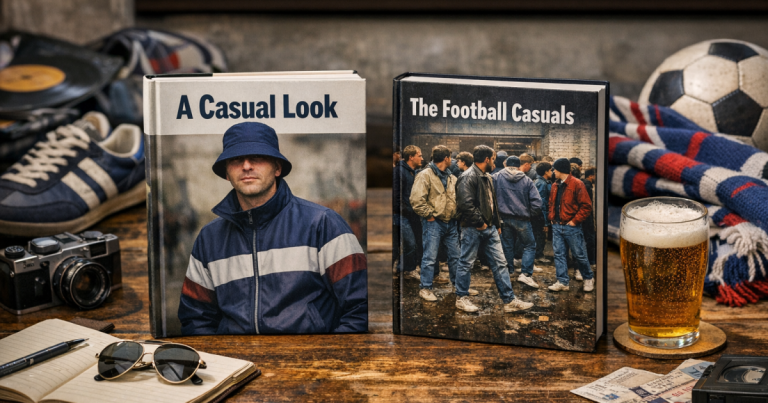
This is where books and documentaries are strongest: they show how clothing gained meaning through people and places. Cass Pennant’s The Football Casuals: A History is useful for understanding the wider culture around football casual identity, while Gavin Watson’s A Casual Look: A Photodiary of the 1980s Casual, Terrace and Football Scene rewards close visual reading because the details are embedded in real people rather than styled shoots.
Step 4: Build a colour palette from repeated evidence
One photograph can inspire you, but repeated patterns are more reliable. As you read, keep a simple list of colour combinations that appear again and again. Terrace dressing is often strongest when it is restrained: navy with white, burgundy with cream, bottle green with dark denim, red with black, grey marl with royal blue, or stone outerwear over darker layers.
Try to avoid building an outfit around too many references at once. A striped track top, bright trainers, printed tee, checked overshirt and statement cap may all have roots in casual culture, but together they can look like a mood board rather than an outfit. Pick one lead piece, then let everything else support it.
For example, if a book sends you towards a navy track jacket, make the palette do the work: off-white tee, mid-wash denim or dark track pants, and trainers that do not fight the jacket. If you want to turn that into a wearable outfit rather than a vague idea, the principles in building a terrace outfit around a navy track jacket are a useful next step.
Step 5: Read trainer references as shape and mood
Trainer choices can change the whole reading of a retro outfit. A slim suede terrace trainer feels different from a chunkier runner, even if both have a credible place in UK sportswear memory. Books may not always identify the exact model clearly, especially in older photographs, so train your eye to read shape before label.
- Low-profile suede trainers usually make a tracksuit look more understated and terrace-friendly.
- Chunkier runners push the outfit towards late-century sportswear and streetwear influence.
- White leather trainers can smarten a busy track top, but they can also flatten a look if everything else is too clean.
- Dark trainers keep attention on a bright jacket; pale trainers brighten navy, black and bottle green outfits.
If a photograph makes you wonder whether a Samba-style or Gazelle-style shape would work better with a retro tracksuit, look at sole thickness, toe shape and texture rather than chasing an exact archive match. The comparison of Samba and Gazelle with retro tracksuits gives a more practical way to make that call.
Step 6: Watch documentaries with a notebook, not just nostalgia
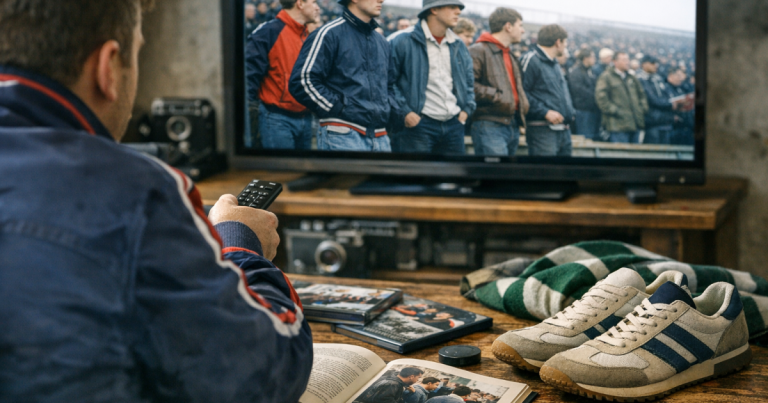
Documentaries and films linked to football casual culture are excellent for movement, context and atmosphere. They show how clothes sit when people walk, travel, lean against barriers or layer up in poor weather. That matters because a still photograph can make a jacket look sharper than it feels in real life.
When watching, pause on wider street scenes rather than only the obvious hero shots. Look for how ordinary outfits are put together: plain tees under track tops, collars zipped halfway, caps worn low, jackets layered over knitwear, track pants broken up with non-matching tops. These are the details that stop an outfit feeling over-styled.
Film influence also needs care. Some titles shape the mythology of terrace style as much as the clothing itself. If you are reading or watching around football casuals, it helps to understand why The Firm still influences terrace wardrobes, while remembering that screen styling is heightened and should not be treated as documentary evidence on its own.
Step 7: Turn one reference into three outfits
A useful exercise is to take one book image and produce three versions: faithful, toned down and modernised. This stops you buying or wearing things only because they appear in one compelling photograph.
Faithful version
Keep the strongest period cues: a heritage track top, straight-leg trousers or track pants, and trainers close in shape to the reference. This is the version for people who enjoy the archive feel and are comfortable with a more recognisable retro look.
Toned-down version
Keep the colour palette but simplify the pieces. A bright track jacket becomes a muted jacket in the same family. Full track pants become dark denim or relaxed chinos. The trainers stay terrace-friendly, but the outfit reads more everyday.
Modernised version
Keep the structure but update the fit and fabric. A period tracksuit might become a modern retro-inspired track top with a plain tee, contemporary straight-leg trousers and clean trainers. The reference is still there, but it is no longer shouting.
This method is especially useful if you buy vintage. Archive sizing can be unpredictable, and old labels do not always match current expectations. Before committing to an original piece, read up on checking vintage tracksuit sizing before you buy so the outfit idea survives contact with the actual garment.
Step 8: Keep a reference log that helps you get dressed
A reference log does not need to be elaborate. Create four simple headings: colour, top layer, legwear and trainers. Add a fifth heading for mood: smart, scruffy, travel, match day, pub, summer, winter or night out. The mood is important because terrace style is not just a list of garments; it is a balance between polish and ease.
Over time, your notes will show which ideas you actually return to. You may find that you are drawn to navy and burgundy rather than bright red, or that you like track jackets more than full tracksuits. You may notice that most of your saved references rely on plain tees and low-profile trainers. That tells you where your wardrobe should focus.
Do not worry if your final outfit contains no rare archive piece. The point of reading is to sharpen taste. A current retro-style jacket, well-chosen trainers and a good colour palette can carry more terrace credibility than an expensive vintage item worn without understanding.
Common questions
Do I need to copy the exact brands shown in old photos?
No. Exact brands can matter historically, but outfit-building works better when you understand the reason behind the brand choice: colour, status, sport association, rarity or silhouette.
Are photobooks better than written histories for outfit ideas?
Photobooks are usually better for fit, colour and layering. Written histories are better for context, meaning and how certain clothes became important within football casual culture.
How do I avoid looking like I am wearing a costume?
Use one or two archive cues at a time. Keep modern fit, clean basics and wearable trainers in the mix, and avoid copying every period detail from a single image.
Can documentaries be used as style references?
Yes, but separate real documentary footage from dramatised styling. Screen wardrobes can be useful for mood, but they are often more deliberate than everyday terrace clothing.
What should I write down while reading?
Record colour combinations, jacket shapes, trainer silhouettes, legwear choices and the situation where the outfit appears. Those notes are more useful than a list of logos.
Final thoughts
Reading terrace and sportswear history well is about patience. The best ideas are often in the background of a photograph, in a throwaway clothing detail from an interview, or in the way a group balances smartness with practicality.
Treat books and documentaries as reference material, then edit hard. Keep the colours that suit you, the silhouettes that fit your life, and the cultural details that still feel honest. That is how sportswear history becomes a wardrobe tool rather than just nostalgia on a shelf.