Online listings can make a tired track top look terrace-ready, and a counterfeit one look convincing from three cropped photos. Spotting fake Adidas Originals track tops is partly about knowing the garment, but mostly about slowing down and checking the evidence before you pay.
The aim is not to become a forensic authenticator overnight. It is to build enough confidence to walk away from weak listings, ask better questions, and avoid paying proper archive money for something that only looks right at first glance.
The quick read before you zoom in
A genuine Adidas Originals track top should make sense as a whole: label, logo, cut, zip, fabric, stitching, colourway and seller story should all point in the same direction. One odd detail is not always proof of a fake, because older sportswear can vary by country, production run and era. Several odd details together are the warning sign.
- Ask for clear, daylight photos of the front, back, neck label, wash label, zip pull, cuffs, hem and logo.
- Compare the piece with known examples of the same model or era, not just any Adidas jacket.
- Be wary of listings using stock images, heavy filters, vague descriptions or copied wording.
- Check whether the condition matches the claimed age; perfect vintage pieces exist, but they are not the norm.
- When the price feels strangely low for a sought-after track top, treat it as a reason to investigate, not as a bargain already won.
Start with the listing, not the logo
Most bad purchases begin before you even inspect the garment. A seller who cannot show basic details of the track top is asking you to gamble. On eBay, Vinted, Depop or Facebook Marketplace, a solid listing should show more than a single front-on shot. You want enough visual information to inspect the construction, not just the vibe.
Look for repeated image sets across different sellers. Counterfeit and drop-shipping listings often recycle the same photographs, sometimes with the background cropped or blurred. Reverse image search can help, but even a manual scan of similar listings may reveal identical creases, shadows or hanger positions.
Seller behaviour matters too. A private seller clearing out old sportswear may not know every model name, but they should still be able to answer simple questions and provide extra photos. Vague replies such as “bought ages ago” or “not sure, looks real” are not automatic deal-breakers, but they should lower your confidence. If you regularly buy full sets as well as tops, the checklist in our guide to buying a second-hand Kappa tracksuit without regrets is also useful because the same online habits apply: inspect the evidence, not the excitement.
Check the Adidas Originals branding carefully
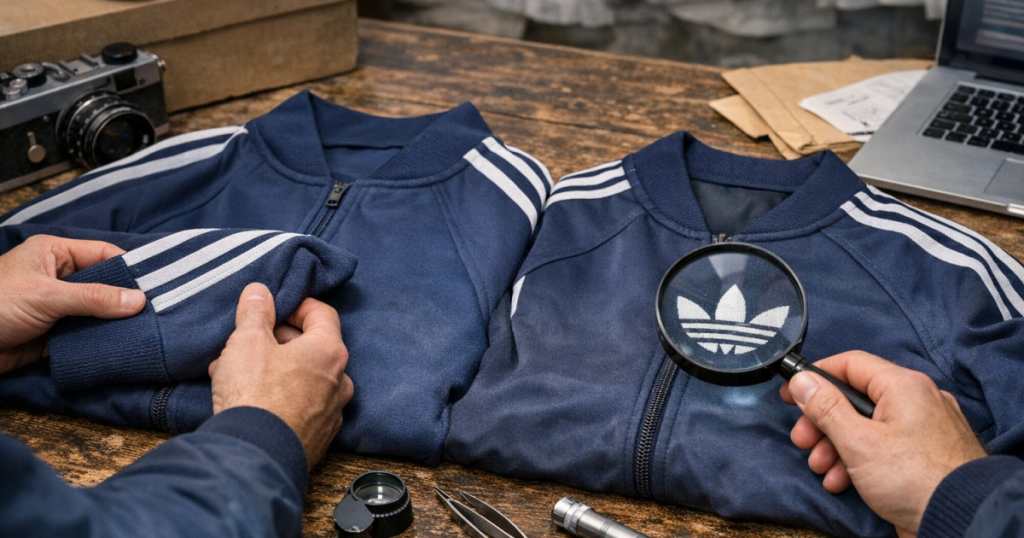
The Trefoil is central to Adidas Originals, so it is one of the first details fakers try to copy. Do not rely on the logo alone, though. Some counterfeits have a passable Trefoil while failing elsewhere, and some legitimate older pieces show wear, slight distortion or imperfect stitching after years of washing.
On embroidered logos, check the shape of the leaves, the spacing, the text beneath or beside the symbol, and whether the embroidery sits cleanly on the fabric. Loose threads are common on worn garments, but messy outlines, uneven letter height, crowded spacing or a Trefoil that looks stretched can be a warning sign.
On printed or flocked branding, look for cracking, lifting and alignment. Age-related cracking can be normal, especially on older synthetic sportswear, but a fresh-looking print on a supposedly decades-old jacket should make you pause. Compare with the same model where possible. A Firebird-style top, a Beckenbauer-style top and a 1980s-inspired archive piece should not all have identical branding placement.
Read the neck label and wash label together
The neck label often gets the most attention, but the wash label is usually more revealing. A genuine track top should have labels that make sense together: brand style, sizing, care information, language mix, production details and garment age should not contradict one another.
Modern Adidas Originals pieces usually include detailed internal labels with product information, care symbols and manufacturing details. Older vintage pieces may have simpler labels, and some heavily worn tops may have faded or missing wash labels. That does not automatically mean the garment is fake, but it does mean you need stronger evidence elsewhere.
Watch for obvious spelling errors, poor print quality, incorrect spacing, flimsy label material, labels sewn in at odd angles, or size information that does not match the cut. UK sellers sometimes list European or international sizing loosely, so do not reject a piece just because the seller’s title says medium and the label says something different. Instead, ask for flat measurements in centimetres: pit-to-pit, shoulder width where relevant, sleeve length and back length.
Compare the model, colourway and era
A common mistake is comparing a suspect track top with the wrong reference. Adidas has produced many silhouettes across Originals, performance sportswear, reissues, collaborations and regional releases. A detail that looks wrong on one line may be normal on another.
If a listing claims to be an Adidas Originals Firebird Track Top, compare it with other Firebird examples: collar shape, three-stripe placement, pocket style, zip length and overall cut. If it is described as a Beckenbauer-inspired piece, compare it with examples of the Adidas Originals Beckenbauer Track Top rather than a shiny full tracksuit top from a different line.
Colourways need the same treatment. Adidas has released plenty of bold combinations, so unusual colours are not automatically suspicious. The issue is whether the colourway appears plausible for that model and whether details such as stripes, collar, cuffs and zip colour are consistent across the garment. Be wary of sellers who use phrases like “rare colourway” to explain away every oddity without showing any evidence.
Inspect zips, stitching, cuffs and hem
Construction tells you what photos of the front cannot. Original and reissue Adidas track tops are not all made identically, but they should still feel coherent. On close-up photos, check whether the zip sits straight, whether pocket edges are clean, and whether the three stripes line up properly across sleeves and shoulder seams where the design requires it.
Cuffs and hems are especially useful on used pieces. Loose ribbing can happen through age, storage and wear, so damage is not proof of a counterfeit. But if a top is being sold as barely worn while the ribbing is badly stretched, the story does not match the condition. For repairable vintage pieces, our guide to fixing loose ribbing on a retro track jacket explains what can and cannot usually be improved.
Look for stitching that changes quality from one part of the garment to another. A slightly wavy stitch on a worn cuff is one thing; rough seams, puckered fabric, uneven stripe attachment and loose internal finishing across the whole top suggest poor manufacture. Also check whether the pockets sit at the same height and whether the collar shape is balanced when zipped up.
Think about fabric and finish, even through a screen
You cannot feel fabric through a listing, but photos still give clues. Many classic Adidas track tops use shiny polyester, brushed tricot or smoother modern synthetic blends, depending on the line and era. Counterfeit listings often struggle with finish: fabric can look too thin, oddly stiff, overly glossy, or inconsistent between body and sleeves.
Ask for a close-up of the material in natural light. Flash photography and strong filters can make nylon and polyester look misleading, so daylight shots are more useful. Check whether the fabric hangs like a track top rather than a cheap fancy-dress jacket. A genuine piece can be creased, worn or faded, but it should not look like the fabric and trim belong to two different garments.
Smell is harder to assess before purchase, yet it matters with second-hand sportswear. Smoke, damp storage and heavy fragrance can all be hidden by a tidy photo. Ask directly about odours, especially for older pieces. If you do take a chance on a promising top, our advice on removing smoke smells from a retro track top can help you judge whether the problem is manageable.
Use measurements to catch suspicious sizing
Counterfeit sportswear often gives itself away through strange proportions. The label might say large, while the pit-to-pit measurement fits closer to a small. Or the body might be boxy while the sleeves are unusually short. Sizing has varied across Adidas lines and decades, so the point is not to apply one perfect size chart. The point is to see whether the measurements match the claimed model and intended fit.
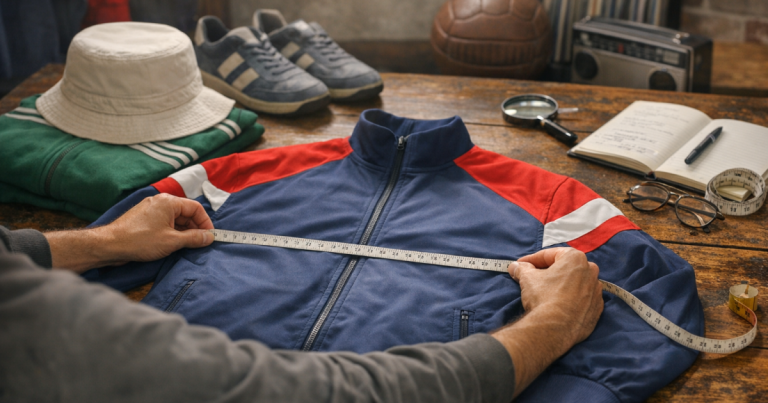
Ask for measurements in centimetres with the garment laid flat. For track tops, the most useful are pit-to-pit, back length from collar seam to hem, sleeve length from armpit to cuff, and hem width. If the seller refuses measurements on an expensive item, that is a trust issue as much as a sizing issue.
Terrace style often relies on fit as much as branding. A top that is technically genuine but badly proportioned for you may still sit wrong with jeans, cords or track bottoms. If you are buying to wear rather than archive, authenticity and fit both matter.
Warning signs that deserve extra caution
No single warning sign proves anything by itself, but clusters of them should make you step back. Treat the following as reasons to ask more questions or move on.
- Only one or two photos, with no close-ups of labels, logo or zip.
- Stock images mixed with unclear photos of the actual garment.
- Seller claims it is “vintage” but cannot show the wash label or condition details.
- Branding that looks too large, oddly placed or poorly spaced.
- Three stripes that appear uneven, twisted or badly attached.
- Labels with spelling mistakes, strange fonts or inconsistent size information.
- A price that is far below similar sold listings for the same model and condition.
- A seller pushing for rushed payment outside the platform’s normal process.
A simple step-by-step check before you commit
1. Save the listing photos
Keep screenshots or saved images before asking questions. If the seller changes photos or wording later, you have a record of what you originally judged.
2. Identify the claimed model
Do not settle for “Adidas track jacket” if the asking price suggests something more specific. Work out whether it is a Firebird, Beckenbauer, Chile-style top, collaboration, team issue or general Originals release.
3. Compare like with like
Search for the same model and similar colourway from reliable references, sold listings and archive-style images. Avoid comparing a modern reissue with a completely different vintage silhouette.
4. Ask for missing photos
Request neck label, wash label, zip pull, logo, cuffs, hem and inside seams. A genuine private seller may take a little time, but they should understand why you are asking.
5. Check the seller’s pattern
One old track top in a wardrobe clear-out is different from an account selling endless “rare vintage” tops in every size. Neither automatically proves authenticity, but the pattern changes the level of caution needed.
6. Decide what would make you walk away
Set your own line before you get emotionally attached. Missing wash label, no returns, poor photos and a pushy seller might be enough. The cleanest way to avoid a bad buy is often to leave the listing alone.
FAQ
Are all fake Adidas Originals track tops obvious?
No. Some are crude, but others look convincing in casual photos. The safer approach is to judge the whole listing: labels, construction, model accuracy, seller behaviour and price.
Does a missing wash label mean the track top is fake?
Not always. Older or heavily worn tops can have faded or removed labels. It does reduce the evidence available, so you should expect stronger proof from logos, stitching, measurements and provenance.
Is a very low price always suspicious?
It depends on condition and seller knowledge. A low price can be a genuine clear-out, but for sought-after Adidas Originals pieces it should prompt closer checks rather than instant excitement.
Can I authenticate an Adidas track top from photos alone?
You can often make a sensible risk judgement, but photos alone rarely give absolute certainty. Clear close-ups, model comparison and a trustworthy selling platform improve your odds.
Should I buy if the seller refuses extra photos?
For a cheap beater, you might accept the risk. For a collectible or expensive track top, refusal to show labels, logo and construction is a strong reason to walk away.
In brief
The best way to avoid counterfeits is to slow the process down. A real Adidas Originals track top should have details that agree with each other: the model, label, branding, cut, fabric, stitching, condition and seller story should all feel plausible. If too many parts need explaining away, the listing is probably not worth your money.
For terrace wear, the goal is not just a logo on the chest. It is a piece that looks right, wears well, and carries the right connection to the culture rather than a poor imitation of it.