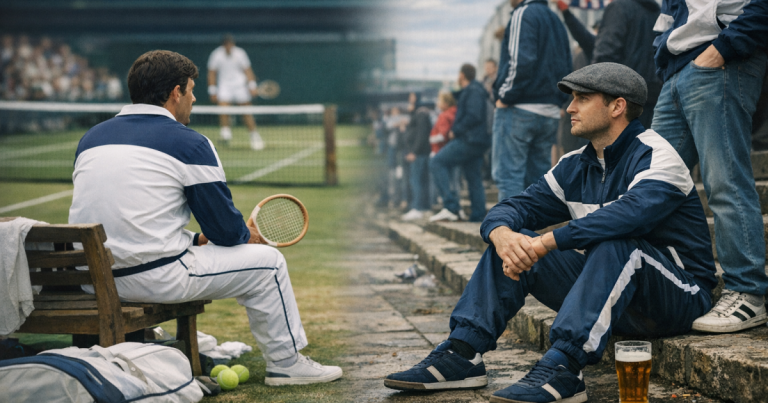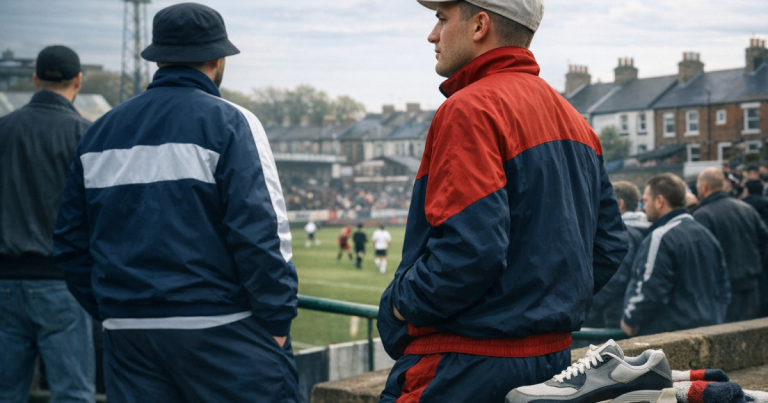
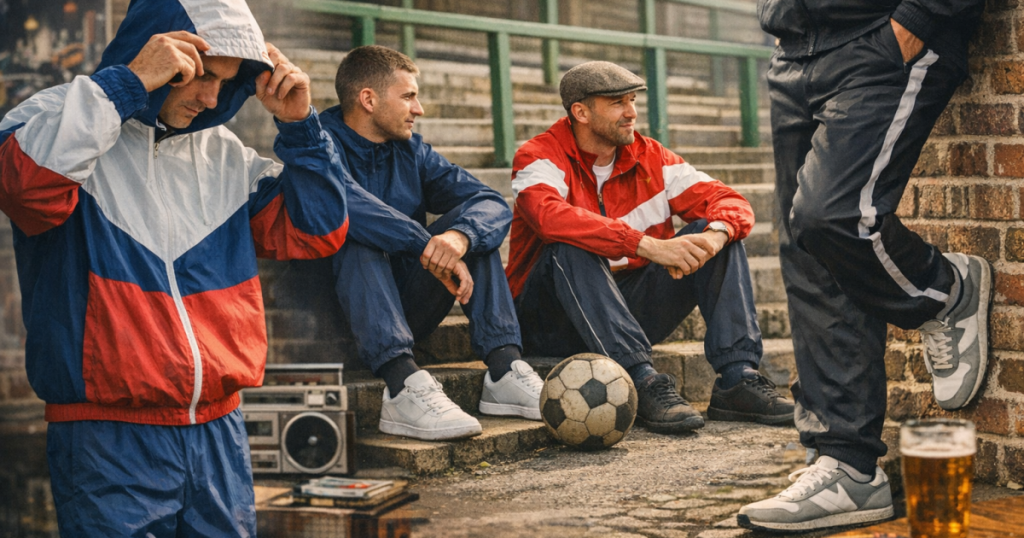
Nike tracksuit history is not a straight line from Oregon running kit to British terraces; it is a story of technical running shapes, football training wear, trainer culture and the way UK lads re-coded sportswear for the weekend.
For a UK terrace audience, Nike sits in a slightly different place from adidas, Sergio Tacchini, Fila or Ellesse. It was not the original continental status symbol of early casual culture, but it became impossible to ignore once running jackets, training tops, Air Max trainers and football teamwear started feeding into everyday matchday dress. That is what makes the Nike story interesting: less about one perfect archival tracksuit, more about how a global sportswear brand kept being absorbed by British subcultures.
Main points
- Nike’s most recognisable tracksuit-adjacent shape is the Windrunner, a running jacket design that became much bigger than its original purpose.
- In UK casual culture, Nike’s trainer influence often arrived before its tracksuit influence, especially through Air Max and other visible street-level footwear.
- Football training wear, drill tops and shell suits helped Nike feel at home on British terraces, even when the early casual wardrobe leaned heavily towards European labels.
- Modern Nike terrace styling works best when the pieces are treated as part of a layered outfit, not as a head-to-toe costume.
- Vintage Nike can be excellent, but labels, condition, fabric feel and proportions matter more than the size of the Swoosh.
Before the terrace: Nike as a running and performance brand
Nike’s early identity was built around running, athletics and performance rather than British football culture. The Swoosh belonged first to the track, the road and the American sportswear imagination. That matters because Nike’s archive looks different from the Italian and European tennis-driven brands that fed much of the classic casual look.
The Nike Windrunner Jacket, introduced in the late 1970s, is the key starting point. Its V-shaped colour blocking gave it an immediate graphic identity. It was designed as running outerwear, but the silhouette is exactly the sort of thing that later made sense beyond sport: lightweight, zipped, visible from a distance and easy to throw over a sweatshirt or track top.
Strictly speaking, the Windrunner is not a tracksuit in the same way as a matching track top and bottoms. But in British style terms, it belongs in the same family of garments: nylon shells, zip jackets, elasticated hems, contrast panels and sportswear worn outside its intended arena. Once a garment moves from training ground to pavement to away end, its meaning changes.
Why Nike was not the first terrace uniform
Early football-casual dress in Britain was heavily shaped by imported European sportswear, premium trainers, golf wear, tennis labels and pieces that felt hard to get. adidas, Diadora, Sergio Tacchini, Fila, Ellesse, Lacoste and other labels carried a particular cachet because they seemed connected to travel, scarcity and continental sport.
Nike, by contrast, became part of the UK casual conversation in a more staggered way. It was visible, desirable and increasingly influential, but it did not replace the older casual codes overnight. That distinction is important if you want an authentic-looking terrace wardrobe rather than a modern sportswear outfit with a retro badge attached.
British football style also had its own home-grown pressures. Club culture, sports shops, local availability, regional taste and the shift from standing terraces to more regulated matchdays all affected what people wore. To understand that wider landscape, it is worth reading how Umbro’s football heritage shaped British terrace sportswear, because Nike’s later football presence sits alongside a long domestic teamwear tradition rather than outside it.
The Windrunner: from running jacket to casual shorthand
The Windrunner’s appeal is partly visual and partly practical. The chevron chest panel gives the jacket a strong outline, while the zip-front construction makes it easy to layer. For terrace dressing, that combination matters. A jacket needs to read from a distance, cope with changeable weather and sit comfortably over knitwear, a polo, a hoodie or a track top.
What made Nike’s shell shapes useful in Britain was not just brand recognition. It was how they fitted the rhythms of daily wear: train into town, pub before the match, ground, takeaway, late bus home. A lightweight jacket that packs down or sits under a heavier coat has more value in the UK than a purely decorative archive piece.
Collectors often look for older Windrunners with period labels, older zip pulls, distinctive panel colours and a roomier shape. Reissues can still work well, but you should check the cut rather than assuming every modern version recreates an old fit. Some are neater, some are more fashion-led, and seasonal fabrics can vary. For an authentic terrace look, the jacket should have enough ease to sit over layers without ballooning.
How trainers pulled Nike deeper into terrace style
Nike’s terrace authority in Britain owes a great deal to trainers. While many classic casual looks are built around adidas, Diadora or PUMA, Nike’s running footwear became a powerful street signal in its own right. Air-cushioned silhouettes, visible branding and bolder colourways gave Nike a different type of presence from low-profile suede terrace trainers.
The Nike Air Max 90 is a useful example because it shows how Nike could look futuristic and nostalgic at the same time. It is not a traditional early casual trainer in the same way as an adidas City Series shoe or a Diadora Borg Elite, but it has become part of the broader British sportswear memory: town centres, music videos, estates, indie nights, rave-adjacent wardrobes and later retro revival looks.
This is where Nike tracksuits and jackets make most sense: not as a copy of the original Italian casual uniform, but as part of a later, layered British sportswear language. A Nike shell with dark track pants and Air Max gives a different message from a full Sergio Tacchini set with clean white trainers. Both can be terrace-relevant, but they point to different eras and references.
Football teamwear and the shift into matchday clothing
Nike’s role in football grew through boots, shirts, training wear and major club associations. For many UK fans, the most familiar Nike garments were not archive fashion pieces but training tops, drill tops, rain jackets and warm-up gear connected to the modern professional game.
That changed the way Nike sat in a matchday wardrobe. A track jacket no longer had to look like a rare European find to feel relevant. It could look like something from a training ground, a five-a-side bag or a club shop, then be styled with better trousers, older trainers and sharper outerwear. This is one of the reasons Nike’s terrace appeal is sometimes more practical than romantic.
There is also a class and geography angle. A lot of British sportswear culture has been shaped by what people could actually get hold of locally: high-street chains, independent sports shops, market finds, hand-me-downs, outlet rails and online resale. Nike’s scale meant its pieces were visible across towns and cities, but the best looks still depended on selection. Not every big-logo tracksuit reads as terrace; some just read as gym kit.
Music videos, rave memory and street-level visibility
British sportswear did not move through football alone. Music videos, club photography, pirate radio culture, magazine shoots and later online nostalgia all helped fix certain garments in the public imagination. Nike appears in that wider visual archive because it was worn by people who mixed football, music and street style rather than treating them as separate worlds.
This is especially true from the late 1980s onwards, when shell jackets, track pants, trainers and bold branding worked across acid house, hip-hop-influenced looks, indie scenes and everyday casual wear. The codes were not identical in every city, but the crossover was obvious: clothes for movement, weather, dancing, travelling and being seen.
If you want to read those visual clues more closely, our guide to terrace tracksuit influences through British music videos is a useful companion. It helps separate genuine period cues from modern styling that only looks old because it has been filtered through nostalgia.
What makes a Nike tracksuit feel terrace rather than generic sportswear?
The difference is rarely just the logo. A Nike outfit feels terrace when the proportions, materials, colour and styling choices line up with a recognisable British sportswear language. A full bright set with fresh running shoes may look like modern leisurewear. A slightly boxier track top under a casual jacket, worn with understated trainers and straight-leg trousers, often lands closer to the terrace mood.
Useful cues to look for
- Shape: Older and archive-inspired jackets often have a roomier body and a shorter, more structured feel than slim modern gym tops.
- Fabric: Nylon shells, polyester track tops and brushed training pieces all give different references. Check the hand feel and drape before buying vintage.
- Colour: Navy, black, red, royal blue, white and green are easier to integrate than novelty colours, though bold panels can work when the rest of the outfit is calm.
- Branding: A small Swoosh can look sharper than oversized front-and-centre branding, depending on the era you are referencing.
- Layering: A Nike jacket often works best with a plain polo, sweatshirt or knit underneath rather than another loud sportswear piece.
For fit, the biggest mistake is treating every track top as a slim modern jacket. Terrace style needs proportion. Sleeves should not swamp the hands, hems should not ride awkwardly above the waist, and bottoms should sit cleanly over trainers. If you are refining that balance, use the terrace fit guide for silhouettes, layers and matchday proportions as a practical reference.
Vintage versus reissue: where Nike needs careful checking
Vintage Nike can be rewarding, but it is easy to overpay for a tired piece just because the label looks right. Before buying, check the zip, elastic, lining, cuffs, stains, peeling prints and any cracking to logos. On shell jackets, look for fabric pulls, seam wear and odours that may not come out with a gentle wash. On track pants, check knee shine, ankle zips and waistband stretch.
Reissues and current archive-inspired pieces are often easier to wear. They usually give you cleaner condition, more predictable sizing and simpler returns from UK retailers. The trade-off is that they may not have the same cut, colour depth or label detail as an original. That is not automatically a problem. If you want something for wet Saturday travel and regular wear, a modern piece can be the smarter choice.
For care, avoid treating synthetic sportswear like heavy cotton. Read the garment label, wash gently, avoid excessive heat and let pieces dry naturally where the care instructions allow. A garment steamer can help relax creases in some track tops, but always test carefully and keep heat away from prints, badges and delicate panels.
Different views: was Nike truly a terrace brand?
There are two honest answers. If you are talking about the earliest, most purist football-casual uniform, Nike was not the central label. European sportswear, rare trainers and imported leisurewear carried more of the original mystique. In that version of the story, Nike belongs more to later streetwear, running culture and mainstream sportswear than to the first wave of casuals.
But if you are talking about the broader British terrace wardrobe as it evolved, Nike absolutely belongs. Fans did not freeze their clothing choices in one decade. They adapted. Air Max, football training tops, shell jackets, tracksuits and club-linked gear all became part of what people actually wore around football, music and town-centre life.
That is the sensible middle ground. Nike is not the whole terrace story, and it should not be styled as if it is. But it is one of the major reasons modern retro sportswear looks the way it does: athletic, graphic, trainer-led and comfortable enough for real use.
How to wear Nike’s archive influence now
A strong modern Nike terrace outfit usually starts with restraint. Pick one obvious Nike piece, then let the rest of the outfit support it. A Windrunner over a plain sweatshirt with straight-leg track pants and clean trainers is easier to wear than a full matching set with competing logos. A vintage track top under a wax jacket or rain shell can look more natural than trying to recreate a catalogue image from head to toe.
Colour discipline helps. If the jacket has contrast panels, keep the trousers dark or neutral. If the trainers are the statement, choose a quieter top. If you are wearing a club-related Nike training piece, avoid piling on too many other football references unless you deliberately want a matchday look.
The best test is whether the outfit would make sense in a real British setting: damp walk to the station, pub before kick-off, standing outside a takeaway, Sunday record fair, or a casual night out. Terrace style has always been about clothes that carry social meaning while still doing a job.
Questions people ask
Is Nike a traditional football-casual brand?
Nike is not the defining label of the earliest UK casual look, but it became important through trainers, training wear, shell jackets and football visibility. Its place is stronger in later terrace and streetwear-influenced outfits.
Is the Windrunner a tracksuit top?
Not exactly. The Windrunner began as a running jacket, but its zip shape, panel design and lightweight shell fabric make it part of the same sportswear language as track tops and terrace jackets.
Which Nike pieces work best for terrace styling?
Look for Windrunner-style shells, older track tops, understated training jackets and track pants with clean proportions. Avoid pieces that look too much like current gym wear unless that is the look you want.
Should I buy vintage Nike or a modern reissue?
Buy vintage for label detail, period shape and character. Choose a reissue if you want cleaner condition, easier sizing and regular wear. Always verify fit, fabric and care instructions before buying.
Why does Nike tracksuit history matter to UK style?
It shows how British sportswear culture moved beyond one narrow casual uniform. Nike connects running design, football training wear, trainer culture and everyday terrace dressing.
What to remember
Nike’s place in terrace style is strongest when you understand the route it took. The Windrunner brought a graphic running silhouette. Air Max helped make Nike unavoidable at street level. Football training wear pulled the brand closer to matchday clothing. UK subcultures then did what they always do: took useful sportswear, changed its meaning and made it part of everyday identity.
For today’s wardrobe, the lesson is simple. Do not chase a logo alone. Look for proportion, fabric, colour and context. A well-chosen Nike shell or track top can sit comfortably beside adidas, Umbro, Barbour, PUMA, Diadora or Ellesse references, provided the outfit feels lived-in rather than assembled for fancy dress.