Cold concourses, damp high streets and late trains make layering essential, but too much fabric can kill the clean shape of a terrace-inspired outfit. The trick when you layer a hoodie into terrace style is to keep the silhouette tidy, the colours controlled and the outer layer doing most of the visual work.
A hoodie can sit comfortably within football-casual dressing, but it should feel like part of the outfit rather than a gym layer thrown on underneath. Think neat hood, compact shoulders, straight hem and enough room to move without turning a track top or jacket into a padded shell.
At a glance
- Choose a midweight or lightweight hoodie rather than a thick fleece if it is going under a jacket.
- Keep the hood flat and tidy so it frames the collar instead of bunching behind the neck.
- Use one strong outer layer: a track top, casual jacket or shell should set the tone.
- Limit visible logos so the hoodie does not fight with stripes, piping or badge details.
- Balance the bottom half with straight track pants, denim or chinos rather than overly slim trousers.
Start with the shape, not the logo
The easiest mistake is choosing a hoodie because the branding feels right, then discovering it ruins the proportions. Terrace style relies on clean lines: the jacket sits properly, the shoulder does not balloon, and the outfit looks intentional from a distance. A hoodie that is too long, too boxy or too heavy will pull the eye away from the track top, trainers and overall stance.
Before thinking about colour, check three things in the mirror. First, the shoulder seam should sit close to your natural shoulder rather than dropping halfway down the arm. Second, the hem should not hang far below the outer layer unless you are deliberately going for a longer streetwear shape. Third, the hood should sit flat between the shoulder blades when the outer layer is on.
If you are still refining the fundamentals, it helps to understand what terrace style is built around: sportswear, football-casual confidence, music culture and a sharp sense of restraint. The hoodie should support that, not swamp it.
Step 1: Pick the right hoodie weight
For layering, weight matters more than softness. A plush heavyweight hoodie feels good on its own, but under a track jacket it can create a rounded shoulder and a tight chest. A midweight loopback cotton hoodie or a lighter brushed-back style is usually easier to wear beneath sportswear because it adds warmth without too much volume.
Look for ribbed cuffs that sit neatly at the wrist and a hem that holds its shape. Loose, stretched cuffs make the sleeves bunch under a jacket, which is one of the quickest ways to make the outfit look untidy. If the hoodie has a large kangaroo pocket, check whether it creates a lump under a zip jacket when fastened. Some do; some sit flat enough to work.
A simple base hoodie, such as the type covered in our Adidas Essentials Hoodie review, is useful as a reference point because it shows the kind of plain, dependable layer that can sit behind stronger terrace pieces. It does not need to be the loudest garment in the outfit.
Step 2: Keep the hood under control
The hood is where many outfits go wrong. A big double-layer hood can look good with a parka or heavier casual jacket, but it often sits awkwardly under a slim track top. It pushes the collar up, rounds the neck and can make the whole top half look crowded.
After putting on the outer layer, pull the hood out fully, then flatten it with your hands so it sits evenly across the shoulders. Avoid letting one side twist or fold under the collar. Drawstrings should hang evenly or be tucked away if they clash with the jacket zip, chest logo or piping.
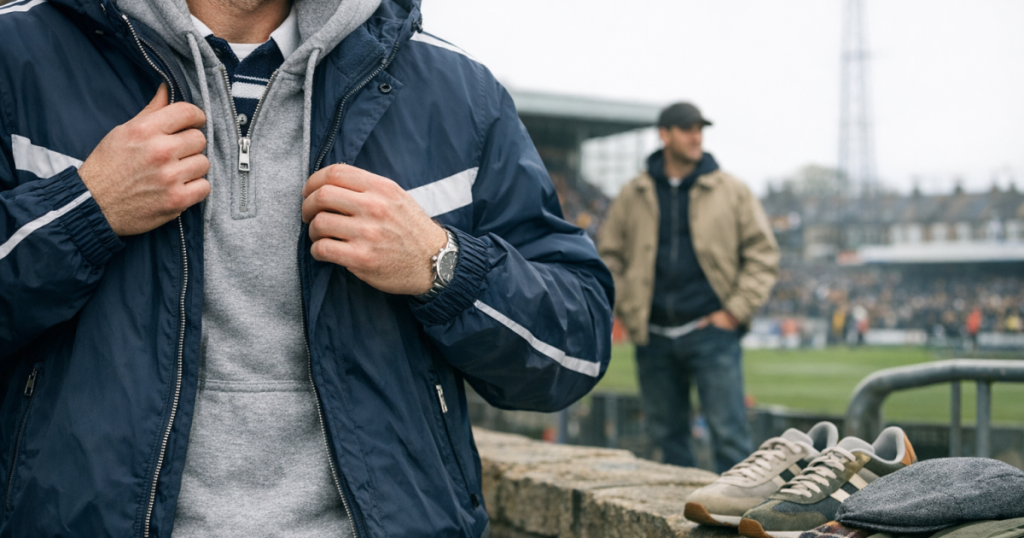
If the jacket has a stand collar, leave the zip slightly open at the top so the hood has space. A fully zipped track top over a thick hood can look forced, especially if the collar is fighting for position. With a shell jacket or looser casual outerwear, you have more room, but the same rule applies: the hood should look placed, not trapped.
Step 3: Match the hoodie to the outer layer
The outer layer decides the mood. A heritage track top gives a sportswear-led look; a lightweight shell feels more match-day and practical; a waxed or casual jacket shifts the outfit into a broader British casual lane. The hoodie has to sit beneath that message rather than pulling the outfit somewhere else.
Under a track top
Keep the hoodie plain and relatively thin. A grey, navy, off-white or black hoodie usually works because it lets the track top’s stripes, colour blocking and badge details lead. A classic piece such as the Adidas Originals Firebird Track Top has enough visual identity already, so the layer underneath should not compete.
Under a shell jacket
This is the most forgiving setup. A shell jacket normally has more space through the body and sleeves, so a hoodie can add warmth without distorting the outline. It works well for wet pavements, away-day travel and general winter wear. Keep the shell slightly relaxed, but avoid going so oversized that the outfit becomes shapeless.
Under a casual jacket
A hoodie under a casual jacket can look strong, but it needs restraint. With something like a waxed jacket or Harrington-style outer layer, choose a hoodie with minimal branding and a compact hood. A garment such as the Barbour Bedale Wax Jacket naturally brings countryside and British casual references, so the sportswear underneath should be clean rather than loud.
Step 4: Use colour like a terrace dresser, not a mood board
Terrace outfits tend to work best when there is one clear colour idea. That might be navy and white, green and cream, black and grey, or burgundy against neutral layers. Problems start when the hoodie, jacket, trainers and cap all try to introduce different accents.
A safe method is to make the hoodie the quietest layer. If the track top is bright, keep the hoodie neutral. If the jacket is plain, the hoodie can carry a small logo or subtle colour, but it should still sit inside the palette. Matching the hoodie to the trainers can work, but only if it feels natural rather than overly coordinated.
For a more Britpop-influenced feel, a grey hoodie under a navy track top or casual jacket still looks grounded. For a sharper football-casual look, navy under forest green, black under burgundy, or off-white under deep blue can give contrast without shouting.
Step 5: Avoid bulk through the sleeves and waist
Sleeve bulk is the giveaway. If you put the jacket on and the hoodie sleeves ride up, bunch at the elbow or twist around the forearm, the combination is not working. Pull the hoodie cuffs down before putting on the outer layer, then slide the jacket on carefully rather than forcing your arms through.
The waist matters just as much. A hoodie hem that curls or rolls under a zipped jacket creates a padded band around the middle. If the hoodie is slightly longer than the jacket, let it hang evenly rather than half-tucking it or letting one side sag. If it is much longer, use it with a more relaxed outer layer rather than a trim track top.
When you layer a hoodie well, the outfit should still have movement. You should be able to sit, walk and raise your arms without the jacket pulling across the chest. If everything feels tight, size balance is wrong: either the hoodie is too thick, the outer layer is too slim, or both are fighting the same space.
Step 6: Balance the bottom half
A bulky top half looks worse when paired with very skinny trousers. Terrace-inspired outfits generally benefit from balance: straight track pants, relaxed denim, cords or clean chinos tend to sit better with hoodie layering than spray-on fits. The aim is not to go baggy everywhere, but to avoid a top-heavy outline.
If the upper half includes a hoodie and track jacket, keep the lower half calm. Plain track pants, dark denim or muted casual trousers will usually do more for the outfit than another loud logo. Trainers should also fit the era and mood. Suede, gum soles, indoor handball shapes and classic runners can all work, but the trainer should not make the hoodie-jacket combination look like general gym wear.
Step 7: Keep accessories useful and quiet
Caps, bags and scarves can finish the look, but they can also add clutter. A cap works best when it repeats one colour from the outfit or stays neutral. A crossbody bag should sit flat, not drag the hoodie forward or crush the outer layer across the chest.
If you carry a bag often, pay attention to strap width and placement. A narrow strap across a thick hoodie can dig in and create folds, while a bulky pouch worn high can obscure the jacket details. For more detail on that specific balance, our guide to wearing a crossbody bag with terrace style covers the common mistakes.
Quick outfit checks before you leave
- Collar check: the jacket collar should sit cleanly around the hood, not collapse into it.
- Shoulder check: there should be no rounded padding effect unless the jacket is deliberately roomy.
- Zip check: the outer zip should close without pulling across the chest or stomach.
- Hem check: the hoodie should sit evenly and not bunch into a thick roll.
- Logo check: one obvious brand moment is enough; two can work, three usually looks busy.
- Movement check: walk, sit and reach forward. If the outfit twists or rides up, simplify the layers.
Common mistakes that make hoodie layering look bulky
The first is treating every hoodie as an outerwear piece. Some hoodies are designed to be worn on their own, with heavy fleece, dropped shoulders and oversized hoods. They can look excellent, but not necessarily under a close-fitting track top.
The second is choosing a jacket that is too small for layering. A track jacket that looks sharp over a T-shirt may be too tight over a hoodie. If you want a layered terrace look, the outer piece needs just enough room through the chest and upper arm.
The third is overloading the outfit with references. A hoodie, track top, cap, crossbody bag, branded trainers and loud socks can all belong to the same world, but wearing every cue at once can make the outfit look assembled rather than lived-in. Terrace style has always been about knowing when to stop.
Helpful questions
Can a hoodie go under a full tracksuit?
Yes, but it works best when the tracksuit top has enough room and the hoodie is plain. Keep the track pants simple so the whole outfit does not become too heavy or overly coordinated.
Should the hoodie be visible below the jacket?
A small, even line of hoodie below the jacket can look relaxed. A long drop below a short track top usually throws off the proportions unless the whole outfit is deliberately oversized.
Is a zip hoodie better than a pullover?
A zip hoodie can reduce bulk at the front if worn open, but the extra zip can clash with a track jacket zip. A pullover is cleaner when the fabric is not too thick.
What colour hoodie is safest for terrace outfits?
Grey, navy, black and off-white are the easiest to layer. They sit behind stronger jackets and trainers without making the outfit look overplanned.
Can older retro jackets work with modern hoodies?
They can, but check the cut. Some retro-style jackets are slimmer through the arm, so a thinner hoodie is usually more comfortable and better proportioned.
What stands out
Hoodie layering works in terrace style when it respects the shape of the outfit. The best combinations look warm, easy and considered, not padded or overstyled. Keep the hoodie compact, let the outer layer carry the character, and use colour sparingly. If the shoulders sit cleanly, the hood lies flat and the hem behaves, the outfit will usually look right.