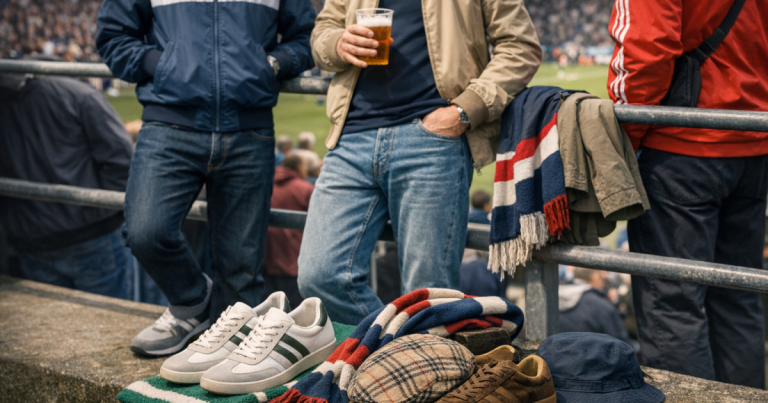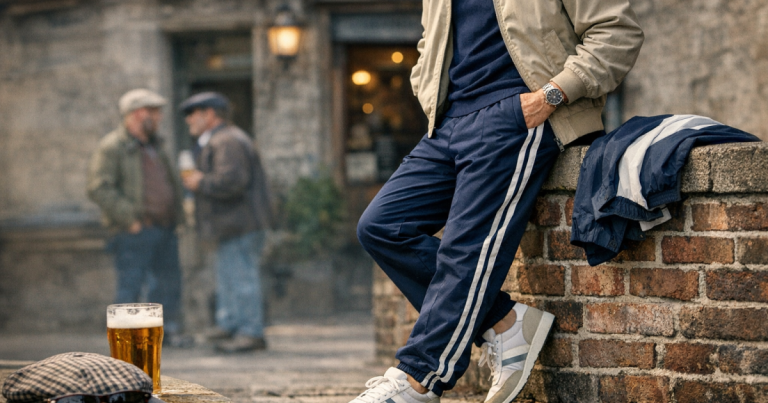
A track top sets the mood quickly: sharp terrace, Britpop weekend, gym-bag nostalgia or full-on shell-suit chaos. Getting retro trainers with a track top right is mostly about matching era, shape and attitude rather than chasing a perfect brand set. The aim is believable, wearable and specific — not costume.
The easiest mistake is treating every vintage-looking trainer as interchangeable. A narrow suede terrace shoe gives a different signal from a chunky running silhouette, and both can work brilliantly when the jacket shape, fabric and colours support them.
The short version
- Start with the track top: its cut, fabric, collar and stripe detail usually tell you which trainer shape will look natural.
- Keep eras close rather than identical. A 1970s-flavoured top can handle an 1980s terrace trainer, but a shiny 1990s shell jacket may need more trainer weight.
- Use colour restraint. One strong colour on the top is enough; let the trainers echo a stripe, badge or zip rather than copying the whole palette.
- Balance volume. Slim track tops tend to suit lower-profile trainers, while boxier tops can carry a chunkier pair.
- Avoid head-to-toe perfection. The most convincing terrace look often has one clean reference point and one modernising detail.
Step 1: Read the track top before choosing the trainers
The track top is the anchor. Before you reach for trainers, look at what sort of top you are dealing with. Is it a clean zip-through with ribbed cuffs and a neat collar? A shiny nylon number with colour blocking? A velour or brushed-feel piece with a softer drape? Each one points towards a different footwear language.
A slim, old-school track jacket with narrow stripes usually sits well with low-profile court or terrace trainers. The shape is neat, so the footwear should not overpower it. A heavier, boxier track top can cope with a broader trainer shape because the proportions are already stronger up top. A loud shell-style jacket, especially one with contrast panels, often looks more natural with a trainer that has a bit of visual weight rather than a delicate plimsoll-like outline.
Fabric matters too. Nylon, polyester tricot, velour and brushed cotton all catch the eye differently. If you want a deeper read on why different materials carry different cultural signals, the guide to tracksuit fabrics by era is a useful reference point before you start pairing outfits.
Step 2: Match the silhouette, not just the logo
Brand loyalty is part of terrace culture, but silhouette is what makes the outfit work in real life. A big logo match can still look wrong if the shapes fight each other. Think in three broad trainer shapes: slim terrace trainers, classic court trainers and chunkier running-style trainers.
Slim terrace trainers
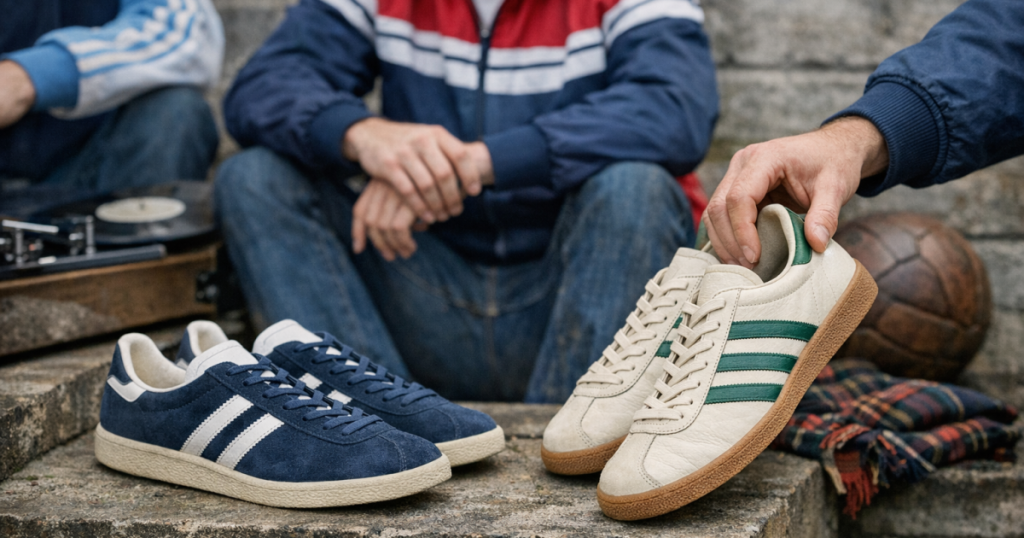
Slim suede or leather terrace trainers tend to work with tighter track tops, fitted track jackets and smarter casual layers. They are good when the top has a narrow cuff, a close hem and a collar that sits neatly under a coat. The look feels more pub-before-the-match than gym kit.
Classic court trainers
Court-style trainers are a middle ground. They can soften a loud track top without making the whole outfit too sporty. They also work when you want the track top to be the main reference and the footwear to feel clean rather than attention-seeking.
Chunkier running-style trainers
Chunkier trainers need space around them. They generally sit better with relaxed track pants, straight-leg denim, cargo trousers or a boxier top. With a very slim jacket and skinny trousers, they can make the outfit look bottom-heavy. With a 1990s-influenced shell or roomy track top, they can feel completely natural.
Step 3: Keep the era believable
You do not have to dress like you have stepped out of one exact year. In fact, that can look too studied. But the references should sit in the same neighbourhood. A sharply cut tennis-influenced track top makes sense with clean court trainers. A Britpop-leaning zip top can work with suede terrace shoes or classic runners. A bright, synthetic shell top usually wants something more casual and energetic underfoot.
For example, adidas Originals Gazelle Indoor is an easy reference for a low-profile terrace shape, particularly with neat track tops, denim and a casual jacket over the top. adidas Originals Handball Spezial sits in similar territory but has its own handball-court feel, which can make an outfit look less like a direct replica of a football-casual uniform. For a more tennis-led line, Diadora B. Elite can help frame a cleaner, sharper top without leaning too heavily into running-shoe bulk.
If the top is later, louder or more shell-suit adjacent, a trainer with a larger sole unit or more visible panels can make sense. Nike Air Max 90 is a recognisable example of a chunkier retro running shape that can work with relaxed trousers and a bolder jacket, though the colourway still needs careful handling.
Step 4: Use colour like a terrace regular, not a mannequin
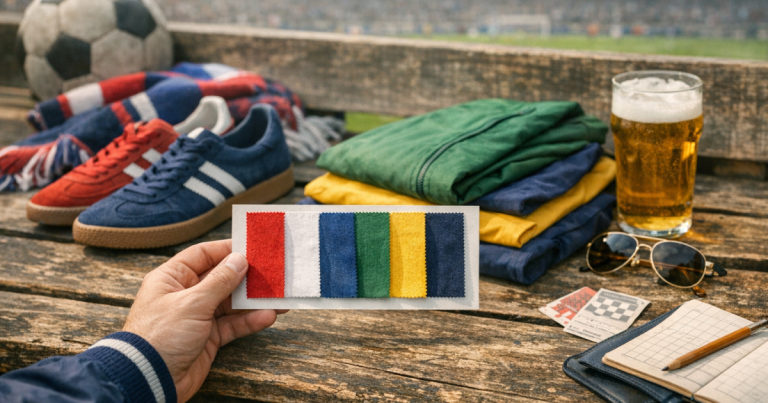
Colour matching is where many otherwise good outfits become too tidy. A red stripe on the sleeve does not mean you need red trainers, a red cap and red socks. The better move is to echo one small detail and leave the rest calm.
- Pick one lead colour: if the track top is navy with white piping, let navy lead and keep the trainer light or neutral.
- Echo, do not duplicate: a green heel tab can nod to a green chest stripe without turning the outfit into a uniform.
- Respect off-whites and creams: bright white trainers can jar against aged-looking vintage tops. Softer white, cream or gum details often feel more natural.
- Use black carefully: black trainers can sharpen a darker outfit, but they can also make a bright track top feel disconnected if there is no other black detail.
- Let one item shout: if the top has large colour-blocking, keep the footwear quieter. If the top is plain, the trainers can carry more personality.
A useful test is to cover the logos in your mind. If the colours and shapes still make sense without the badges, the outfit is probably working.
Step 5: Balance trousers into the equation
Matching trainers and a track top is not only a two-item problem. The trousers sit between them, so they decide whether the outfit flows or breaks in half. Straight-leg denim is the safest bridge for many terrace looks because it takes the sportswear edge down a notch. Track pants can work, but a full set needs confidence and restraint elsewhere. Cargo trousers can push the outfit towards late 1990s and early 2000s casualwear, especially with bulkier trainers.
Pay attention to the hem. A trainer with a low profile can disappear under a wide trouser leg, while a chunky runner can look cramped under a narrow hem. The break should feel deliberate: either a clean sit on the trainer or a slight crop that shows the shape. If the trouser leg pools heavily over the shoe, the careful trainer choice gets lost.
For more detail on how jacket length, trouser width and fabric weight change the overall look, the fit guide to terrace cuts, fabrics and details gives a clearer framework than relying on brand names alone.
Step 6: Avoid the fancy-dress traps
Retro sportswear works best when it feels worn, not performed. The danger signs are obvious once you know them: too many pristine archive references at once, a tracksuit that looks like a costume set, trainers matched to every stripe, or accessories piled on because they seem “retro”.
Modernise one part of the outfit. That could mean wearing the track top over a plain heavyweight T-shirt, choosing dark straight denim rather than matching track bottoms, or keeping the trainers clean and understated. A small contemporary shift makes the heritage piece look lived-in rather than staged.
Condition matters as well. A lightly worn pair of trainers can look great with an older track top, but battered suede or yellowed midsoles can drag the outfit down. Equally, a deadstock-looking jacket with spotless trainers may feel too showroom-clean. Aim for cared-for, not sterile.
Step 7: Build reliable pairings by track top type
Minimal track top with fine stripes
Go for a slim terrace or court trainer. Keep the colour palette tight: navy, white, grey, burgundy, forest green or black usually behaves well. This is the most versatile pairing for pubs, gigs and everyday wear because it does not rely on nostalgia being understood by everyone in the room.
Bold colour-blocked track top
Let the top lead. Trainers should pick up one secondary colour or stay neutral. If the jacket has several colours, avoid multi-coloured footwear unless the tones are very close. Straight denim or plain track pants help settle the look.
Velour or softer retro top
A clean court trainer often works better than a technical running shape. The softer texture already brings a strong retro feel, so the footwear can stay simple. Too much shine below the ankle can clash with the plushness of the top.
Shell-style or 1990s-leaning track top
This is where a broader trainer can work. Keep the trousers relaxed rather than tight, and watch the colours. If the jacket is loud, a trainer with white, grey, black or navy grounding is easier to wear than one competing for attention.
Step 8: Check the outfit in real-life conditions
Terrace style was never only about standing still for a mirror photo. Before heading out, do three quick checks. First, look at the outfit under normal daylight, not just bedroom lighting. Synthetic track tops can look far brighter outside. Second, check the side profile. That is where trainer bulk and trouser break become obvious. Third, remove one reference if the outfit feels too themed: swap the cap, simplify the T-shirt or change the trousers.
If you are testing a basic track jacket as a base layer rather than a statement piece, the Puma track jacket review is a useful example of how a simple top can either support a terrace outfit or feel a bit too plain depending on what surrounds it.
Main points
- Use the track top as the starting point, then choose trainers that match its era, fabric and shape.
- Low-profile terrace trainers suit neater tops; chunkier runners need roomier clothes around them.
- Colour should connect the outfit subtly, not turn it into a matching set.
- Trousers are the bridge: denim, relaxed track pants and cargos all change the trainer pairing.
- The strongest looks feel culturally aware but still wearable in a normal British high street, pub or match-day setting.
Common questions
Do trainers and track top need to be the same brand?
No. Same-brand pairings can work, but they are not essential. Shape, colour and era matter more than matching badges. Mixed brands often look more natural if the references sit together.
Can you wear running-style trainers with a slim track top?
You can, but the trousers need to balance the bulk. Straight-leg denim or relaxed track pants usually work better than very narrow trousers with a chunky trainer.
What colour trainers are safest with a bright track top?
White, off-white, grey, navy or black are usually easiest. Pick one colour from the jacket if you want a connection, but avoid matching every panel or stripe.
Are full tracksuits harder to pair with trainers?
Yes, because the look becomes more committed. Keep the trainers simple, avoid over-matching accessories and make sure the fit is sharp rather than baggy for the sake of it.
How do you stop the outfit looking like fancy dress?
Modernise one element. Plain denim, a simple T-shirt, restrained trainers or a normal outer layer can stop a retro track top from feeling like a costume.
Final thoughts
The best pairings are rarely the most obvious ones. Matching trainers with a track top is about reading the cut, fabric and colour first, then choosing footwear that supports the reference without shouting over it. Keep the eras close, the proportions balanced and the colour story controlled, and the outfit will feel like terrace style rather than retro fancy dress.