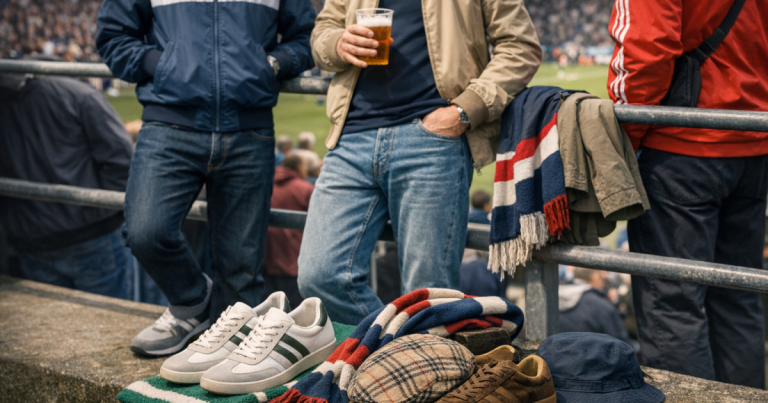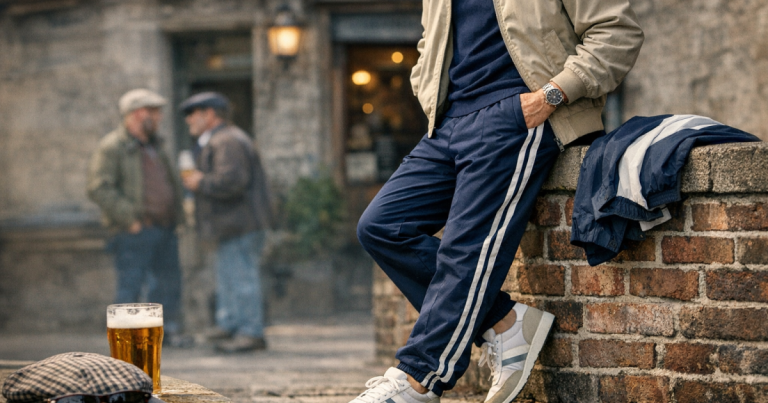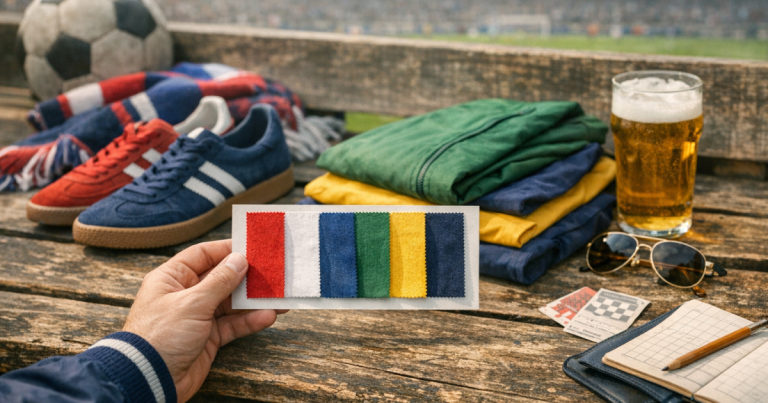
On a wet platform, outside a ground, or heading into town after the match, colour does half the work. A terrace style colour guide is not about strict rules; it is about knowing which shades look sharp, lived-in and believable with retro sportswear.
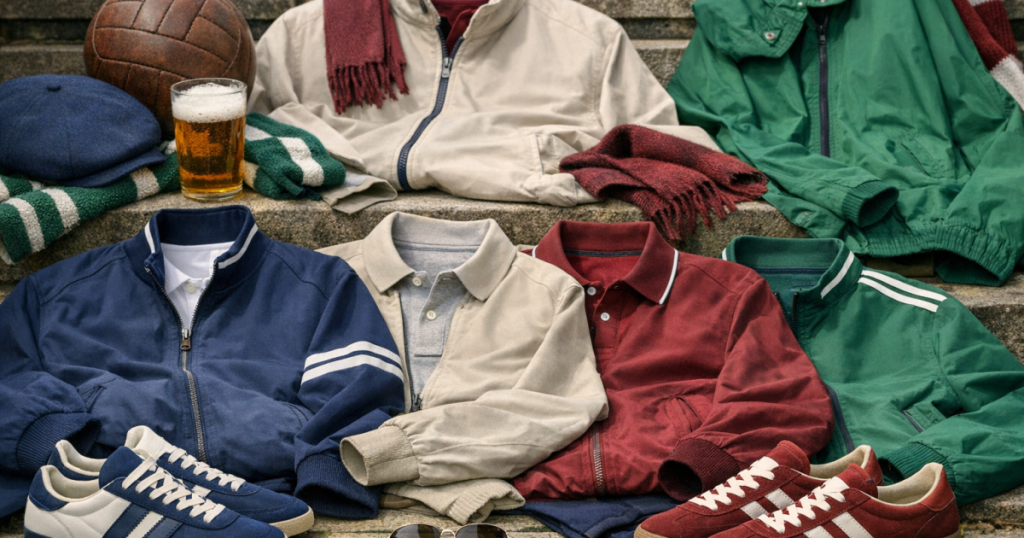
Navy, stone, burgundy and green are useful because they sit between football-casual heritage and ordinary British wardrobe sense. They work with track tops, polos, suede trainers, wax jackets and old-school caps without shouting. Get the balance right and the outfit looks considered. Push every colour at once and it starts to feel like costume.
In brief
- Navy is the safest base: clean, understated and easy with white, grey, stone and burgundy.
- Stone lightens the look, especially through overshirts, macs, chinos and pale track tops.
- Burgundy works best as a rich accent rather than a full outfit colour.
- Green gives the look outdoor, military and sportswear energy, but needs restraint.
- The strongest outfits usually use one base colour, one contrast and one small accent.
Why these colours feel right on the terrace
British terrace dressing has always borrowed from several places at once: football grounds, European sportswear, golf and tennis clubs, high-street menswear, post-punk nights, rave culture and practical outerwear. That is why the palette rarely sits in one neat lane. Navy can feel athletic or pub-ready. Stone can look continental or very northern-suburban. Burgundy has that sharp casual edge, while green brings in Barbour, MA-1 and outdoors-coded references.
The key is subtlety. Many of the most convincing looks avoid obvious team-colour dressing unless it is deliberate. Instead, they use quiet combinations: navy track top with stone trousers, green jacket over a burgundy polo, or a clean white trainer under dark track pants. For the wider story of why tracksuits became so tied to the British terraces, the background in tracksuit terrace culture is worth reading alongside this colour breakdown.
Navy: the dependable base
Navy is the easiest colour to build around because it does not demand attention. It suits retro sportswear particularly well: track jackets, zip-neck tops, cotton polos, drill trousers, cords and rain jackets all look natural in it. Compared with black, navy feels less severe and more connected to classic leisurewear.
A navy track top works well with stone chinos, washed denim, grey marl layers or white leather trainers. If the top has stripes, piping or a badge, keep the rest calm. Navy also lets one brighter detail breathe: a burgundy collar, a green cap, off-white trainers or a red-and-white logo can sit in the outfit without taking over.
For a modern but heritage-aware route, something like an adidas Originals Beckenbauer Track Top shows why navy and tonal striping can look sharper than louder archive colourways. The point is not that one track top solves everything; it is that restrained colour makes the cut, fabric and proportions easier to read.
Stone: the colour that stops sportswear looking heavy
Stone is underrated in terrace dressing because it softens strong sportswear pieces. It can be beige, sand, putty, oat or light khaki, depending on the garment. In a British context, it works because it nods to macs, golf jackets, Clarks-style casualwear, lightweight trousers and early casual travel looks.
The trick is to avoid making stone too pristine. Pale trousers and jackets can look smart, but they show marks quickly, especially in rain, train stations and stadium queues. A textured overshirt, cotton drill trouser or washed jacket often looks more forgiving than a flat, bright cream piece.
Stone is excellent with navy. It is also strong with forest green, burgundy and darker brown. If you are wearing a stone jacket over a navy track top, use white or gum-sole trainers to keep the lower half grounded. If you wear stone trousers, darker outerwear usually works better than pale-on-pale unless the shades are deliberately varied.
Burgundy: sharp, rich and best used carefully
Burgundy has long suited football-casual dressing because it feels smarter than red but still has energy. It can appear in polos, knitwear, track tops, trainer details, scarves and linings. Too much burgundy can look heavy, though, especially in synthetic fabrics with shine.
Use burgundy as a focal point. A burgundy polo under a navy jacket is easy. A burgundy track top with stone trousers can look strong if the trainers are plain. Burgundy socks, piping or collar tipping can be enough if the rest of the outfit is already doing a lot.
A Fred Perry Twin Tipped Polo Shirt is a useful reference here because tipping changes the whole mood of a colour. Burgundy with cream, navy or white trim reads very differently from burgundy with black. Small details matter, and that is where terrace style often becomes interesting rather than merely nostalgic.
Green: outdoor utility meets sportswear
Green works because it connects terrace dressing to utility clothing: wax jackets, parkas, military surplus, field coats and classic waterproofs. It also pairs naturally with sportswear colours. Forest green, bottle green and olive are more versatile than bright emerald, though brighter green can work when the garment itself is minimal.
Olive outerwear over navy track pants is one of the simplest ways to make retro sportswear wearable day to day. Bottle green looks good with burgundy, especially if stone or white breaks up the outfit. Dark green track tops can look excellent with pale trainers and straight-leg trousers, but avoid adding too many competing logo colours.
If you are drawn to Italian sportswear references, a Sergio Tacchini Damarindo Track Top is the sort of silhouette that shows how green, navy and white can sit together without feeling novelty-led. Always check the exact seasonal colour and material before buying, because online images can make greens look lighter or bluer than they are.
Combinations that rarely miss
- Navy and stone: the cleanest pairing. Try navy track top, stone trousers and white or gum-sole trainers.
- Navy and burgundy: sharper and more evening-ready. Keep logos small and avoid adding another loud colour.
- Green and stone: ideal for outerwear-led outfits. Olive jacket, stone trousers and a white tee feels relaxed but still considered.
- Burgundy and stone: warm and slightly dressier. Works well with polos, knitwear and suede trainers.
- Navy, green and white: good for sporty track-top looks, provided the white appears as trim, trainer leather or a tee rather than a huge block.
Logo balance matters as much as colour
Colour can make a loud logo feel quieter, or make a small logo look more obvious. A navy top with a white chest badge is crisp. A burgundy top with bright contrast stripes can dominate the whole outfit. A green jacket with multiple patches can quickly pull the look away from casual sharpness and into themed dressing.
A useful rule is to let either the colour or the logo do the talking, not both. If the track top is bold, keep the trouser and trainer colours quiet. If the colours are restrained, a recognisable badge can sit more naturally. For more on that judgement, read how to balance logos in a terrace style outfit.
Trainers and the colour line
Trainers are where many outfits either settle or fall apart. Navy and stone outfits can take white leather, off-white suede, gum soles or dark blue detailing. Burgundy looks better when the trainer is calmer: white, cream, grey or brown suede tends to work more easily than another strong red tone. Green can take gum soles beautifully, especially with olive outerwear.
Something like the Diadora B. Elite shows how a simple court profile can bridge sportswear and casual wear without dragging the whole outfit towards gym kit. The same principle applies broadly: slimmer, cleaner trainers usually work better with smarter terrace palettes than bulky performance runners, unless the outfit is deliberately 1990s or rave-influenced.
How to wear the colours without looking costume-like
- Limit the palette: two main colours and one small accent is usually enough.
- Mind fabric shine: glossy burgundy or green can look louder than the same shade in cotton, suede or brushed fabric.
- Use stone to separate dark blocks: a pale tee, overshirt or trouser can stop navy and green looking muddy.
- Check the logo colours: a small badge can introduce red, yellow or white without needing another matching item.
- Dress for the weather: British rain changes how pale trousers and suede trainers behave. Keep the outfit wearable, not precious.
Care keeps the colours looking right
Colour is not only a styling issue. Navy can fade, stone can mark, burgundy can bleed if washed carelessly, and green synthetics can show creases across shiny panels. Always follow the care label, wash similar colours together and avoid over-ironing synthetic sportswear. If you wear retro track tops regularly, crease control becomes part of keeping the look sharp; the site’s handheld garment steamer review for retro track tops explains where steaming can help and what to check before using heat on synthetic fabrics.
Where to find the right shades
For current clothing, look at heritage sportswear reissues, casual menswear retailers, vintage shops and club-adjacent independents. Do not rely on colour names alone. One brand’s stone may be closer to cream, another’s burgundy may lean purple, and olive can range from grey-green to brown khaki. Product photos, return terms, fabric composition and close-up images matter.
Vintage pieces have character, but they also bring uncertainty: fading, altered fits, missing zip pulls, stretched cuffs and colour variation. Reissues are often easier if you want a cleaner everyday outfit. Originals make more sense when the cut, label, era or fabric matters to you enough to accept the trade-offs.
Common questions
Can I wear navy and black together in terrace outfits?
Yes, but it needs intention. Navy sportswear with black trainers can look flat unless there is a white tee, stone trouser or lighter trim to break it up.
Is stone too smart for track tops?
No. Stone often makes a track top easier to wear away from football settings. The key is choosing relaxed fabrics and avoiding a look that feels too formal or too clean.
Which colour is best for a first retro track jacket?
Navy is the safest starting point. It works with denim, stone trousers, grey layers, white trainers and darker outerwear, so it gives you the most outfit options.
Can burgundy work as a full tracksuit?
It can, but it is harder to wear casually. A burgundy top with neutral trousers is usually more flexible than a full matching set.
What shade of green is easiest to wear?
Olive or bottle green is easiest. Both pair well with navy, stone, white, burgundy and gum soles without looking too bright.
Why it matters
Navy, stone, burgundy and green work because they carry the mood of terrace dressing without trapping it in one decade. They are practical British colours: good in poor weather, easy with outerwear, strong with trainers and subtle enough for everyday wear. Start with navy, use stone to lighten, bring burgundy in sparingly, and let green do the outdoor-utility work. That is usually enough colour to show you know the codes without needing to announce them.